
Ulefone Armor Mini 20 Pro vs. Ulefone Armor 8 Pro: A Deep Dive into Rugged Smartphone Evolution
| Phones Images | |||||
|---|---|---|---|---|---|
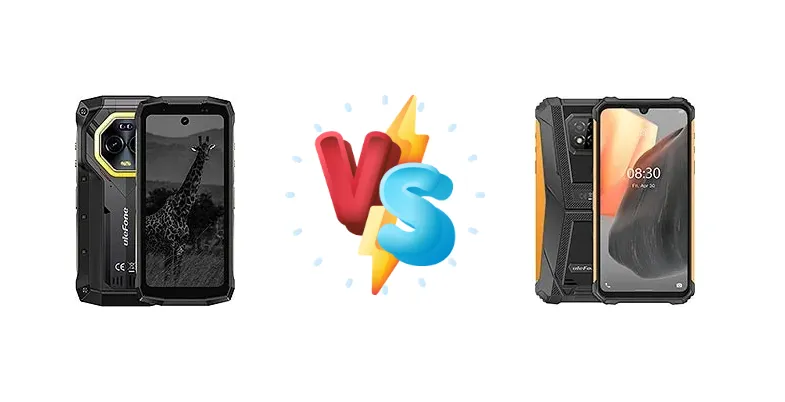
|
🏆 Quick Verdict
For most users, the Ulefone Armor Mini 20 Pro is the superior choice. Its significantly faster Mediatek Dimensity 6300 processor, coupled with 33W wired and 15W wireless charging, offers a substantial performance and convenience boost over the Armor 8 Pro's Helio P60 and 15W wired charging. The price difference justifies the upgrade for anyone prioritizing responsiveness and future-proofing.
| PHONES | ||
|---|---|---|
| Phone Names | Ulefone Armor Mini 20 Pro | Ulefone Armor 8 Pro |
| Network | ||
|---|---|---|
| 2G bands | GSM 850 / 900 / 1800 / 1900 | GSM 850 / 900 / 1800 / 1900 |
| 3G bands | HSDPA 800 / 850 / 900 / 1700(AWS) / 1900 / 2100 | HSDPA 850 / 900 / 1700(AWS) / 1900 / 2100 |
| 4G bands | 1, 2, 3, 4, 5, 7, 8, 12, 13, 17, 18, 19, 20, 25, 26, 28, 32, 34, 38, 39, 40, 41, 66, 71 | 1, 2, 3, 4, 5, 7, 8, 12, 13, 17, 18, 19, 20, 25, 26, 28, 66 |
| 5G bands | 1, 2, 3, 5, 7, 8, 20, 25, 28, 38, 40, 41, 66, 71, 77, 78, 79 SA/NSA/Sub6 | - |
| Speed | HSPA, LTE, 5G | HSPA 42.2/11.5 Mbps, LTE Cat7 300/150 Mbps |
| Technology | GSM / CDMA / HSPA / CDMA2000 / LTE / 5G | GSM / HSPA / LTE |
| Launch | ||
|---|---|---|
| Announced | 2024, September | 2021, April 28 |
| Status | Available. Released 2024, September | Available. Released 2021, April 28 |
| Body | ||
|---|---|---|
| Build | - | Front glass, aluminum back with rubber, aluminum frame |
| Dimensions | 133.5 x 63.3 x 24.9 mm (5.26 x 2.49 x 0.98 in) | 166 x 81.8 x 15 mm (6.54 x 3.22 x 0.59 in) |
| SIM | Nano-SIM + Nano-SIM | Nano-SIM + Nano-SIM |
| Weight | 301 g (10.62 oz) | 282 g (9.95 oz) |
| - | IP68 dust/water resistant (up to 1.5m for 30 min) Drop-to-concrete resistance from up to 1.2m MIL-STD-810G compliant | |
| Display | ||
|---|---|---|
| Protection | - | Scratch-resistant glass, oleophobic coating |
| Resolution | 720 x 1600 pixels, 20:9 ratio (~373 ppi density) | 720 x 1560 pixels, 19.5:9 ratio (~282 ppi density) |
| Size | 4.7 inches, 53.3 cm2 (~63.1% screen-to-body ratio) | 6.1 inches, 91.3 cm2 (~67.3% screen-to-body ratio) |
| Type | IPS LCD, 90Hz | IPS LCD |
| Platform | ||
|---|---|---|
| CPU | Octa-core (2x2.4 GHz Cortex-A76 & 6x2.0 GHz Cortex-A55) | Octa-core (4x2.0 GHz Cortex-A73 & 4x2.0 GHz Cortex-A53) |
| Chipset | Mediatek Dimensity 6300 (6 nm) | Mediatek MT6771 Helio P60 (12 nm) |
| GPU | Mali-G57 MC2 | Mali-G72 MP3 |
| OS | Android 14 | Android 11 |
| Memory | ||
|---|---|---|
| Card slot | microSDXC (uses shared SIM slot) | microSDXC (uses shared SIM slot) |
| Internal | 256GB 8GB RAM | 128GB 6GB RAM, 128GB 8GB RAM |
| Main Camera | ||
|---|---|---|
| Dual | 50 MP, f/2.0, (wide), 1/1.31", 1.2µm Night vision camera | - |
| Features | Dual-LED flash, HDR, panorama | LED flash, Panorama, HDR |
| Single | - | 8 MP, f/2.2 |
| Triple | - | 16 MP, f/2.2, (wide), PDAF 5 MP (macro) Auxiliary lens |
| Video | 1440p@30fps, 1080p@30fps | 1080p@30fps |
| Selfie camera | ||
|---|---|---|
| Single | 32 MP, f/2.5, (wide), 1/2.8", 0.8µm | 8 MP, f/2.2 |
| Video | 1440p@30fps, 1080p@30fps | 1080p@30fps |
| Sound | ||
|---|---|---|
| 3.5mm jack | - | Yes |
| 35mm jack | Yes | Yes |
| Loudspeaker | Yes | Yes |
| Comms | ||
|---|---|---|
| Bluetooth | 5.2, A2DP, LE | 4.2, A2DP, LE |
| Infrared port | Yes | - |
| NFC | Yes | Yes |
| Positioning | GPS, GALILEO, GLONASS, BDS, QZSS | GPS, GLONASS, GALILEO, BDS |
| Radio | Wireless FM radio | FM radio, RDS, recording |
| USB | USB Type-C 2.0, OTG | USB Type-C 2.0, OTG |
| WLAN | Wi-Fi 802.11 a/b/g/n/ac, dual-band | Wi-Fi 802.11 a/b/g/n/ac, Wi-Fi Direct |
| Features | ||
|---|---|---|
| Sensors | Fingerprint, accelerometer, gyro, proximity, compass, barometer | Fingerprint (side-mounted), accelerometer, gyro, proximity, compass |
| Battery | ||
|---|---|---|
| Charging | 33W wired 15W wireless 5W reverse wireless | 15W wired |
| Type | Li-Ion 6200 mAh | Li-Po 5580 mAh |
| Misc | ||
|---|---|---|
| Colors | Black | Black, Orange, Red |
| Price | About 340 EUR | About 190 EUR |
Ulefone Armor Mini 20 Pro
- Significantly faster processor (Dimensity 6300)
- 33W wired and 15W wireless charging
- More power-efficient chipset (6nm)
- Potential for smoother gaming and multitasking
- Likely higher price point
- May have a slightly smaller form factor, potentially less comfortable for some
Ulefone Armor 8 Pro
- Lower price point
- Proven durability (Armor series reputation)
- Simple and reliable performance for basic tasks
- Familiar user experience for existing Ulefone users
- Outdated processor (Helio P60)
- Slow 15W wired charging only
- Less responsive performance
- Limited future-proofing
Display Comparison
While both phones likely feature similar ruggedized display construction, the internal components driving them differ significantly. We lack specific display specs for both, but the chipset difference suggests the Mini 20 Pro could support a higher refresh rate panel. The Armor 8 Pro's Helio P60 may struggle to consistently deliver smooth visuals at higher refresh rates. The 6nm Dimensity 6300 in the Mini 20 Pro is more efficient, potentially allowing for a brighter display without excessive battery drain.
Camera Comparison
Without detailed camera specifications, a direct comparison is difficult. However, the processing power of the Dimensity 6300 in the Armor Mini 20 Pro will likely enable superior image processing, resulting in better dynamic range and noise reduction. While both phones likely feature similar sensor configurations (given Ulefone's typical approach), the newer chipset can extract more detail and clarity from the available hardware. The Armor 8 Pro's Helio P60 may struggle with complex image processing tasks, especially in low-light conditions.
Performance
The core difference lies in the chipsets. The Ulefone Armor Mini 20 Pro’s Mediatek Dimensity 6300 (6nm) is a substantial upgrade over the Armor 8 Pro’s Helio P60 (12nm). The Dimensity 6300’s Cortex-A76 cores, clocked at 2.4 GHz, offer significantly higher single-core performance than the Helio P60’s Cortex-A73 cores at 2.0 GHz. This translates to snappier app launches, smoother multitasking, and improved gaming performance. The 6nm process node also provides better power efficiency, meaning less heat generation and potentially longer sustained performance. The Armor 8 Pro’s older architecture will show its age in demanding scenarios.
Battery Life
The Armor 8 Pro offers 15W wired charging, while the Armor Mini 20 Pro steps up to 33W wired and adds 15W wireless charging and 5W reverse wireless charging. This is a major convenience upgrade. While battery capacity isn't specified, the Dimensity 6300’s improved power efficiency should offset any potential capacity difference. The 33W charging will significantly reduce charging times compared to the Armor 8 Pro’s 15W, and the addition of wireless charging provides a cable-free option.
Buying Guide
Buy the Ulefone Armor Mini 20 Pro if you need a rugged phone capable of handling demanding tasks like gaming or running multiple apps simultaneously, and value the convenience of wireless charging. Buy the Ulefone Armor 8 Pro if you prioritize a lower price point and only require basic smartphone functionality – calls, texts, and light app usage – in a durable package. The Armor 8 Pro remains a viable option for budget-conscious users who don't need cutting-edge performance.