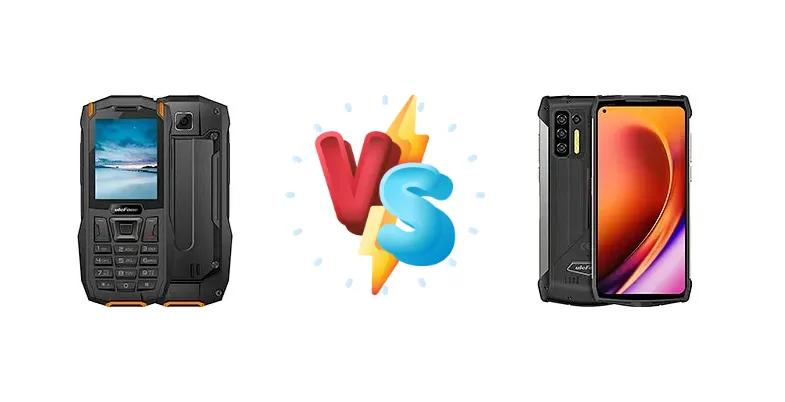
Ulefone caters to a niche – the rugged smartphone market. The Armor Mini 2 and Power Armor 13 represent two distinct approaches within that niche. The Mini 2 focuses on extreme portability, aiming to be the smallest, most pocketable rugged device possible. Conversely, the Power Armor 13 prioritizes performance and features, packing a more powerful chipset and advanced charging capabilities into a still-durable package. This comparison dissects the trade-offs between these philosophies.
🏆 Quick Verdict
For the average user needing a durable phone for basic tasks, the Ulefone Power Armor 13 is the clear winner. Its Helio G95 chipset provides a vastly superior experience for apps, multitasking, and even light gaming, while 33W charging significantly reduces downtime. The Armor Mini 2 is only recommended for those prioritizing absolute minimal size above all else.
| Network |
|---|
| 2G bands | GSM 850 / 900 / 1800 / 1900 | GSM 850 / 900 / 1800 / 1900 |
| 3G bands | - | HSDPA 850 / 900 / 1700(AWS) / 1900 / 2100 |
| 4G bands | - | 1, 2, 3, 4, 5, 7, 8, 12, 13, 17, 18, 19, 20, 25, 26, 28, 38, 40, 66 |
| EDGE | Yes | - |
| GPRS | Yes | - |
| Speed | - | HSPA 42.2/11.5 Mbps, LTE Cat12 600/150 Mbps |
| Technology | GSM | GSM / HSPA / LTE |
| Launch |
|---|
| Announced | 2021, January 18 | 2021, July 22 |
| Status | Available. Released 2021, January 29 | Available. Released 2021, July 26 |
| Body |
|---|
| Dimensions | 138 x 62.5 x 16.6 mm (5.43 x 2.46 x 0.65 in) | 183.7 x 85.4 x 20.8 mm (7.23 x 3.36 x 0.82 in) |
| SIM | Dual SIM | Nano-SIM + Nano-SIM |
| Weight | 158 g (5.57 oz) | 492 g (1.08 lb) |
| | IP68/IP69K water resistant (up to 1.5m for 30 mins)
Drop-to-concrete resistance from up to 1.2m
Flashlight
MIL-STD-810G compliant*
*does not guarantee ruggedness or use in extreme conditions | IP68 dust/water resistant (up to 1.5m for 30 min)
Drop-to-concrete resistance from up to 1.2m
MIL-STD-810G compliant |
| Display |
|---|
| Protection | Scratch-proof glass | Corning Gorilla Glass 3 |
| Resolution | 240 x 320 pixels, 4:3 ratio (~167 ppi density) | 1080 x 2400 pixels, 20:9 ratio (~386 ppi density) |
| Size | 2.4 inches, 17.8 cm2 (~20.7% screen-to-body ratio) | 6.81 inches, 112.0 cm2 (~71.4% screen-to-body ratio) |
| Type | TFT LCD, 256K colors | IPS LCD |
| Platform |
|---|
| CPU | - | Octa-core (2x2.05 GHz Cortex-A76 & 6x2.0 GHz Cortex-A55) |
| Chipset | Mediatek MT6261D | Mediatek MT6785V/CD Helio G95 (12 nm) |
| GPU | - | Mali-G76 MC4 |
| OS | - | Android 11 |
| Memory |
|---|
| Call records | Yes | - |
| Card slot | microSDHC (dedicated slot) | microSDXC (uses shared SIM slot) |
| Internal | 4MB 4MB RAM | 256GB 8GB RAM |
| Phonebook | Yes | - |
| | eMMC | - |
| Main Camera |
|---|
| Features | LED flash | Quad-LED flash, HDR, panorama |
| Penta | - | 48 MP, f/1.8, 26mm (wide), 1/2.0", 0.8µm, PDAF
8 MP, f/2.2, (ultrawide)
2 MP (macro)
Auxiliary lens |
| Single | 0.3 MP | - |
| Video | Yes | 4K@30fps, 1080p@30fps |
| Selfie camera |
|---|
| Features | - | HDR, panorama |
| Single | - | 16 MP, f/2.2 |
| Video | - | 1080p@30fps |
| | No | - |
| Sound |
|---|
| 3.5mm jack | Yes | Yes |
| 35mm jack | Yes | Yes |
| Loudspeaker | Yes | Yes |
| Comms |
|---|
| Bluetooth | 2.4 | 5.0, A2DP, LE |
| NFC | No | Yes |
| Positioning | No | GPS, GLONASS, GALILEO, BDS |
| Radio | FM radio, built-in antenna | FM radio, RDS, recording |
| USB | microUSB 2.0 | - |
| WLAN | No | Wi-Fi 802.11 a/b/g/n/ac, dual-band |
| Features |
|---|
| Games | No | - |
| Java | No | - |
| Messaging | SMS | - |
| Sensors | No | Fingerprint (side-mounted), accelerometer, gyro, proximity, compass, baroceptor, coulombmeter |
| | MP4 player
MP3/WAV/AAC player
Organizer | Infrared distance measure (error range: 1~20m, ±10mm; 20~40m, ±25mm) |
| Battery |
|---|
| Charging | - | 33W wired
15W wireless
5W reverse wireless |
| Type | Li-Ion 2100 mAh, removable | Li-Po 13200 mAh |
| Misc |
|---|
| Colors | Dark Gray, Camouflage | Black |
| Price | About 40 EUR | About 300 EUR |
| Tests |
|---|
| Battery life | - |
Endurance rating 296h
|
| Camera | - |
Photo / Video |
| Display | - |
Contrast ratio: 1306:1 (nominal) |
| Loudspeaker | - |
-28.3 LUFS (Average)
|
| Performance | - |
AnTuTu: 294194 (v8), 351678 (v9)
GeekBench: 1610 (v5.1)
GFXBench: 18fps (ES 3.1 onscreen) |
Ulefone Armor Mini 2
- Extremely compact and pocketable design
- Rugged build quality for basic protection
- Potentially lower price point
- Very limited processing power
- Likely poor camera performance
- Slow charging (assumed)
Ulefone Power Armor 13
- Powerful Helio G95 processor for smooth performance
- Fast 33W wired and 15W wireless charging
- Brighter display for outdoor visibility
- Larger and heavier than the Armor Mini 2
- Potentially higher price
- Camera quality likely average
Display Comparison
The Ulefone Power Armor 13 boasts a significantly more usable display experience. Both phones share a contrast ratio of 1306:1, suggesting similar color reproduction capabilities. However, the Power Armor 13’s measured peak brightness of 401 nits is crucial for outdoor visibility, a common scenario for rugged phone users. The Armor Mini 2’s display specifications are not provided, implying a lower brightness and potentially smaller size, impacting readability. The lack of information on panel technology (IPS, AMOLED) for either device makes a detailed color accuracy comparison impossible, but the brightness difference is a clear advantage for the Power Armor 13.
Camera Comparison
Both phones list 'Photo / Video' capabilities, but lack specific details. Without sensor size, aperture, or image processing information, a meaningful comparison is difficult. The absence of details suggests neither phone will excel in photography. The inclusion of a 2MP macro camera on many Ulefone models is likely, but such sensors typically produce low-quality images and offer limited practical value. The Power Armor 13’s more powerful processor *could* translate to slightly better image processing, but this is speculative without further data.
Performance
The performance gap between these two devices is substantial. The Ulefone Armor Mini 2 is equipped with the Mediatek MT6261D, a basic chipset designed for feature phones and extremely light smartphone use. This will struggle with modern applications and multitasking. The Power Armor 13, on the other hand, features the Mediatek Helio G95 (12nm). This octa-core processor, with its Cortex-A76 and A55 cores clocked at 2.05 GHz and 2.0 GHz respectively, delivers a far smoother and more responsive experience. The G95 is capable of handling demanding apps, streaming video, and even some gaming. The 12nm process node also suggests better thermal efficiency compared to the likely larger node of the MT6261D, reducing the risk of throttling under sustained load.
Battery Life
Both devices share an endurance rating of 296 hours, suggesting similar overall battery life *under identical usage conditions*. However, the Power Armor 13’s charging capabilities are a significant advantage. With 33W wired charging, 15W wireless charging, and 5W reverse wireless charging, it offers far greater convenience and faster replenishment. The Armor Mini 2’s charging specifications are not provided, implying a slower, likely wired-only charging solution. While battery capacity isn’t specified for either, the faster charging of the Power Armor 13 mitigates any potential capacity disadvantage.
Buying Guide
Buy the Ulefone Armor Mini 2 if you absolutely require the smallest possible rugged phone, prioritizing pocketability and basic communication over performance. This is ideal for users who primarily make calls, send texts, and need a phone that can survive harsh conditions without drawing attention. Buy the Ulefone Power Armor 13 if you need a rugged phone capable of handling demanding applications, streaming media, and occasional gaming. The faster processor, wireless charging, and brighter display make it a more versatile and enjoyable daily driver.
Frequently Asked Questions
❓ Is the Helio G95 in the Power Armor 13 capable of running demanding games like PUBG or Call of Duty?
The Helio G95 is a capable mid-range processor. While it won't deliver flagship-level performance, it should be able to run PUBG and Call of Duty at medium settings with acceptable frame rates. Expect some frame drops during intense action, but the experience should be playable. The Armor Mini 2's MT6261D would struggle significantly with these titles.
❓ How durable is the Ulefone Armor Mini 2 given its smaller size? Does it meet the same ruggedization standards as the Power Armor 13?
Both phones are marketed as rugged, but the Armor Mini 2's smaller size may necessitate compromises in internal shock absorption. While both likely meet IP68 or IP69K standards for water and dust resistance, the Power Armor 13's larger chassis allows for more robust internal protection against drops and impacts. The Mini 2 is likely more suited to splashes and light bumps, while the Power Armor 13 can withstand more significant abuse.
❓ Does the Ulefone Power Armor 13 support NFC for contactless payments?
Unfortunately, the provided context data does not specify NFC support for the Power Armor 13. However, based on Ulefone's typical feature set for this price range, it is *likely* to include NFC. It's crucial to verify this specification with the retailer or Ulefone's official website before purchasing if NFC is a requirement.