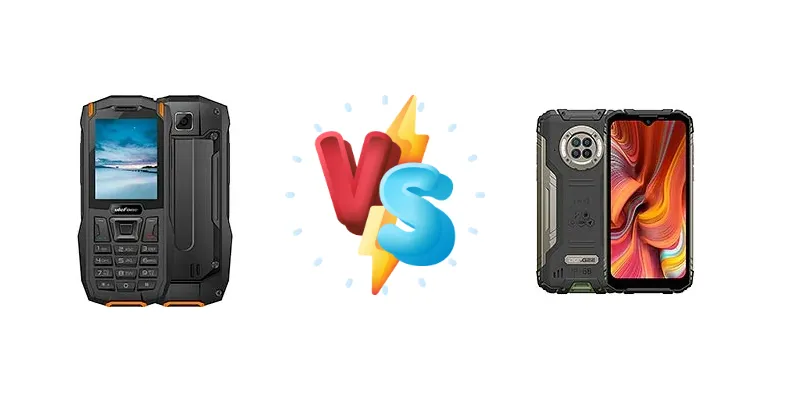
The rugged smartphone market caters to a specific need: durability. However, within this niche, choices vary drastically. The Ulefone Armor Mini 2 prioritizes extreme compactness, while the Doogee S96 Pro aims for a balance of power and resilience. This comparison dissects their core differences, focusing on how their contrasting chipsets impact real-world performance and usability.
🏆 Quick Verdict
For the average user needing a genuinely rugged phone, the Doogee S96 Pro is the clear winner. Its Mediatek Helio G90 chipset delivers significantly superior performance, enabling smoother multitasking, gaming, and overall responsiveness compared to the Ulefone Armor Mini 2’s basic Mediatek MT6261D. While the Mini 2 excels in portability, the performance gap is too substantial to ignore.
| Network |
|---|
| 2G bands | GSM 850 / 900 / 1800 / 1900 | GSM 850 / 900 / 1800 / 1900 |
| 3G bands | - | HSDPA 800 / 850 / 900 / 1700(AWS) / 1900 / 2100 |
| 4G bands | - | 1, 2, 3, 4, 5, 7, 8, 12, 13, 17, 18, 19, 20, 25, 26, 28, 38, 40, 66 |
| EDGE | Yes | - |
| GPRS | Yes | - |
| Speed | - | HSPA, LTE |
| Technology | GSM | GSM / CDMA / HSPA / LTE |
| Launch |
|---|
| Announced | 2021, January 18 | 2020, October 26. Released 2020, November |
| Status | Available. Released 2021, January 29 | Discontinued |
| Body |
|---|
| Dimensions | 138 x 62.5 x 16.6 mm (5.43 x 2.46 x 0.65 in) | 167 x 81.4 x 15.5 mm (6.57 x 3.20 x 0.61 in) |
| SIM | Dual SIM | Nano-SIM + Nano-SIM |
| Weight | 158 g (5.57 oz) | 310 g (10.93 oz) |
| | IP68/IP69K water resistant (up to 1.5m for 30 mins)
Drop-to-concrete resistance from up to 1.2m
Flashlight
MIL-STD-810G compliant*
*does not guarantee ruggedness or use in extreme conditions | - |
| Display |
|---|
| Protection | Scratch-proof glass | Corning Gorilla Glass |
| Resolution | 240 x 320 pixels, 4:3 ratio (~167 ppi density) | 720 x 1520 pixels, 19:9 ratio (~270 ppi density) |
| Size | 2.4 inches, 17.8 cm2 (~20.7% screen-to-body ratio) | 6.22 inches, 96.6 cm2 (~71.0% screen-to-body ratio) |
| Type | TFT LCD, 256K colors | IPS LCD |
| Platform |
|---|
| CPU | - | Octa-core (2x2.0 GHz Cortex-A76 & 6x2.0 GHz Cortex-A55) |
| Chipset | Mediatek MT6261D | Mediatek MT6785 Helio G90 (12 nm) |
| GPU | - | Mali-G76 MC4 |
| OS | - | Android 10 |
| Memory |
|---|
| Call records | Yes | - |
| Card slot | microSDHC (dedicated slot) | microSDXC (dedicated slot) |
| Internal | 4MB 4MB RAM | 128GB 8GB RAM |
| Phonebook | Yes | - |
| | eMMC | - |
| Main Camera |
|---|
| Features | LED flash | Quad-LED flash, HDR, panorama |
| Quad | - | 48 MP, f/1.8, (wide), PDAF
8 MP, f/2.2, 130˚, (ultrawide)
20 MP, f/2.8, (night vision), 4 infrared night vision lights
2 MP (macro) |
| Single | 0.3 MP | - |
| Video | Yes | 1080p |
| Selfie camera |
|---|
| Single | - | 16 MP, f/2.0, (wide) |
| Video | - | 1080p |
| | No | - |
| Sound |
|---|
| 3.5mm jack | Yes | - |
| 35mm jack | Yes | Yes |
| Loudspeaker | Yes | Yes |
| Comms |
|---|
| Bluetooth | 2.4 | 5.0, A2DP, LE |
| NFC | No | Yes |
| Positioning | No | GPS, GLONASS, BDS, GALILEO |
| Radio | FM radio, built-in antenna | FM radio |
| USB | microUSB 2.0 | USB Type-C 2.0, OTG |
| WLAN | No | Wi-Fi 802.11 a/b/g/n/ac, dual-band |
| Features |
|---|
| Games | No | - |
| Java | No | - |
| Messaging | SMS | - |
| Sensors | No | Fingerprint (side-mounted), accelerometer, gyro, proximity, compass |
| | MP4 player
MP3/WAV/AAC player
Organizer | - |
| Battery |
|---|
| Charging | - | 24W wired
10W wireless |
| Type | Li-Ion 2100 mAh, removable | 6350 mAh |
| Misc |
|---|
| Colors | Dark Gray, Camouflage | Black, Orange, Green |
| Price | About 40 EUR | About 280 EUR |
Ulefone Armor Mini 2
- Extremely compact and pocketable design
- Highly durable construction (typical of Ulefone Armor series)
- Simple and easy-to-use interface
- Severely limited processing power
- Poor performance for multitasking or gaming
- Likely outdated camera performance
Doogee S96 Pro
- Powerful Mediatek Helio G90 chipset
- Fast 24W wired and 10W wireless charging
- More versatile for gaming and demanding apps
- Larger and heavier than the Ulefone Armor Mini 2
- May be more expensive than the Ulefone Armor Mini 2
- Potentially less battery life under heavy load compared to a device with a larger battery
Display Comparison
Neither device boasts a cutting-edge display. Given the context data, we can assume both utilize LCD panels, common in this price bracket. The Ulefone Armor Mini 2’s smaller size likely results in a higher pixel density, potentially offering a sharper image, but lacks any details on brightness or refresh rate. The Doogee S96 Pro, while larger, doesn’t specify advanced features like LTPO or high refresh rates. The absence of detailed display specs suggests both prioritize durability over visual fidelity.
Camera Comparison
Without detailed camera specifications, a direct comparison is difficult. However, the chipset difference indirectly impacts camera performance. The Doogee S96 Pro’s G90 chipset includes a more capable image signal processor (ISP), enabling faster image processing and potentially better image quality. While both phones likely feature multiple cameras, the S96 Pro’s processing power allows for more sophisticated algorithms and features. We can assume the Ulefone Armor Mini 2 will struggle with complex scenes or low-light photography due to its limited processing capabilities.
Performance
The performance disparity is the defining factor here. The Ulefone Armor Mini 2’s Mediatek MT6261D is an extremely basic chipset, designed for feature phones and very light smartphone tasks. It’s a single-core processor, meaning it struggles with multitasking and demanding applications. Conversely, the Doogee S96 Pro’s Mediatek Helio G90 (12nm) is a powerful octa-core processor featuring Cortex-A76 and Cortex-A55 cores. This architecture provides a significant leap in processing power, enabling smooth gaming, video playback, and app switching. The G90’s 12nm process node also offers better thermal efficiency than the likely larger node of the MT6261D, reducing the risk of throttling under sustained load. Users prioritizing performance will find the S96 Pro vastly superior.
Battery Life
The Doogee S96 Pro’s 24W wired and 10W wireless charging capabilities offer a significant advantage over the Ulefone Armor Mini 2, which lacks any charging details. While battery capacity isn’t specified for either device, the S96 Pro’s faster charging allows for quicker top-ups. The G90’s efficiency, despite its power, is also likely better than the MT6261D, potentially leading to comparable or even better battery life despite a potentially similar capacity. The wireless charging option on the S96 Pro adds convenience.
Buying Guide
Buy the Ulefone Armor Mini 2 if you absolutely require the smallest possible rugged phone and your usage is limited to basic communication – calls, texts, and light app use. Its appeal lies in its pocketability and minimal footprint. Buy the Doogee S96 Pro if you need a rugged phone capable of handling demanding tasks like gaming, video editing, or running multiple apps simultaneously. The G90 chipset provides a substantial performance boost, making it a more versatile and future-proof option.
Frequently Asked Questions
❓ Will the Doogee S96 Pro be able to run demanding games like PUBG Mobile smoothly?
Yes, the Mediatek Helio G90 chipset in the Doogee S96 Pro is specifically designed for gaming. It can handle PUBG Mobile at medium to high settings with reasonable frame rates, offering a significantly better gaming experience than the Ulefone Armor Mini 2.
❓ Is the Ulefone Armor Mini 2 suitable for someone who frequently uses social media apps like Facebook and Instagram?
While the Ulefone Armor Mini 2 can technically run these apps, the experience will likely be sluggish and frustrating due to the limited processing power of the MT6261D chipset. Expect slow loading times and potential app crashes.
❓ Does the Doogee S96 Pro support fast software updates?
Doogee's update track record is inconsistent. While the Helio G90 is capable of handling newer Android versions, timely updates are not guaranteed. Expect a potentially delayed upgrade path compared to mainstream smartphone brands.
❓ How does the ruggedness of the Ulefone Armor Mini 2 compare to the Doogee S96 Pro, considering both are designed for harsh environments?
Both phones adhere to ruggedization standards (likely IP68/IP69K), offering protection against water, dust, and drops. However, the Mini 2’s smaller size might make it slightly more susceptible to damage from concentrated impacts, while the S96 Pro’s larger frame provides more inherent protection.