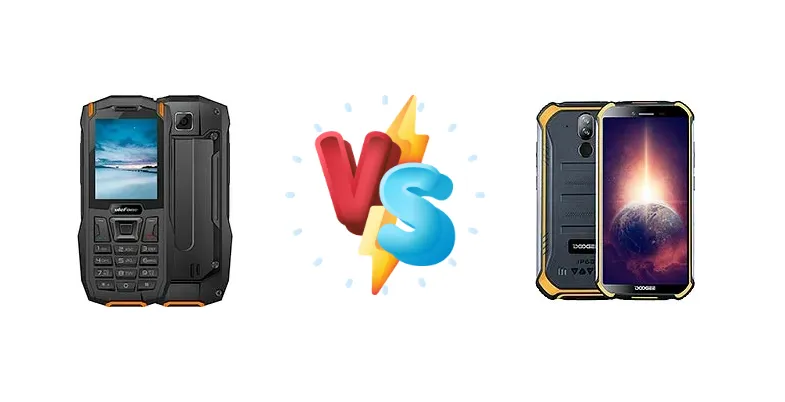
The rugged smartphone market caters to a specific need: durability. Both the Ulefone Armor Mini 2 and the Doogee S40 Pro aim to deliver that, but they approach it with significantly different internal hardware. This comparison dissects those differences, focusing on how the chipset choices impact real-world performance and usability for users needing a dependable, tough device.
🏆 Quick Verdict
For the average user prioritizing basic functionality and extreme portability, the Ulefone Armor Mini 2 offers a compelling package. However, the Doogee S40 Pro, with its significantly more powerful Mediatek Helio A25 chipset, is the better choice for anyone needing to run more demanding apps or multitasking frequently, despite its slightly higher price.
| Network |
|---|
| 2G bands | GSM 850 / 900 / 1800 / 1900 | GSM 850 / 900 / 1800 / 1900 |
| 3G bands | - | HSDPA 900 / 2100 |
| 4G bands | - | 1, 3, 7, 8, 20 |
| EDGE | Yes | - |
| GPRS | Yes | - |
| Speed | - | HSPA, LTE |
| Technology | GSM | GSM / HSPA / LTE |
| Launch |
|---|
| Announced | 2021, January 18 | 2020, July 17. Released 2020, July |
| Status | Available. Released 2021, January 29 | Discontinued |
| Body |
|---|
| Dimensions | 138 x 62.5 x 16.6 mm (5.43 x 2.46 x 0.65 in) | 158.2 x 79.4 x 14.1 mm (6.23 x 3.13 x 0.56 in) |
| SIM | Dual SIM | Nano-SIM + Nano-SIM |
| Weight | 158 g (5.57 oz) | 238 g (8.40 oz) |
| | IP68/IP69K water resistant (up to 1.5m for 30 mins)
Drop-to-concrete resistance from up to 1.2m
Flashlight
MIL-STD-810G compliant*
*does not guarantee ruggedness or use in extreme conditions | - |
| Display |
|---|
| Protection | Scratch-proof glass | Corning Gorilla Glass |
| Resolution | 240 x 320 pixels, 4:3 ratio (~167 ppi density) | 720 x 1440 pixels, 18:9 ratio (~295 ppi density) |
| Size | 2.4 inches, 17.8 cm2 (~20.7% screen-to-body ratio) | 5.45 inches, 76.7 cm2 (~61.0% screen-to-body ratio) |
| Type | TFT LCD, 256K colors | IPS LCD |
| Platform |
|---|
| CPU | - | Octa-core (4x1.8 GHz Cortex-A53 & 4x1.5 GHz Cortex-A53) |
| Chipset | Mediatek MT6261D | Mediatek MT6762 Helio A25 (12 nm) |
| GPU | - | PowerVR GE8320 |
| OS | - | Android 10 |
| Memory |
|---|
| Call records | Yes | - |
| Card slot | microSDHC (dedicated slot) | microSDXC (uses shared SIM slot) |
| Internal | 4MB 4MB RAM | 64GB 4GB RAM |
| Phonebook | Yes | - |
| | eMMC | - |
| Main Camera |
|---|
| Dual | - | 13 MP, f/2.8, (wide)
Auxiliary lens |
| Features | LED flash | LED flash |
| Single | 0.3 MP | - |
| Video | Yes | 1080p |
| Selfie camera |
|---|
| Single | - | 5 MP, f/2.8, (wide) |
| Video | - | Yes |
| | No | - |
| Sound |
|---|
| 3.5mm jack | Yes | - |
| 35mm jack | Yes | Yes |
| Loudspeaker | Yes | Yes |
| Comms |
|---|
| Bluetooth | 2.4 | 5.0, A2DP, LE |
| NFC | No | Yes |
| Positioning | No | GPS, GLONASS, GALILEO, BDS |
| Radio | FM radio, built-in antenna | FM radio |
| USB | microUSB 2.0 | microUSB 2.0, OTG |
| WLAN | No | Wi-Fi 802.11 a/b/g/n |
| Features |
|---|
| Games | No | - |
| Java | No | - |
| Messaging | SMS | - |
| Sensors | No | Fingerprint (rear-mounted), accelerometer, proximity, compass |
| | MP4 player
MP3/WAV/AAC player
Organizer | - |
| Battery |
|---|
| Charging | - | 10W wired |
| Type | Li-Ion 2100 mAh, removable | 4650 mAh |
| Misc |
|---|
| Colors | Dark Gray, Camouflage | Black, Orange, Green |
| Price | About 40 EUR | About 150 EUR |
Ulefone Armor Mini 2
- Ultra-compact and lightweight design
- Extremely durable build quality
- Lowest possible price point for a rugged phone
- Severely limited processing power
- Poor multitasking capabilities
- Unsuitable for demanding applications
Doogee S40 Pro
- Significantly faster processor for smoother performance
- Octa-core CPU enables multitasking
- More versatile for a wider range of applications
- Slightly larger and heavier than the Ulefone
- 10W charging is relatively slow
- May be more expensive than the Ulefone
Display Comparison
Neither Ulefone nor Doogee provide detailed display specifications. Given the price points, both likely utilize IPS LCD panels. The Armor Mini 2’s smaller form factor suggests a lower resolution display, potentially impacting sharpness. The S40 Pro, with more internal processing power, *could* support a slightly higher resolution, but this remains unconfirmed. Both will likely struggle with outdoor visibility under direct sunlight, lacking the brightness of higher-end displays.
Camera Comparison
Detailed camera specs are unavailable for either device. However, given the market segment, expectations should be tempered. Both phones likely feature basic sensors for capturing snapshots in good lighting conditions. The Doogee S40 Pro’s more powerful processor *could* enable slightly better image processing, potentially resulting in sharper images and improved dynamic range. The presence of a 2MP macro camera on the S40 Pro is largely a marketing gimmick; its limited resolution and lack of optical image stabilization will yield subpar results. Focusing on the main sensor’s megapixel count (if available) will be a better indicator of image quality.
Performance
The core difference lies in the chipsets. The Ulefone Armor Mini 2’s Mediatek MT6261D is a feature phone-level processor, designed for basic communication and limited functionality. It’s a single-core processor, meaning it can only handle one task at a time efficiently. Conversely, the Doogee S40 Pro boasts the Mediatek MT6762 Helio A25, an octa-core processor built on a 12nm process. This translates to significantly faster app loading times, smoother multitasking, and the ability to run more complex applications. The Helio A25’s Cortex-A53 cores, while not high-end, offer a substantial performance leap over the MT6261D, benefiting users who need to use mapping apps, messaging platforms, or document viewers. The 12nm process also implies better power efficiency compared to older, larger node processors.
Battery Life
Battery capacity is not specified for either device. However, the Doogee S40 Pro’s 10W wired charging suggests a smaller battery capacity to keep charging times reasonable. The Ulefone Armor Mini 2, with its simpler chipset, may achieve comparable battery life despite a potentially smaller capacity due to lower power consumption. Real-world battery performance will heavily depend on usage patterns, but the Helio A25’s higher power draw will likely result in shorter runtimes under heavy load.
Buying Guide
Buy the Ulefone Armor Mini 2 if you need an ultra-compact, incredibly durable phone primarily for calls, texts, and basic navigation – a true ‘burner’ phone for harsh environments. Buy the Doogee S40 Pro if you prefer a more versatile device capable of handling social media, light gaming, and running a wider range of applications without significant lag, making it suitable for field work or outdoor adventures requiring more than just communication.
Frequently Asked Questions
❓ Is the Mediatek Helio A25 in the Doogee S40 Pro powerful enough for basic social media apps like Facebook and WhatsApp?
Yes, the Helio A25 is sufficiently powerful to run Facebook, WhatsApp, and similar social media applications without significant lag. While it won't offer a flagship-level experience, it provides a usable and responsive experience for these common tasks, unlike the Ulefone Armor Mini 2 which would struggle.
❓ Can the Ulefone Armor Mini 2 handle GPS navigation using Google Maps or similar apps?
The Ulefone Armor Mini 2 *can* technically run GPS navigation apps, but the experience will be slow and potentially unreliable. The MT6261D processor lacks the processing power to handle map rendering and route calculations efficiently, leading to delays and potential crashes. The Doogee S40 Pro is a much better choice for reliable navigation.
❓ What type of SIM cards do these phones support?
While not explicitly stated, both phones likely support standard Nano-SIM cards, common in the rugged phone segment. Dual SIM support is also probable for the Doogee S40 Pro, given its more advanced feature set, but this needs confirmation.
❓ How water and dust resistant are these phones, and what IP rating do they have?
Both phones are marketed as rugged, but specific IP ratings are crucial. Without that information, it's difficult to assess their true level of protection. Expect at least IP68 certification (dust tight and immersion in 1.5 meters of freshwater for up to 30 minutes) for both, but verify this before purchase.