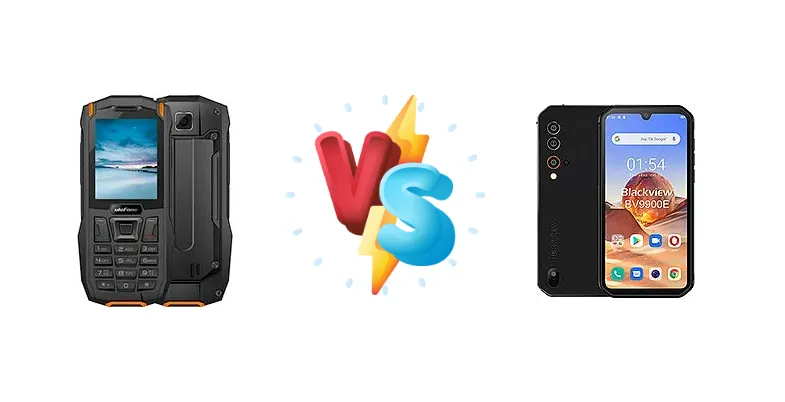
The rugged phone market caters to distinct needs, from those prioritizing extreme portability to users demanding substantial performance. The Ulefone Armor Mini 2 represents the ultra-compact end of the spectrum, while the Blackview BV9900E aims for a balance of power and durability. This comparison dissects their core differences to help you choose the right tool for your lifestyle.
🏆 Quick Verdict
For the average user needing a genuinely pocketable, highly durable phone for basic tasks, the Ulefone Armor Mini 2 offers compelling value. However, the Blackview BV9900E is the clear winner for anyone prioritizing performance, faster charging, and a more versatile user experience thanks to its significantly more powerful Helio P90 chipset.
| Network |
|---|
| 2G bands | GSM 850 / 900 / 1800 / 1900 | GSM 850 / 900 / 1800 / 1900 |
| 3G bands | - | HSDPA 800 / 850 / 900 / 1700(AWS) / 1900 / 2100 |
| 4G bands | - | 1, 2, 3, 4, 5, 7, 8, 12, 13, 17, 18, 19, 20, 25, 26, 28, 34, 38, 39, 40, 41, 66 |
| EDGE | Yes | - |
| GPRS | Yes | - |
| Speed | - | HSPA, LTE |
| Technology | GSM | GSM / CDMA / HSPA / CDMA2000 / LTE |
| Launch |
|---|
| Announced | 2021, January 18 | 2020, September 10. Released 2020, September |
| Status | Available. Released 2021, January 29 | Discontinued |
| Body |
|---|
| Dimensions | 138 x 62.5 x 16.6 mm (5.43 x 2.46 x 0.65 in) | 156.5 x 78.3 x 14.2 mm (6.16 x 3.08 x 0.56 in) |
| SIM | Dual SIM | Nano-SIM + Nano-SIM |
| Weight | 158 g (5.57 oz) | 273 g (9.63 oz) |
| | IP68/IP69K water resistant (up to 1.5m for 30 mins)
Drop-to-concrete resistance from up to 1.2m
Flashlight
MIL-STD-810G compliant*
*does not guarantee ruggedness or use in extreme conditions | - |
| Display |
|---|
| Protection | Scratch-proof glass | Corning Gorilla Glass 5 |
| Resolution | 240 x 320 pixels, 4:3 ratio (~167 ppi density) | 1080 x 2280 pixels, 19:9 ratio (~432 ppi density) |
| Size | 2.4 inches, 17.8 cm2 (~20.7% screen-to-body ratio) | 5.84 inches, 85.1 cm2 (~69.5% screen-to-body ratio) |
| Type | TFT LCD, 256K colors | IPS LCD |
| Platform |
|---|
| CPU | - | Octa-core (2x2.2 GHz Cortex-A75 & 6x2.0 GHz Cortex-A55) |
| Chipset | Mediatek MT6261D | Mediatek MT6779V/CE Helio P90 (12 nm) |
| GPU | - | PowerVR GM9446 |
| OS | - | Android 10 |
| Memory |
|---|
| Call records | Yes | - |
| Card slot | microSDHC (dedicated slot) | microSDXC |
| Internal | 4MB 4MB RAM | 128GB 6GB RAM |
| Phonebook | Yes | - |
| | eMMC | - |
| Main Camera |
|---|
| Features | LED flash | LED flash, HDR, panorama |
| Quad | - | 48 MP, f/1.8, (wide), PDAF
16 MP, 120˚ (ultrawide)
2 MP (macro)
Auxiliary lens |
| Single | 0.3 MP | - |
| Video | Yes | 4K@30fps, 1080p@60fps |
| Selfie camera |
|---|
| Single | - | 16 MP, f/2.0, (wide) |
| Video | - | 1080p@30fps |
| | No | - |
| Sound |
|---|
| 3.5mm jack | Yes | - |
| 35mm jack | Yes | No |
| Loudspeaker | Yes | Yes |
| Comms |
|---|
| Bluetooth | 2.4 | 5.0, A2DP, LE |
| NFC | No | Yes |
| Positioning | No | GPS, GLONASS, GALILEO, BDS |
| Radio | FM radio, built-in antenna | FM radio |
| USB | microUSB 2.0 | USB Type-C 2.0, OTG |
| WLAN | No | Wi-Fi 802.11 a/b/g/n/ac |
| Features |
|---|
| Games | No | - |
| Java | No | - |
| Messaging | SMS | - |
| Sensors | No | Fingerprint (side-mounted), accelerometer, gyro, proximity, compass, barometer |
| | MP4 player
MP3/WAV/AAC player
Organizer | - |
| Battery |
|---|
| Charging | - | 15W wired
18W wireless |
| Type | Li-Ion 2100 mAh, removable | 4380 mAh |
| Misc |
|---|
| Colors | Dark Gray, Camouflage | Black, Silver |
| Price | About 40 EUR | About 260 EUR |
Ulefone Armor Mini 2
- Extremely compact and pocketable
- Highly durable and ruggedized
- Affordable price point
- Extremely limited processing power
- Likely poor camera performance
- Limited software support
Blackview BV9900E
- Powerful Helio P90 processor
- Fast 15W wired and 18W wireless charging
- More versatile for gaming and multitasking
- Larger and heavier than the Mini 2
- Higher price point
- May experience some thermal throttling under heavy load
Display Comparison
Display specifications are absent for the Ulefone Armor Mini 2, but given its focus on compactness, we can expect a smaller panel with likely lower resolution. The Blackview BV9900E, while not specified, benefits from the processing power to drive a higher resolution display. The absence of detailed display specs on the Mini 2 suggests a cost-saving measure, prioritizing durability over visual fidelity. The BV9900E’s Helio P90 chipset allows for smoother animations and potentially a higher refresh rate, though this isn’t confirmed. The BV9900E’s larger size likely allows for a more comfortable viewing experience.
Camera Comparison
Camera details are limited for both devices. However, the disparity in processing power suggests the Blackview BV9900E will deliver superior image processing capabilities. While both may feature similar megapixel counts in their primary sensors, the Helio P90’s ISP (Image Signal Processor) will enable better noise reduction, dynamic range, and overall image quality. The Ulefone Armor Mini 2’s limited processing power will likely result in slower image capture and less detailed photos. The presence of a 2MP macro camera on either device is largely a marketing tactic, offering minimal practical benefit due to the low resolution and lack of optical image stabilization.
Performance
The performance gap is substantial. The Ulefone Armor Mini 2’s Mediatek MT6261D is a basic feature phone chipset, designed for voice calls and SMS, not demanding applications. In contrast, the Blackview BV9900E’s Mediatek Helio P90 (12nm) is an octa-core processor featuring Cortex-A75 and A55 cores, offering a significant leap in processing power. The P90’s architecture allows for smoother multitasking, faster app loading times, and the ability to run more complex games. The 12nm process node of the P90 also contributes to better thermal efficiency compared to the likely older, larger node process of the MT6261D, reducing throttling under sustained load. Users needing anything beyond basic functionality will find the BV9900E far more capable.
Battery Life
Battery capacity is unspecified for the Ulefone Armor Mini 2, but its compact size suggests a smaller battery. The Blackview BV9900E offers both 15W wired and 18W wireless charging, a significant advantage over the Mini 2, which likely lacks wireless charging altogether. The P90’s power efficiency, despite being a more powerful chip, combined with the faster charging capabilities, means the BV9900E will likely offer a more convenient and less stressful charging experience. While the Mini 2 may offer longer standby time due to its lower power consumption, the BV9900E will provide more usable screen-on time and faster replenishment.
Buying Guide
Buy the Ulefone Armor Mini 2 if you absolutely need the smallest possible rugged phone for essential communication and occasional use. It’s ideal for those who prioritize portability above all else. Buy the Blackview BV9900E if you require a rugged device capable of handling demanding applications, gaming, and benefit from faster charging speeds, both wired and wireless, making it suitable for professionals and outdoor enthusiasts.
Frequently Asked Questions
❓ Is the Helio P90 in the Blackview BV9900E prone to overheating during extended gaming sessions?
While the Helio P90 is a capable processor, it can experience some thermal throttling under sustained heavy load. However, the BV9900E’s rugged design likely incorporates heat dissipation features to mitigate this, and the throttling shouldn’t be severe enough to render gaming unplayable, but expect some performance dips over longer periods.
❓ Can the Ulefone Armor Mini 2 run popular messaging apps like WhatsApp and Telegram reliably?
The Ulefone Armor Mini 2’s Mediatek MT6261D chipset is very limited. While it can handle basic voice calls and SMS, running modern apps like WhatsApp and Telegram may be slow and unreliable. Expect significant lag and potential crashes, especially with multiple apps open.
❓ Does the Blackview BV9900E support fast charging with any specific Power Delivery (PD) standard?
The Blackview BV9900E supports 18W wireless charging and 15W wired charging, but specific PD standard support isn't explicitly stated. It's likely to use a standard Quick Charge protocol, but compatibility with specific PD chargers may vary. Using the included charger is recommended for optimal charging speeds.