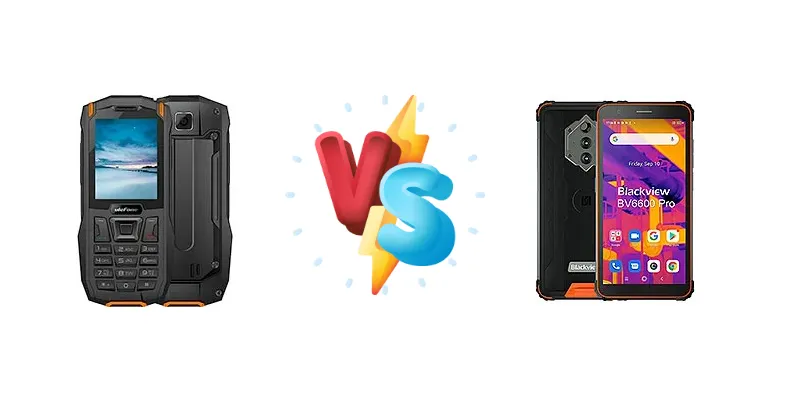
The rugged smartphone market caters to a specific need: durability. However, within this niche, choices vary greatly. We pit the Ulefone Armor Mini 2, prioritizing extreme compactness, against the Blackview BV6600 Pro, which aims for a balance of features and resilience. This comparison focuses on how their core hardware impacts real-world usability.
🏆 Quick Verdict
For the average user needing a durable phone, the Blackview BV6600 Pro is the clear winner. Its Mediatek Helio P35 chipset delivers a significantly more responsive experience than the Ulefone Armor Mini 2’s MT6261D, making it suitable for more than just basic communication. While the Mini 2 excels in portability, its limited processing power is a major drawback.
| Network |
|---|
| 2G bands | GSM 850 / 900 / 1800 / 1900 | GSM 850 / 900 / 1800 / 1900 |
| 3G bands | - | HSDPA 850 / 900 / 1700(AWS) / 1900 / 2100 |
| 4G bands | - | 1, 2, 3, 4, 5, 7, 8, 12, 13, 17, 19, 18, 20, 28, 25, 26, 38, 40, 41, 66 |
| EDGE | Yes | - |
| GPRS | Yes | - |
| Speed | - | HSPA, LTE |
| Technology | GSM | GSM / CDMA / HSPA / CDMA2000 / LTE |
| | - | CDMA2000 1x |
| Launch |
|---|
| Announced | 2021, January 18 | 2021, September 28 |
| Status | Available. Released 2021, January 29 | Available. Released 2021, October |
| Body |
|---|
| Dimensions | 138 x 62.5 x 16.6 mm (5.43 x 2.46 x 0.65 in) | 159 x 79.4 x 18 mm (6.26 x 3.13 x 0.71 in) |
| SIM | Dual SIM | Nano-SIM + Nano-SIM |
| Weight | 158 g (5.57 oz) | 325 g (11.46 oz) |
| | IP68/IP69K water resistant (up to 1.5m for 30 mins)
Drop-to-concrete resistance from up to 1.2m
Flashlight
MIL-STD-810G compliant*
*does not guarantee ruggedness or use in extreme conditions | IP68/IP69K dust/water resistant (up to 1.5m for 30 min)
Drop-to-concrete resistance from up to 1.5m
MIL-STD-810G compliant |
| Display |
|---|
| Protection | Scratch-proof glass | Dragontrail Glass |
| Resolution | 240 x 320 pixels, 4:3 ratio (~167 ppi density) | 720 x 1440 pixels, 18:9 ratio (~282 ppi density) |
| Size | 2.4 inches, 17.8 cm2 (~20.7% screen-to-body ratio) | 5.7 inches, 83.8 cm2 (~66.4% screen-to-body ratio) |
| Type | TFT LCD, 256K colors | IPS LCD |
| Platform |
|---|
| CPU | - | Octa-core (4x2.35 GHz Cortex-A53 & 4x1.8 GHz Cortex-A53) |
| Chipset | Mediatek MT6261D | Mediatek MT6765V/CA Helio P35 (12 nm) |
| GPU | - | PowerVR GE8320 |
| OS | - | Android 11 |
| Memory |
|---|
| Call records | Yes | - |
| Card slot | microSDHC (dedicated slot) | microSDXC |
| Internal | 4MB 4MB RAM | 64GB 4GB RAM |
| Phonebook | Yes | - |
| | eMMC | eMMC |
| Main Camera |
|---|
| Features | LED flash | Thermal imaging, LED flash |
| Single | 0.3 MP | 8 MP, f/2.0, (wide) |
| Triple | - | 16 MP, f/2.0, (wide), PDAF
5 MP, thermal assisted camera
FLIR thermal camera (Lepton module) |
| Video | Yes | 1080p@30fps |
| Selfie camera |
|---|
| Single | - | 8 MP, f/2.0, (wide) |
| Video | - | 1080p@30fps |
| | No | - |
| Sound |
|---|
| 3.5mm jack | Yes | No |
| 35mm jack | Yes | No |
| Loudspeaker | Yes | Yes |
| Comms |
|---|
| Bluetooth | 2.4 | 5.0, A2DP, LE |
| NFC | No | Yes |
| Positioning | No | GPS, GLONASS, GALILEO, BDS |
| Radio | FM radio, built-in antenna | FM radio |
| USB | microUSB 2.0 | USB Type-C 2.0, OTG |
| WLAN | No | Wi-Fi 802.11 a/b/g/n/ac |
| Features |
|---|
| Games | No | - |
| Java | No | - |
| Messaging | SMS | - |
| Sensors | No | Fingerprint (side-mounted), accelerometer, gyro, proximity, compass |
| | MP4 player
MP3/WAV/AAC player
Organizer | - |
| Battery |
|---|
| Charging | - | 18W wired |
| Type | Li-Ion 2100 mAh, removable | 8580 mAh |
| Misc |
|---|
| Colors | Dark Gray, Camouflage | Black, Orange, Green |
| Price | About 40 EUR | About 260 EUR |
Ulefone Armor Mini 2
- Extremely compact and portable
- Potentially longer standby time due to basic chipset
- Lower price point (likely)
- Very limited processing power
- Poor app performance
- Likely low-resolution display
Blackview BV6600 Pro
- Significantly more powerful processor
- Faster 18W charging
- More versatile for everyday tasks
- Larger and less pocketable
- Potentially shorter battery life under heavy use
- Camera quality likely limited
Display Comparison
Neither device boasts a cutting-edge display. The Ulefone Armor Mini 2’s display specifications are unavailable, but given its price point, it likely utilizes a basic LCD panel. The Blackview BV6600 Pro also lacks detailed display specs, but its larger size suggests a potentially higher resolution. The absence of information regarding refresh rates, peak brightness, or color accuracy on both devices indicates a focus on functionality over visual fidelity. Users should expect adequate, but not exceptional, viewing experiences.
Camera Comparison
Camera details are sparse for both devices. It’s safe to assume both phones feature basic camera setups geared towards functional photography rather than high-quality image capture. The lack of sensor size or aperture information suggests neither phone will excel in low-light conditions. The presence of a 2MP macro camera on the BV6600 Pro is likely a marketing tactic, as such low-resolution sensors rarely produce usable results. The BV6600 Pro’s chipset may offer slightly better image processing capabilities, but overall camera performance will be limited by the hardware.
Performance
The performance gap is the most significant differentiator. The Ulefone Armor Mini 2 is equipped with the Mediatek MT6261D, a basic chipset designed for feature phones and extremely low-end smartphones. This translates to limited multitasking capabilities and sluggish app loading times. Conversely, the Blackview BV6600 Pro features the Mediatek MT6765V/CA Helio P35 (12nm). This octa-core processor, while not a powerhouse, offers a substantial performance boost with its Cortex-A53 cores clocked up to 2.35 GHz. The 12nm manufacturing process also contributes to improved power efficiency compared to older, larger node chipsets. This means the BV6600 Pro will handle everyday tasks and even some light gaming with considerably more ease.
Battery Life
Battery capacity details for the Ulefone Armor Mini 2 are unavailable. However, its compact size likely limits its battery capacity. The Blackview BV6600 Pro offers 18W wired charging, a significant advantage over the likely slower charging speeds of the Mini 2. While the actual battery capacity of the BV6600 Pro is not specified, the more efficient Helio P35 chipset and faster charging will provide a more convenient and reliable user experience. Users prioritizing all-day battery life will likely find the BV6600 Pro more dependable.
Buying Guide
Buy the Ulefone Armor Mini 2 if you absolutely prioritize the smallest possible rugged phone, primarily for calls, texts, and emergency communication where battery life is paramount and app performance is secondary. Buy the Blackview BV6600 Pro if you need a rugged phone capable of handling everyday tasks like navigation, social media, and light gaming, and appreciate the convenience of faster charging and a more versatile chipset.
Frequently Asked Questions
❓ Is the Mediatek Helio P35 in the Blackview BV6600 Pro capable of running popular apps like WhatsApp and Facebook smoothly?
Yes, the Helio P35 is sufficient for running common social media applications like WhatsApp and Facebook without significant lag. While it won't deliver a flagship-level experience, it provides a usable and responsive experience for everyday tasks.
❓ How does the Ulefone Armor Mini 2 perform with GPS navigation, and is it accurate enough for hiking or outdoor activities?
Given the MT6261D's limited processing power, GPS performance on the Ulefone Armor Mini 2 may be slower to acquire a signal and less accurate than the Blackview BV6600 Pro. While it will likely function for basic navigation, users engaging in serious hiking or outdoor activities should expect potential inaccuracies and delays.
❓ Can the Blackview BV6600 Pro handle basic mobile gaming, and what kind of frame rates can I expect?
The Blackview BV6600 Pro can handle basic mobile gaming, but don't expect high frame rates or demanding graphics settings. Games like PUBG Mobile will likely need to be played on low settings to achieve playable frame rates, potentially around 30fps. More casual games will run more smoothly.