
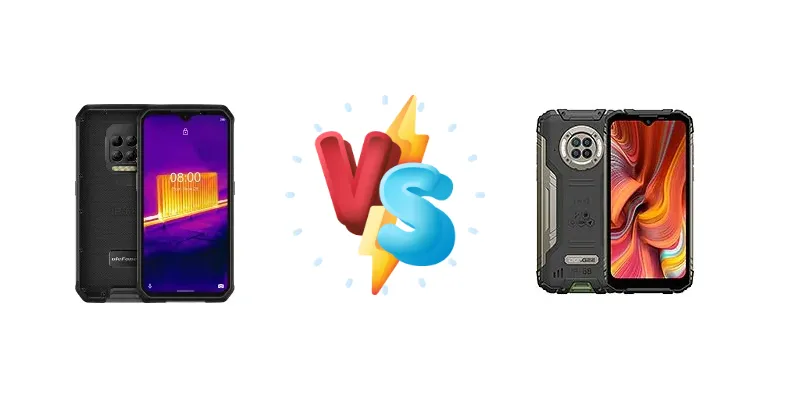
Ulefone Armor 9 vs. Doogee S96 Pro: A Deep Dive into Rugged Smartphone Performance
| Phones Images | |||||
|---|---|---|---|---|---|
|
🏆 Quick Verdict
For the average user prioritizing sustained performance and faster charging, the Doogee S96 Pro emerges as the better choice. Its Helio G90 chipset and 24W charging offer a noticeable advantage over the Ulefone Armor 9’s Helio P90 and 18W charging, making it more suitable for gaming and power users.
| PHONES | ||
|---|---|---|
| Phone Names | Ulefone Armor 9 | Doogee S96 Pro |
| Network | ||
|---|---|---|
| 2G bands | GSM 850 / 900 / 1800 / 1900 | GSM 850 / 900 / 1800 / 1900 |
| 3G bands | HSDPA 850 / 900 / 1700(AWS) / 1900 / 2100 | HSDPA 800 / 850 / 900 / 1700(AWS) / 1900 / 2100 |
| 4G bands | 1, 2, 3, 4, 5, 7, 8, 12, 13, 17, 18, 19, 20, 25, 26, 28, 34, 38, 39, 40, 41, 66 | 1, 2, 3, 4, 5, 7, 8, 12, 13, 17, 18, 19, 20, 25, 26, 28, 38, 40, 66 |
| Speed | HSPA 42.2/11.5 Mbps, LTE Cat12 600/150 Mbps | HSPA, LTE |
| Technology | GSM / CDMA / HSPA / EVDO / LTE | GSM / CDMA / HSPA / LTE |
| CDMA2000 1xEV-DO | - | |
| Launch | ||
|---|---|---|
| Announced | 2020, June 29. Released 2020, June 29 | 2020, October 26. Released 2020, November |
| Status | Discontinued | Discontinued |
| Body | ||
|---|---|---|
| Build | Front glass, aluminum back with rubber, aluminum frame | - |
| Dimensions | 168.2 x 82 x 15 mm (6.62 x 3.23 x 0.59 in) | 167 x 81.4 x 15.5 mm (6.57 x 3.20 x 0.61 in) |
| SIM | Nano-SIM + Nano-SIM | Nano-SIM + Nano-SIM |
| Weight | 320 g (11.29 oz) | 310 g (10.93 oz) |
| IP68/IP69K dust/water resistant (up to 1.5m for 30 min) Drop-to-concrete resistance from up to 1.2m MIL-STD-810G compliant | - | |
| Display | ||
|---|---|---|
| Protection | Scratch-resistant glass, oleophobic coating | Corning Gorilla Glass |
| Resolution | 1080 x 2340 pixels, 19.5:9 ratio (~409 ppi density) | 720 x 1520 pixels, 19:9 ratio (~270 ppi density) |
| Size | 6.3 inches, 97.4 cm2 (~70.6% screen-to-body ratio) | 6.22 inches, 96.6 cm2 (~71.0% screen-to-body ratio) |
| Type | IPS LCD | IPS LCD |
| Platform | ||
|---|---|---|
| CPU | Octa-core (2x2.2 GHz Cortex-A75 & 6x2.0 GHz Cortex-A55) | Octa-core (2x2.0 GHz Cortex-A76 & 6x2.0 GHz Cortex-A55) |
| Chipset | Mediatek MT6779 Helio P90 (12 nm) | Mediatek MT6785 Helio G90 (12 nm) |
| GPU | PowerVR GM9446 | Mali-G76 MC4 |
| OS | Android 10 | Android 10 |
| Memory | ||
|---|---|---|
| Card slot | microSDXC (uses shared SIM slot) | microSDXC (dedicated slot) |
| Internal | 128GB 8GB RAM | 128GB 8GB RAM |
| UFS 2.1 | - | |
| Main Camera | ||
|---|---|---|
| Features | Thermal imaging, heat palettes, temp. spot meter, quad-LED flash, panorama | Quad-LED flash, HDR, panorama |
| Quad | - | 48 MP, f/1.8, (wide), PDAF 8 MP, f/2.2, 130˚, (ultrawide) 20 MP, f/2.8, (night vision), 4 infrared night vision lights 2 MP (macro) |
| Triple | 64 MP, f/1.9, 26mm (wide), 1/1.72", 0.8µm, PDAF FLIR thermal camera (Lepton module) Auxiliary lens | - |
| Video | 1080p@30fps | 1080p |
| Selfie camera | ||
|---|---|---|
| Single | 8 MP, f/2.2 | 16 MP, f/2.0, (wide) |
| Video | 1080p@30fps | 1080p |
| Sound | ||
|---|---|---|
| 3.5mm jack | Yes | - |
| 35mm jack | Yes | Yes |
| Loudspeaker | Yes | Yes |
| Comms | ||
|---|---|---|
| Bluetooth | 5.0, A2DP, LE | 5.0, A2DP, LE |
| NFC | Yes | Yes |
| Positioning | GPS, GLONASS, GALILEO, BDS | GPS, GLONASS, BDS, GALILEO |
| Radio | FM radio, RDS, recording | FM radio |
| USB | USB Type-C 2.0, OTG, accessory connector (endoscope) | USB Type-C 2.0, OTG |
| WLAN | Wi-Fi 802.11 a/b/g/n/ac, Wi-Fi Direct | Wi-Fi 802.11 a/b/g/n/ac, dual-band |
| Features | ||
|---|---|---|
| Sensors | Fingerprint (side-mounted), accelerometer, gyro, proximity, compass, baroceptor, coulombmeter | Fingerprint (side-mounted), accelerometer, gyro, proximity, compass |
| Battery | ||
|---|---|---|
| Charging | 18W wired | 24W wired 10W wireless |
| Type | Li-Po 6600 mAh | 6350 mAh |
| Misc | ||
|---|---|---|
| Colors | Black | Black, Orange, Green |
| Price | About 550 EUR | About 280 EUR |
| Tests | ||
|---|---|---|
| Battery life | Endurance rating 148h | - |
| Camera | Photo / Video | - |
| Display | Contrast ratio: 1541:1 (nominal) | - |
| Loudspeaker | -30.1 LUFS (Below average) | - |
| Performance | AnTuTu: 197000 (v8) GeekBench: 1498 (v5.1) GFXBench: 7.9fps (ES 3.1 onscreen) | - |
Ulefone Armor 9
- Exceptional battery endurance (148h rating)
- Proven rugged design
- Potentially lower price point
- Older Helio P90 chipset
- Slower 18W charging
- Limited display information
Doogee S96 Pro
- More powerful Helio G90 chipset
- Faster 24W wired and 10W wireless charging
- Improved gaming performance
- Potentially shorter battery life compared to Armor 9
- May be more expensive
- Limited display information
Display Comparison
Both devices lack detailed display specifications beyond the Ulefone Armor 9’s contrast ratio of 1541:1. Given their rugged focus, neither is likely to boast a high refresh rate or exceptional color accuracy. The absence of detailed specs suggests both likely utilize IPS LCD panels, prioritizing durability and visibility in direct sunlight over premium display features. Users seeking vibrant colors or smooth scrolling should consider other options.
Camera Comparison
Both phones list 'Photo / Video' capabilities, offering minimal insight into camera performance. Without sensor size, aperture, or image processing details, a direct comparison is impossible. However, the rugged phone market often prioritizes durability over camera quality. Users should expect competent, but not exceptional, camera performance from both devices. The lack of specific details suggests neither phone is targeting photography enthusiasts.
Performance
The core difference lies in the chipsets. The Doogee S96 Pro’s MediaTek Helio G90 (12nm) features Cortex-A76 cores, a significant architectural upgrade over the Ulefone Armor 9’s Helio P90 (12nm) and its Cortex-A75 cores. The A76 offers improved IPC (Instructions Per Clock) resulting in faster single-core performance. While both are octa-core CPUs with the same number of Cortex-A55 efficiency cores, the G90’s superior architecture translates to a smoother experience in demanding applications and games. The G90 also benefits from a more capable GPU, further enhancing gaming performance. The Armor 9’s P90 is still a capable chip, but the G90 provides a clear advantage.
Battery Life
The Ulefone Armor 9 boasts an endurance rating of 148 hours, indicating excellent battery life. However, the Doogee S96 Pro compensates for potentially smaller battery capacity with significantly faster charging. Its 24W wired charging is 33% faster than the Armor 9’s 18W, reducing downtime. The addition of 10W wireless charging on the S96 Pro provides further convenience. While the Armor 9 may last longer on a single charge, the S96 Pro’s faster charging mitigates this advantage for users who frequently top up their battery.
Buying Guide
Buy the Ulefone Armor 9 if you prioritize maximum endurance and a proven track record of ruggedness within a slightly more affordable price bracket. Its 148-hour endurance rating suggests it will last longer between charges during extended field work. Buy the Doogee S96 Pro if you need a more responsive experience for gaming or demanding applications, and value the convenience of faster wired and wireless charging. The G90 chipset provides a performance edge for those tasks.