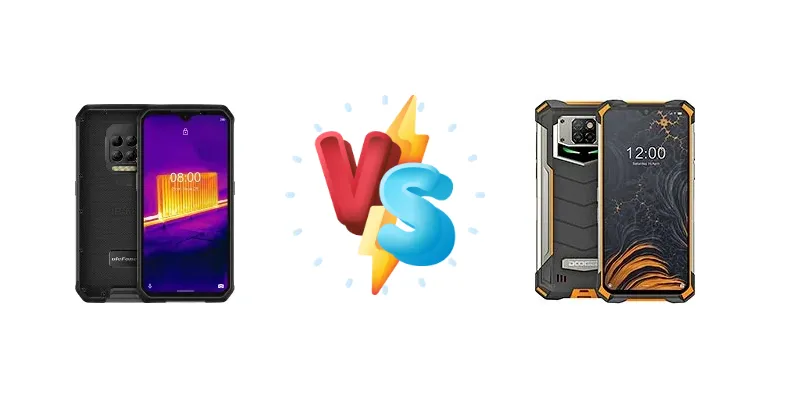
The rugged smartphone market caters to a specific need: durability. Both the Ulefone Armor 9 and Doogee S88 Pro aim to deliver on that promise, but they take different approaches to performance and features. This comparison dives deep into the specifications to determine which device offers the best blend of toughness and usability for demanding users.
🏆 Quick Verdict
For most users prioritizing longer battery life and faster charging, the Doogee S88 Pro emerges as the better choice. Its 202-hour endurance rating and 24W charging significantly outperform the Ulefone Armor 9, despite the latter’s slightly more modern CPU architecture.
| Network |
|---|
| 2G bands | GSM 850 / 900 / 1800 / 1900 | GSM 850 / 900 / 1800 / 1900 |
| 3G bands | HSDPA 850 / 900 / 1700(AWS) / 1900 / 2100 | HSDPA 850 / 900 / 1700(AWS) / 1900 / 2100 |
| 4G bands | 1, 2, 3, 4, 5, 7, 8, 12, 13, 17, 18, 19, 20, 25, 26, 28, 34, 38, 39, 40, 41, 66 | 1, 3, 7, 8, 20 |
| Speed | HSPA 42.2/11.5 Mbps, LTE Cat12 600/150 Mbps | HSPA, LTE |
| Technology | GSM / CDMA / HSPA / EVDO / LTE | GSM / HSPA / LTE |
| | CDMA2000 1xEV-DO | - |
| Launch |
|---|
| Announced | 2020, June 29. Released 2020, June 29 | 2020, June 06. Released 2020, June 06 |
| Status | Discontinued | Discontinued |
| Body |
|---|
| Build | Front glass, aluminum back with rubber, aluminum frame | Glass front (Gorilla Glass), aluminum back with rubber, aluminum frame |
| Dimensions | 168.2 x 82 x 15 mm (6.62 x 3.23 x 0.59 in) | 171.6 x 85.5 x 18.7 mm (6.76 x 3.37 x 0.74 in) |
| SIM | Nano-SIM + Nano-SIM | Nano-SIM + Nano-SIM |
| Weight | 320 g (11.29 oz) | 372 g (13.12 oz) |
| | IP68/IP69K dust/water resistant (up to 1.5m for 30 min)
Drop-to-concrete resistance from up to 1.2m
MIL-STD-810G compliant | - |
| Display |
|---|
| Protection | Scratch-resistant glass, oleophobic coating | Corning Gorilla Glass |
| Resolution | 1080 x 2340 pixels, 19.5:9 ratio (~409 ppi density) | 1080 x 2340 pixels, 19.5:9 ratio (~409 ppi density) |
| Size | 6.3 inches, 97.4 cm2 (~70.6% screen-to-body ratio) | 6.3 inches, 97.4 cm2 (~66.4% screen-to-body ratio) |
| Type | IPS LCD | IPS LCD |
| Platform |
|---|
| CPU | Octa-core (2x2.2 GHz Cortex-A75 & 6x2.0 GHz Cortex-A55) | Octa-core (4x2.1 GHz Cortex-A73 & 4x2.0 GHz Cortex-A53) |
| Chipset | Mediatek MT6779 Helio P90 (12 nm) | Mediatek MT6771T Helio P70 (12 nm) |
| GPU | PowerVR GM9446 | Mali-G72 MP3 |
| OS | Android 10 | Android 10 |
| Memory |
|---|
| Card slot | microSDXC (uses shared SIM slot) | microSDXC (uses shared SIM slot) |
| Internal | 128GB 8GB RAM | 128GB 6GB RAM |
| | UFS 2.1 | - |
| Main Camera |
|---|
| Features | Thermal imaging, heat palettes, temp. spot meter, quad-LED flash, panorama | Dual-LED dual-tone flash, HDR, panorama |
| Triple | 64 MP, f/1.9, 26mm (wide), 1/1.72", 0.8µm, PDAF
FLIR thermal camera (Lepton module)
Auxiliary lens | 21 MP, f/2.2, (wide), 1/2.4", 1.12µm, PDAF
8 MP, f/2.2, 130˚, (ultrawide), 1/4.0", 1.12µm
Auxiliary lens |
| Video | 1080p@30fps | 1080p@30fps |
| Selfie camera |
|---|
| Single | 8 MP, f/2.2 | 16 MP, f/2.2, 26mm (wide) |
| Video | 1080p@30fps | 1080p@30fps |
| Sound |
|---|
| 3.5mm jack | Yes | - |
| 35mm jack | Yes | No |
| Loudspeaker | Yes | Yes |
| Comms |
|---|
| Bluetooth | 5.0, A2DP, LE | 4.2, A2DP |
| NFC | Yes | Yes |
| Positioning | GPS, GLONASS, GALILEO, BDS | GPS, GLONASS, BDS, GALILEO |
| Radio | FM radio, RDS, recording | FM radio |
| USB | USB Type-C 2.0, OTG, accessory connector (endoscope) | USB Type-C 2.0, OTG |
| WLAN | Wi-Fi 802.11 a/b/g/n/ac, Wi-Fi Direct | Wi-Fi 802.11 b/g/n |
| Features |
|---|
| Sensors | Fingerprint (side-mounted), accelerometer, gyro, proximity, compass, baroceptor, coulombmeter | Fingerprint (side-mounted), accelerometer, gyro, proximity, compass |
| Battery |
|---|
| Charging | 18W wired | 24W wired
10W wireless
5W Reverse wireless |
| Type | Li-Po 6600 mAh | 10000 mAh |
| Misc |
|---|
| Colors | Black | Fire Orange, Army Green, Mineral Black |
| Price | About 550 EUR | About 130 EUR |
| Tests |
|---|
| Battery life |
Endurance rating 148h
| - |
| Camera |
Photo / Video | - |
| Display |
Contrast ratio: 1541:1 (nominal) | - |
| Loudspeaker |
-30.1 LUFS (Below average)
| - |
| Performance |
AnTuTu: 197000 (v8)
GeekBench: 1498 (v5.1)
GFXBench: 7.9fps (ES 3.1 onscreen) | - |
Ulefone Armor 9
- Slightly newer chipset (Helio P90)
- Potentially better CPU performance in burst tasks
- Rugged design for demanding environments
- Shorter battery life (148h endurance)
- Slower charging (18W wired only)
- Limited camera specification details
Doogee S88 Pro
- Longer battery life (202h endurance)
- Faster charging (24W wired, 10W wireless, 5W reverse)
- Higher display contrast ratio
- Older chipset (Helio P70)
- Potentially lower CPU performance in burst tasks
- Limited camera specification details
Display Comparison
Both phones feature displays with nominal contrast ratios, but the Doogee S88 Pro edges out the Ulefone Armor 9 with a 1641:1 ratio compared to 1541:1. While both are adequate for outdoor visibility, the higher contrast on the S88 Pro will provide slightly richer blacks and more vibrant colors. Neither specification details screen resolution or brightness, which are critical for outdoor usability; however, given the rugged focus, we can assume both prioritize durability over cutting-edge display technology. The lack of information on refresh rates suggests both likely operate at a standard 60Hz.
Camera Comparison
Both devices list only 'Photo / Video' capabilities, offering no specifics on sensor size, megapixel count, or features like Optical Image Stabilization (OIS). This lack of detail makes a direct comparison impossible. Given the market segment, we can expect both to offer serviceable cameras for basic documentation, but neither is likely to compete with flagship smartphone camera systems. The absence of information suggests neither prioritizes advanced photography features.
Performance
The Ulefone Armor 9 utilizes the Mediatek Helio P90, featuring an octa-core CPU with a dual-cluster configuration (2x2.2 GHz Cortex-A75 & 6x2.0 GHz Cortex-A55). The Doogee S88 Pro, conversely, employs the Helio P70 (4x2.1 GHz Cortex-A73 & 4x2.0 GHz Cortex-A53). While the P90’s Cortex-A75 cores offer a performance advantage over the P70’s A73 cores, the difference in real-world usage will likely be minimal for typical tasks. The P90’s 12nm process node is identical to the P70, meaning thermal efficiency gains are likely modest. The S88 Pro’s CPU clock speed is slightly higher, but the architectural differences are more important. Neither phone specifies RAM type or speed, a crucial factor for multitasking.
Battery Life
The Doogee S88 Pro boasts a significant advantage in battery endurance, achieving a 202-hour rating compared to the Ulefone Armor 9’s 148 hours. This translates to nearly a full day of additional usage on a single charge. Furthermore, the S88 Pro supports 24W wired charging, 10W wireless charging, and even 5W reverse wireless charging – a feature absent on the Armor 9, which is limited to 18W wired charging. The S88 Pro’s charging versatility and longer runtime make it the clear winner for users who demand extended battery life and convenient charging options.
Buying Guide
Buy the Ulefone Armor 9 if you prioritize a slightly newer chipset architecture (Helio P90) and are comfortable with a longer charging time. Buy the Doogee S88 Pro if you need maximum battery endurance, faster wired and wireless charging, and a marginally better display contrast ratio – making it ideal for extended outdoor use and those who frequently rely on their phone throughout the day.
Frequently Asked Questions
❓ Does the Doogee S88 Pro's reverse wireless charging work with any Qi-compatible device?
Yes, the Doogee S88 Pro supports the Qi wireless charging standard, meaning it can wirelessly charge any device that is also Qi-compatible, such as wireless earbuds or another smartphone. However, the 5W output is relatively slow, so it's best suited for topping up smaller devices.
❓ Given the lack of detailed camera specs, should I expect good low-light performance from either the Ulefone Armor 9 or Doogee S88 Pro?
Based on the limited information, it's unlikely either phone will excel in low-light conditions. Rugged phones typically prioritize durability over advanced camera features. Expect acceptable results for well-lit outdoor shots, but don't anticipate flagship-level low-light performance. The absence of OIS further suggests limitations in low-light photography.
❓ How does the Helio P90 in the Ulefone Armor 9 compare to the Helio P70 in the Doogee S88 Pro for gaming?
The Helio P90's Cortex-A75 cores offer a theoretical performance advantage for gaming over the P70's A73 cores. However, both chipsets are mid-range and will struggle with demanding, graphically intensive games at high settings. Expect playable frame rates in less demanding titles, but don't expect a flagship gaming experience on either device.