
Ulefone Armor 8 vs. Doogee S96 Pro: A Head-to-Head Rugged Smartphone Showdown
| Phones Images | |||||
|---|---|---|---|---|---|
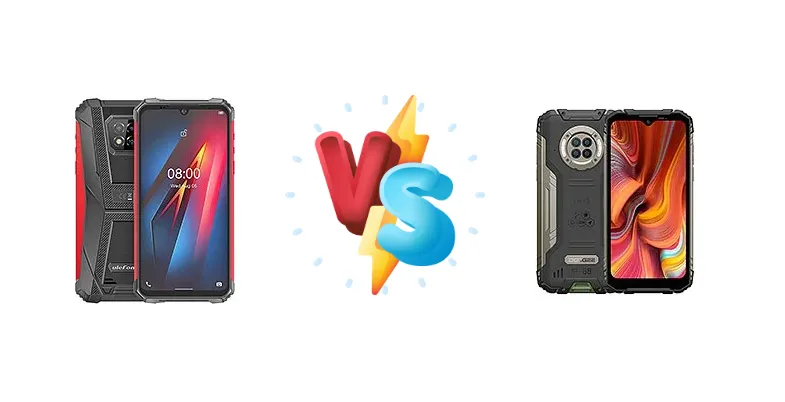
|
🏆 Quick Verdict
For the average user prioritizing performance and faster charging, the Doogee S96 Pro is the clear winner. Its Helio G90 chipset provides a significant performance uplift over the Armor 8’s Helio P60, and the inclusion of wireless charging adds convenience. However, the Armor 8 remains a viable option for budget-conscious buyers.
| PHONES | ||
|---|---|---|
| Phone Names | Ulefone Armor 8 | Doogee S96 Pro |
| Network | ||
|---|---|---|
| 2G bands | GSM 850 / 900 / 1800 / 1900 | GSM 850 / 900 / 1800 / 1900 |
| 3G bands | HSDPA 850 / 900 / 1700(AWS) / 1900 / 2100 | HSDPA 800 / 850 / 900 / 1700(AWS) / 1900 / 2100 |
| 4G bands | 1, 2, 3, 4, 5, 7, 8, 12, 13, 17, 18, 19, 20, 25, 26, 28, 28, 66 | 1, 2, 3, 4, 5, 7, 8, 12, 13, 17, 18, 19, 20, 25, 26, 28, 38, 40, 66 |
| Speed | HSPA 42.2/11.5 Mbps, LTE Cat7 300/150 Mbps | HSPA, LTE |
| Technology | GSM / HSPA / LTE | GSM / CDMA / HSPA / LTE |
| Launch | ||
|---|---|---|
| Announced | 2020, August 17. Released 2020, August 17 | 2020, October 26. Released 2020, November |
| Status | Discontinued | Discontinued |
| Body | ||
|---|---|---|
| Build | Front glass, aluminum back with rubber, aluminum frame | - |
| Dimensions | 166 x 81.8 x 15 mm (6.54 x 3.22 x 0.59 in) | 167 x 81.4 x 15.5 mm (6.57 x 3.20 x 0.61 in) |
| SIM | Nano-SIM + Nano-SIM | Nano-SIM + Nano-SIM |
| Weight | 282 g (9.95 oz) | 310 g (10.93 oz) |
| IP68 dust/water resistant (up to 1.5m for 30 mins) Drop-to-concrete resistance from up to 1.2 m MIL-STD-810G compliant | - | |
| Display | ||
|---|---|---|
| Protection | Scratch-resistant glass, oleophobic coating | Corning Gorilla Glass |
| Resolution | 720 x 1560 pixels, 19.5:9 ratio (~282 ppi density) | 720 x 1520 pixels, 19:9 ratio (~270 ppi density) |
| Size | 6.1 inches, 91.3 cm2 (~67.3% screen-to-body ratio) | 6.22 inches, 96.6 cm2 (~71.0% screen-to-body ratio) |
| Type | IPS LCD | IPS LCD |
| Platform | ||
|---|---|---|
| CPU | Octa-core (4x2.0 GHz Cortex-A73 & 4x2.0 GHz Cortex-A53) | Octa-core (2x2.0 GHz Cortex-A76 & 6x2.0 GHz Cortex-A55) |
| Chipset | Mediatek MT6771 Helio P60 (12 nm) | Mediatek MT6785 Helio G90 (12 nm) |
| GPU | Mali-G72 MP3 | Mali-G76 MC4 |
| OS | Android 10 | Android 10 |
| Memory | ||
|---|---|---|
| Card slot | microSDXC (uses shared SIM slot) | microSDXC (dedicated slot) |
| Internal | 64GB 4GB RAM | 128GB 8GB RAM |
| eMMC 5.1 | - | |
| Main Camera | ||
|---|---|---|
| Features | LED flash, Panorama, HDR | Quad-LED flash, HDR, panorama |
| Quad | - | 48 MP, f/1.8, (wide), PDAF 8 MP, f/2.2, 130˚, (ultrawide) 20 MP, f/2.8, (night vision), 4 infrared night vision lights 2 MP (macro) |
| Triple | 16 MP, f/2.2, (wide), PDAF 5 MP (macro) Auxiliary lens | - |
| Video | 1080p@30fps | 1080p |
| Selfie camera | ||
|---|---|---|
| Single | 8 MP, f/2.2 | 16 MP, f/2.0, (wide) |
| Video | 1080p@30fps | 1080p |
| Sound | ||
|---|---|---|
| 3.5mm jack | Yes | - |
| 35mm jack | Yes | Yes |
| Loudspeaker | Yes | Yes |
| Comms | ||
|---|---|---|
| Bluetooth | 4.2, A2DP, LE | 5.0, A2DP, LE |
| NFC | Yes | Yes |
| Positioning | GPS, GLONASS, GALILEO, BDS | GPS, GLONASS, BDS, GALILEO |
| Radio | FM radio, RDS, recording | FM radio |
| USB | USB Type-C 2.0, OTG | USB Type-C 2.0, OTG |
| WLAN | Wi-Fi 802.11 a/b/g/n/ac, Wi-Fi Direct | Wi-Fi 802.11 a/b/g/n/ac, dual-band |
| Features | ||
|---|---|---|
| Sensors | Fingerprint (side-mounted), accelerometer, gyro, proximity, compass, baroceptor, coulombmeter | Fingerprint (side-mounted), accelerometer, gyro, proximity, compass |
| Battery | ||
|---|---|---|
| Charging | 15W wired | 24W wired 10W wireless |
| Type | Li-Po 5580 mAh | 6350 mAh |
| Misc | ||
|---|---|---|
| Colors | Black, Orange, Red | Black, Orange, Green |
| Price | About 200 EUR | About 280 EUR |
Ulefone Armor 8
- More affordable price point
- Rugged design for durability
- Acceptable performance for basic tasks
- Outdated Helio P60 chipset
- Slow 15W wired charging only
- Limited performance for demanding apps
Doogee S96 Pro
- Faster Helio G90 chipset for improved performance
- 24W wired and 10W wireless charging
- More responsive user experience
- Higher price compared to the Armor 8
- Rugged design may be bulky
- Camera performance likely not flagship-level
Display Comparison
Neither Ulefone nor Doogee provide detailed display specifications beyond the basic panel type. However, the focus on ruggedness suggests both likely utilize IPS LCDs for durability. The absence of high refresh rates or advanced features like LTPO is expected in this segment. The real-world impact will be similar viewing experiences, prioritizing visibility in direct sunlight over color accuracy or smoothness.
Camera Comparison
Detailed camera specs are unavailable, but the focus for both devices is likely on practicality rather than photographic excellence. The absence of information suggests both phones utilize standard camera setups. The S96 Pro’s chipset has a more powerful ISP (Image Signal Processor) which will likely result in better image processing, especially in low-light conditions. The Armor 8 will likely produce acceptable images in good lighting, but will struggle in challenging scenarios.
Performance
The Doogee S96 Pro’s Mediatek Helio G90 chipset represents a substantial upgrade over the Ulefone Armor 8’s Helio P60. The G90 features a more modern CPU architecture – 2x2.0 GHz Cortex-A76 cores alongside 6x2.0 GHz Cortex-A55 cores – compared to the P60’s 4x2.0 GHz Cortex-A73 and 4x2.0 GHz Cortex-A53 configuration. The Cortex-A76 cores in the G90 offer significantly improved single-core performance, crucial for responsive app launches and smoother UI navigation. While both chips are built on a 12nm process, the G90’s architecture delivers a noticeable performance advantage, particularly in gaming and demanding applications. The Armor 8 will handle everyday tasks, but the S96 Pro will provide a more fluid experience.
Battery Life
The charging capabilities are a key differentiator. The Doogee S96 Pro supports 24W wired charging and 10W wireless charging, offering significantly faster and more convenient charging options than the Ulefone Armor 8’s 15W wired charging. While battery capacity isn't specified, the faster charging of the S96 Pro translates to less downtime. The addition of wireless charging is a significant convenience feature for users who prefer cable-free charging.
Buying Guide
Buy the Ulefone Armor 8 if you need a highly affordable, genuinely rugged phone for basic tasks and occasional use, and aren't concerned with demanding applications. Buy the Doogee S96 Pro if you prioritize smoother multitasking, gaming, and faster charging speeds, and are willing to spend a bit more for a more capable rugged device.