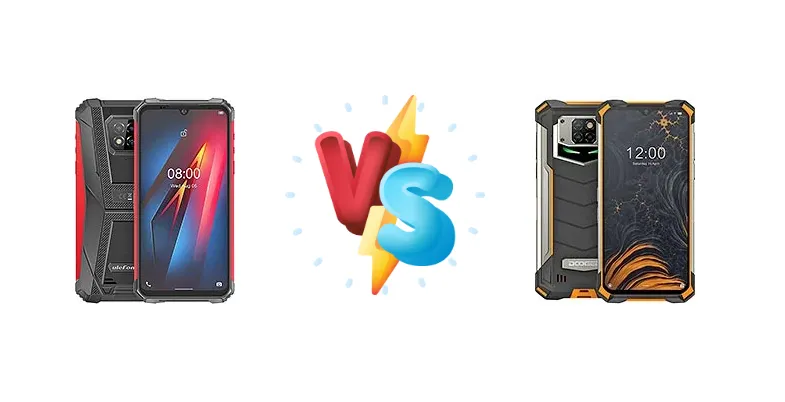
The rugged smartphone market caters to a specific user: those needing durability and reliability in challenging environments. Both the Ulefone Armor 8 and Doogee S88 Pro aim to deliver this, but they approach it with slightly different hardware choices. This comparison dissects those differences, focusing on performance, battery, and charging to determine which phone offers the best value for demanding users.
🏆 Quick Verdict
For most users prioritizing a balance of affordability and functionality, the Doogee S88 Pro emerges as the better choice. Its Helio P70 chipset provides a modest performance edge, and the inclusion of 24W wired, 10W wireless, and 5W reverse wireless charging offers significantly more versatility than the Ulefone Armor 8’s 15W wired charging.
| Network |
|---|
| 2G bands | GSM 850 / 900 / 1800 / 1900 | GSM 850 / 900 / 1800 / 1900 |
| 3G bands | HSDPA 850 / 900 / 1700(AWS) / 1900 / 2100 | HSDPA 850 / 900 / 1700(AWS) / 1900 / 2100 |
| 4G bands | 1, 2, 3, 4, 5, 7, 8, 12, 13, 17, 18, 19, 20, 25, 26, 28, 28, 66 | 1, 3, 7, 8, 20 |
| Speed | HSPA 42.2/11.5 Mbps, LTE Cat7 300/150 Mbps | HSPA, LTE |
| Technology | GSM / HSPA / LTE | GSM / HSPA / LTE |
| Launch |
|---|
| Announced | 2020, August 17. Released 2020, August 17 | 2020, June 06. Released 2020, June 06 |
| Status | Discontinued | Discontinued |
| Body |
|---|
| Build | Front glass, aluminum back with rubber, aluminum frame | Glass front (Gorilla Glass), aluminum back with rubber, aluminum frame |
| Dimensions | 166 x 81.8 x 15 mm (6.54 x 3.22 x 0.59 in) | 171.6 x 85.5 x 18.7 mm (6.76 x 3.37 x 0.74 in) |
| SIM | Nano-SIM + Nano-SIM | Nano-SIM + Nano-SIM |
| Weight | 282 g (9.95 oz) | 372 g (13.12 oz) |
| | IP68 dust/water resistant (up to 1.5m for 30 mins)
Drop-to-concrete resistance from up to 1.2 m
MIL-STD-810G compliant | - |
| Display |
|---|
| Protection | Scratch-resistant glass, oleophobic coating | Corning Gorilla Glass |
| Resolution | 720 x 1560 pixels, 19.5:9 ratio (~282 ppi density) | 1080 x 2340 pixels, 19.5:9 ratio (~409 ppi density) |
| Size | 6.1 inches, 91.3 cm2 (~67.3% screen-to-body ratio) | 6.3 inches, 97.4 cm2 (~66.4% screen-to-body ratio) |
| Type | IPS LCD | IPS LCD |
| Platform |
|---|
| CPU | Octa-core (4x2.0 GHz Cortex-A73 & 4x2.0 GHz Cortex-A53) | Octa-core (4x2.1 GHz Cortex-A73 & 4x2.0 GHz Cortex-A53) |
| Chipset | Mediatek MT6771 Helio P60 (12 nm) | Mediatek MT6771T Helio P70 (12 nm) |
| GPU | Mali-G72 MP3 | Mali-G72 MP3 |
| OS | Android 10 | Android 10 |
| Memory |
|---|
| Card slot | microSDXC (uses shared SIM slot) | microSDXC (uses shared SIM slot) |
| Internal | 64GB 4GB RAM | 128GB 6GB RAM |
| | eMMC 5.1 | - |
| Main Camera |
|---|
| Features | LED flash, Panorama, HDR | Dual-LED dual-tone flash, HDR, panorama |
| Triple | 16 MP, f/2.2, (wide), PDAF
5 MP (macro)
Auxiliary lens | 21 MP, f/2.2, (wide), 1/2.4", 1.12µm, PDAF
8 MP, f/2.2, 130˚, (ultrawide), 1/4.0", 1.12µm
Auxiliary lens |
| Video | 1080p@30fps | 1080p@30fps |
| Selfie camera |
|---|
| Single | 8 MP, f/2.2 | 16 MP, f/2.2, 26mm (wide) |
| Video | 1080p@30fps | 1080p@30fps |
| Sound |
|---|
| 3.5mm jack | Yes | - |
| 35mm jack | Yes | No |
| Loudspeaker | Yes | Yes |
| Comms |
|---|
| Bluetooth | 4.2, A2DP, LE | 4.2, A2DP |
| NFC | Yes | Yes |
| Positioning | GPS, GLONASS, GALILEO, BDS | GPS, GLONASS, BDS, GALILEO |
| Radio | FM radio, RDS, recording | FM radio |
| USB | USB Type-C 2.0, OTG | USB Type-C 2.0, OTG |
| WLAN | Wi-Fi 802.11 a/b/g/n/ac, Wi-Fi Direct | Wi-Fi 802.11 b/g/n |
| Features |
|---|
| Sensors | Fingerprint (side-mounted), accelerometer, gyro, proximity, compass, baroceptor, coulombmeter | Fingerprint (side-mounted), accelerometer, gyro, proximity, compass |
| Battery |
|---|
| Charging | 15W wired | 24W wired
10W wireless
5W Reverse wireless |
| Type | Li-Po 5580 mAh | 10000 mAh |
| Misc |
|---|
| Colors | Black, Orange, Red | Fire Orange, Army Green, Mineral Black |
| Price | About 200 EUR | About 130 EUR |
Ulefone Armor 8
- More affordable price point
- Rugged design for durability
- Reliable performance for basic tasks
- Slower processor compared to the S88 Pro
- Limited 15W wired charging only
- Lack of wireless charging
Doogee S88 Pro
- Faster Helio P70 processor
- 24W wired charging for quicker top-ups
- 10W wireless and 5W reverse wireless charging
- Potentially higher price
- Rugged design may be bulky
- Camera performance likely average
Display Comparison
Neither Ulefone nor Doogee provide detailed display specifications beyond the Doogee S88 Pro’s contrast ratio of 1641:1. This suggests a reasonably good, though not exceptional, viewing experience. Given both phones target a rugged audience, display quality is likely a secondary concern to durability. We can infer both likely use IPS LCD panels, common in this price bracket, and neither are expected to offer high refresh rates or HDR support. The lack of detailed specs makes a direct comparison impossible, but the contrast ratio suggests the Doogee S88 Pro may offer slightly more vibrant visuals.
Camera Comparison
Detailed camera specifications are absent for both devices. Given the target market, we can expect both phones to prioritize practicality over photographic excellence. The absence of information regarding sensor size, aperture, or image stabilization suggests neither phone will excel in low-light conditions. The inclusion of a 2MP macro lens on either device is likely a marketing gimmick, offering limited real-world benefit. Image processing will likely be heavily reliant on software algorithms to compensate for the limitations of the hardware.
Performance
The Doogee S88 Pro’s Mediatek MT6771T Helio P70 chipset represents a clear, albeit incremental, performance advantage over the Ulefone Armor 8’s MT6771 Helio P60. The P70 features a slightly higher CPU clock speed (4x2.1 GHz vs 4x2.0 GHz Cortex-A73) and a more efficient architecture. While both chipsets utilize the same core configuration (4x Cortex-A73 and 4x Cortex-A53), the P70’s improvements translate to snappier app loading and smoother multitasking. Both phones will handle everyday tasks adequately, but the S88 Pro will likely exhibit less lag under heavier workloads. The impact of RAM isn't specified, but assuming similar configurations, the chipset difference is the primary performance differentiator.
Battery Life
The Doogee S88 Pro boasts a significant advantage in charging versatility. While the Ulefone Armor 8 is limited to 15W wired charging, the S88 Pro supports 24W wired, 10W wireless, and 5W reverse wireless charging. This allows users to top up the battery quickly via a wired connection, conveniently charge wirelessly, or even use the phone as a portable power bank for smaller accessories. The Doogee S88 Pro’s endurance rating of 202 hours suggests a larger battery capacity, though the exact mAh isn’t specified. The faster charging speeds and added wireless options make the S88 Pro the clear winner for users who prioritize battery convenience.
Buying Guide
Buy the Ulefone Armor 8 if you need a highly durable phone on a strict budget and aren't concerned with the latest processing speeds. It's a solid option for basic tasks and reliable communication in harsh conditions. Buy the Doogee S88 Pro if you prefer a slightly faster processor for smoother multitasking, and value the convenience of wireless charging and reverse wireless charging for accessories or other devices.
Frequently Asked Questions
❓ Does the Doogee S88 Pro's Helio P70 chipset offer a noticeable improvement in gaming performance compared to the Ulefone Armor 8?
While neither phone is a gaming powerhouse, the Helio P70 in the S88 Pro will provide a smoother experience with less frame rate stuttering in less demanding titles. Expect to play games like PUBG Mobile on medium settings, but don't anticipate high frame rates or ultra-high graphics settings on either device.
❓ How long does it realistically take to fully charge the Ulefone Armor 8 with its 15W charging?
Given the likely battery capacity (estimated around 5000-6000mAh based on similar rugged phones), a full charge from 0% to 100% with the 15W charger will likely take between 3.5 to 5 hours. This is significantly slower than the Doogee S88 Pro's 24W charging.
❓ Is the reverse wireless charging feature on the Doogee S88 Pro useful for everyday use?
The 5W reverse wireless charging is best suited for topping up small accessories like wireless earbuds or a smartwatch. It's not designed to quickly charge larger devices like another smartphone, but it provides a convenient emergency power source in a pinch.