
Ulefone Armor 8 vs. Blackview BV9900E: A Deep Dive into Rugged Smartphone Performance
| Phones Images | |||||
|---|---|---|---|---|---|
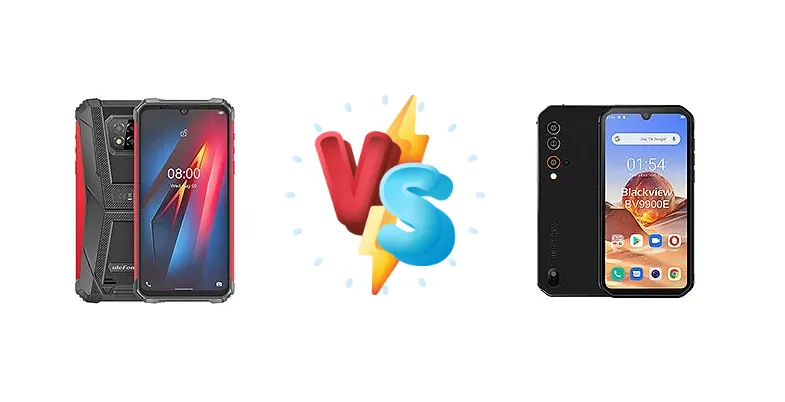
|
🏆 Quick Verdict
For the average user prioritizing raw performance and future-proofing, the Blackview BV9900E is the clear winner. Its Helio P90 chipset offers a noticeable performance uplift over the Armor 8’s Helio P60, coupled with the convenience of wireless charging. However, the Armor 8 remains a viable option for budget-conscious buyers.
| PHONES | ||
|---|---|---|
| Phone Names | Ulefone Armor 8 | Blackview BV9900E |
| Network | ||
|---|---|---|
| 2G bands | GSM 850 / 900 / 1800 / 1900 | GSM 850 / 900 / 1800 / 1900 |
| 3G bands | HSDPA 850 / 900 / 1700(AWS) / 1900 / 2100 | HSDPA 800 / 850 / 900 / 1700(AWS) / 1900 / 2100 |
| 4G bands | 1, 2, 3, 4, 5, 7, 8, 12, 13, 17, 18, 19, 20, 25, 26, 28, 28, 66 | 1, 2, 3, 4, 5, 7, 8, 12, 13, 17, 18, 19, 20, 25, 26, 28, 34, 38, 39, 40, 41, 66 |
| Speed | HSPA 42.2/11.5 Mbps, LTE Cat7 300/150 Mbps | HSPA, LTE |
| Technology | GSM / HSPA / LTE | GSM / CDMA / HSPA / CDMA2000 / LTE |
| Launch | ||
|---|---|---|
| Announced | 2020, August 17. Released 2020, August 17 | 2020, September 10. Released 2020, September |
| Status | Discontinued | Discontinued |
| Body | ||
|---|---|---|
| Build | Front glass, aluminum back with rubber, aluminum frame | - |
| Dimensions | 166 x 81.8 x 15 mm (6.54 x 3.22 x 0.59 in) | 156.5 x 78.3 x 14.2 mm (6.16 x 3.08 x 0.56 in) |
| SIM | Nano-SIM + Nano-SIM | Nano-SIM + Nano-SIM |
| Weight | 282 g (9.95 oz) | 273 g (9.63 oz) |
| IP68 dust/water resistant (up to 1.5m for 30 mins) Drop-to-concrete resistance from up to 1.2 m MIL-STD-810G compliant | - | |
| Display | ||
|---|---|---|
| Protection | Scratch-resistant glass, oleophobic coating | Corning Gorilla Glass 5 |
| Resolution | 720 x 1560 pixels, 19.5:9 ratio (~282 ppi density) | 1080 x 2280 pixels, 19:9 ratio (~432 ppi density) |
| Size | 6.1 inches, 91.3 cm2 (~67.3% screen-to-body ratio) | 5.84 inches, 85.1 cm2 (~69.5% screen-to-body ratio) |
| Type | IPS LCD | IPS LCD |
| Platform | ||
|---|---|---|
| CPU | Octa-core (4x2.0 GHz Cortex-A73 & 4x2.0 GHz Cortex-A53) | Octa-core (2x2.2 GHz Cortex-A75 & 6x2.0 GHz Cortex-A55) |
| Chipset | Mediatek MT6771 Helio P60 (12 nm) | Mediatek MT6779V/CE Helio P90 (12 nm) |
| GPU | Mali-G72 MP3 | PowerVR GM9446 |
| OS | Android 10 | Android 10 |
| Memory | ||
|---|---|---|
| Card slot | microSDXC (uses shared SIM slot) | microSDXC |
| Internal | 64GB 4GB RAM | 128GB 6GB RAM |
| eMMC 5.1 | - | |
| Main Camera | ||
|---|---|---|
| Features | LED flash, Panorama, HDR | LED flash, HDR, panorama |
| Quad | - | 48 MP, f/1.8, (wide), PDAF 16 MP, 120˚ (ultrawide) 2 MP (macro) Auxiliary lens |
| Triple | 16 MP, f/2.2, (wide), PDAF 5 MP (macro) Auxiliary lens | - |
| Video | 1080p@30fps | 4K@30fps, 1080p@60fps |
| Selfie camera | ||
|---|---|---|
| Single | 8 MP, f/2.2 | 16 MP, f/2.0, (wide) |
| Video | 1080p@30fps | 1080p@30fps |
| Sound | ||
|---|---|---|
| 3.5mm jack | Yes | - |
| 35mm jack | Yes | No |
| Loudspeaker | Yes | Yes |
| Comms | ||
|---|---|---|
| Bluetooth | 4.2, A2DP, LE | 5.0, A2DP, LE |
| NFC | Yes | Yes |
| Positioning | GPS, GLONASS, GALILEO, BDS | GPS, GLONASS, GALILEO, BDS |
| Radio | FM radio, RDS, recording | FM radio |
| USB | USB Type-C 2.0, OTG | USB Type-C 2.0, OTG |
| WLAN | Wi-Fi 802.11 a/b/g/n/ac, Wi-Fi Direct | Wi-Fi 802.11 a/b/g/n/ac |
| Features | ||
|---|---|---|
| Sensors | Fingerprint (side-mounted), accelerometer, gyro, proximity, compass, baroceptor, coulombmeter | Fingerprint (side-mounted), accelerometer, gyro, proximity, compass, barometer |
| Battery | ||
|---|---|---|
| Charging | 15W wired | 15W wired 18W wireless |
| Type | Li-Po 5580 mAh | 4380 mAh |
| Misc | ||
|---|---|---|
| Colors | Black, Orange, Red | Black, Silver |
| Price | About 200 EUR | About 260 EUR |
Ulefone Armor 8
- More affordable price point
- Rugged design for durability
- Reliable for basic smartphone tasks
- Older Helio P60 chipset
- Lacks wireless charging
- Lower performance for demanding apps
Blackview BV9900E
- More powerful Helio P90 chipset
- Wireless charging support
- Improved image processing capabilities
- Higher price compared to Armor 8
- Rugged design may be bulky
- Battery life may be similar to Armor 8 despite efficiency gains
Display Comparison
Neither Ulefone nor Blackview provide detailed display specifications beyond the basic panel type. However, the chipset difference suggests potential implications. The P90 in the BV9900E has a more powerful ISP, potentially enabling better image signal processing for the display, resulting in more accurate color reproduction. Both likely utilize IPS LCD panels, common in this segment, but the BV9900E’s processing power could lead to a more refined visual experience. Bezels are expected to be similar, prioritizing durability over a sleek aesthetic.
Camera Comparison
Without detailed camera specs, analysis is limited. However, the Helio P90’s superior image signal processor (ISP) in the BV9900E is a key advantage. A more capable ISP allows for better noise reduction, dynamic range, and overall image quality, even with similar sensor hardware. While both phones likely feature a multi-camera setup, the P90’s processing power will likely result in more detailed and vibrant photos and videos. The inclusion of a 2MP macro lens on both is largely a marketing feature with limited practical benefit.
Performance
The core difference lies in the chipsets. The Blackview BV9900E’s Helio P90 (2x2.2 GHz Cortex-A75 & 6x2.0 GHz Cortex-A55) represents a significant architectural upgrade over the Ulefone Armor 8’s Helio P60 (4x2.0 GHz Cortex-A73 & 4x2.0 GHz Cortex-A53). The P90’s Cortex-A75 cores offer substantially higher single-core performance, crucial for responsive app launches and smoother UI navigation. The P90 also benefits from a more efficient process node, potentially leading to better thermal management under sustained load. While both are 12nm, the P90’s architecture is more modern. This translates to a more fluid experience for demanding tasks like gaming or video editing on the BV9900E.
Battery Life
Both phones offer 15W wired charging, suggesting similar charging speeds. However, the BV9900E adds 18W wireless charging, a significant convenience feature for users who prefer cable-free power-ups. While battery capacity isn’t specified, the P90’s improved efficiency could translate to slightly better battery life on the BV9900E, despite potentially having a similar capacity. The wireless charging capability gives the BV9900E a clear edge for users who value convenience.
Buying Guide
Buy the Ulefone Armor 8 if you need a highly durable phone for basic tasks like communication, navigation, and light media consumption, and are on a strict budget. Buy the Blackview BV9900E if you prioritize smoother multitasking, more demanding applications, and the added convenience of wireless charging, even at a slightly higher price point.