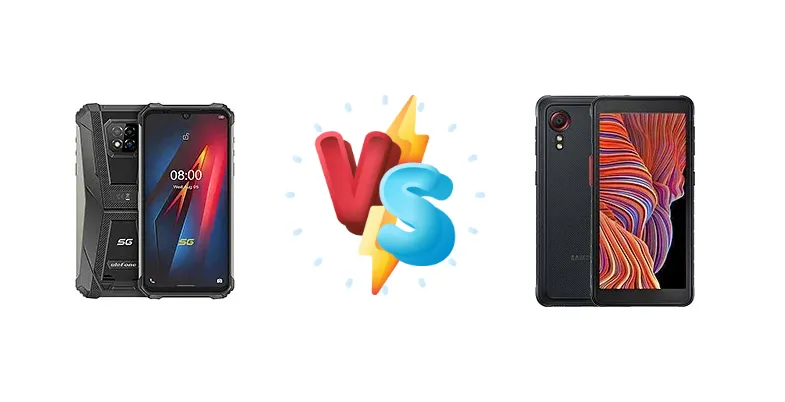
The rugged smartphone market caters to a specific need: durability. However, within this niche, priorities diverge. The Ulefone Armor 8 5G aggressively targets performance with a modern 5G chipset, while the Samsung Galaxy XCover 5 prioritizes a balance of reliability, Samsung’s ecosystem, and a more conservative approach to processing power. This comparison dissects these philosophies to determine which device best suits your needs.
🏆 Quick Verdict
For users demanding 5G connectivity and a performance edge for tasks beyond basic communication, the Ulefone Armor 8 5G is the clear winner. Its Dimensity 800 chipset offers significantly more processing power. However, the Samsung Galaxy XCover 5 remains a compelling choice for those prioritizing Samsung’s software support and a more energy-efficient experience.
| Network |
|---|
| 2G bands | GSM 850 / 900 / 1800 / 1900 | GSM 850 / 900 / 1800 / 1900 |
| 3G bands | HSDPA 850 / 900 / 1700(AWS) / 1900 / 2100 | HSDPA 850 / 900 / 1700(AWS) / 1900 / 2100 |
| 4G bands | LTE | 1, 2, 3, 4, 5, 7, 8, 12, 17, 20, 26, 28, 38, 40, 41, 66 |
| 5G bands | SA/NSA | - |
| Speed | HSPA, LTE, 5G | HSPA, LTE |
| Technology | GSM / HSPA / LTE / 5G | GSM / HSPA / LTE |
| Launch |
|---|
| Announced | 2020, September 21 | 2021, March 04 |
| Status | Cancelled | Available. Released 2021, March 12 |
| Body |
|---|
| Build | Front glass, aluminum back with rubber, aluminum frame | - |
| Dimensions | - | 147.1 x 71.6 x 9.2 mm (5.79 x 2.82 x 0.36 in) |
| SIM | Nano-SIM + Nano-SIM | · Nano-SIM· Nano-SIM + Nano-SIM |
| Weight | - | 172 g (6.07 oz) |
| | IP68 dust/water resistant (up to 1.5m for 30 mins)
Drop-to-concrete resistance from up to 1.2 m
MIL-STD-810G compliant | IP68 dust/water resistant (up to 1.5m for 30 min)
MIL-STD-810H compliant |
| Display |
|---|
| Protection | Scratch-resistant glass, oleophobic coating | - |
| Resolution | 720 x 1560 pixels, 19.5:9 ratio (~282 ppi density) | 720 x 1480 pixels, 18.5:9 ratio (~311 ppi density) |
| Size | 6.1 inches, 91.3 cm2 | 5.3 inches, 71.3 cm2 (~67.7% screen-to-body ratio) |
| Type | IPS LCD | PLS LCD |
| Platform |
|---|
| CPU | Octa-core (4x2.0 GHz Cortex-A76 & 4x2.0 GHz Cortex-A55) | Octa-core (4x2.0 GHz Cortex-A55 & 4x2.0 GHz Cortex-A55) |
| Chipset | Mediatek Dimensity 800 (7 nm) | Exynos 850 (8 nm) |
| GPU | Mali-G57 MP4 | Mali-G52 |
| OS | Android 10 | Android 11, upgradable to Android 14, One UI 6.1 |
| Memory |
|---|
| Card slot | microSDXC (uses shared SIM slot) | microSDXC (dedicated slot) |
| Internal | 256GB 8GB RAM | 64GB 4GB RAM |
| | - | eMMC 5.1 |
| Main Camera |
|---|
| Features | LED flash, Panorama, HDR | Dual LED flash, HDR, panorama |
| Single | - | 16 MP, f/1.8, PDAF |
| Triple | 64 MP, f/1.8, (wide), 1/1.72", 0.8µm, PDAF
2 other unknown cameras | - |
| Video | 1080p@30fps | 1080p@30fps |
| Selfie camera |
|---|
| Single | - | 5 MP, f/2.2 |
| | Unknown camera | - |
| Sound |
|---|
| 3.5mm jack | Yes | Yes |
| 35mm jack | Yes | Yes |
| Loudspeaker | Yes | Yes |
| Comms |
|---|
| Bluetooth | Yes | 5.0, A2DP, LE |
| NFC | Yes | Yes |
| Positioning | GPS, GLONASS, GALILEO, BDS | GPS, GLONASS, GALILEO, BDS |
| Radio | FM radio, RDS, recording | Unspecified |
| USB | USB Type-C 2.0, OTG | USB Type-C 2.0, charging connector pins |
| WLAN | Wi-Fi 802.11 a/b/g/n/ac, Wi-Fi Direct | Wi-Fi 802.11 a/b/g/n/ac, dual-band, Wi-Fi Direct |
| Features |
|---|
| Sensors | Fingerprint (side-mounted), accelerometer, gyro, proximity, compass, baroceptor, coulombmeter | Accelerometer, gyro, proximity, compass |
| Battery |
|---|
| Charging | Wired | 15W wired |
| Type | Li-Po 5080 mAh | Li-Ion 3000 mAh, removable |
| Misc |
|---|
| Colors | Black, Orange, Red | Black |
| Models | - | SM-G525F, SM-G525F/DS, SM-G525N |
| Price | - | £ 61.49 / € 74.89 |
| SAR EU | - | 0.70 W/kg (head) 1.27 W/kg (body) |
Ulefone Armor 8 5G
- Significantly faster processor for demanding tasks
- 5G connectivity for faster data speeds
- Potentially smoother UI experience
- Likely shorter battery life due to more powerful chipset
- Charging speed is unspecified and potentially slow
- Software support may be less consistent than Samsung
Samsung Galaxy XCover 5
- Reliable Samsung software and updates
- More energy-efficient processor for longer battery life
- Established ecosystem and accessory support
- Significantly slower processor for demanding tasks
- Limited to 4G connectivity
- Slow 15W charging
Display Comparison
Neither device boasts a cutting-edge display. Details regarding panel type (IPS vs AMOLED) and resolution are missing, but both are likely to be 720p+ to balance durability and power consumption. The key difference lies in processing power impacting UI smoothness. The Armor 8 5G’s more powerful chipset *could* render the UI more fluidly, even at a similar resolution. Bezels are expected to be substantial on both, prioritizing screen protection over maximizing screen real estate. Color accuracy is likely to be functional rather than color-critical on both devices.
Camera Comparison
Camera details are sparse, but the focus should be on practical utility rather than flagship-level photography. Both devices likely feature a primary sensor paired with auxiliary lenses (potentially macro or depth). The Ulefone Armor 8 5G’s image processing will likely lean towards more vibrant, saturated colors, typical of Mediatek-powered devices. Samsung’s Exynos typically delivers more natural, balanced images. The absence of optical image stabilization (OIS) on either device suggests a reliance on software stabilization, which may struggle in low-light conditions. Any 2MP macro lens on either device should be considered a marketing feature rather than a genuinely useful camera component.
Performance
The performance gap is the most significant differentiator. The Ulefone Armor 8 5G’s Mediatek Dimensity 800 (7nm) is a substantial upgrade over the Samsung Galaxy XCover 5’s Exynos 850 (8nm). The Dimensity 800 utilizes Cortex-A76 cores, offering significantly higher single-core performance, crucial for responsive app launches and general usability. The Exynos 850 relies solely on Cortex-A55 cores, optimized for efficiency but lacking the performance headroom of the Dimensity 800. This translates to a noticeable advantage for the Ulefone in multitasking, gaming, and demanding applications. While both are octa-core, the architectural differences are paramount.
Battery Life
The Ulefone Armor 8 5G’s battery capacity is unknown, but its more power-hungry Dimensity 800 chipset will likely necessitate a larger battery to achieve comparable battery life to the Samsung Galaxy XCover 5. The XCover 5’s 15W charging is slow by modern standards, but its more efficient Exynos 850 will reach a full charge relatively quickly. The Armor 8 5G’s charging speed is only specified as 'wired,' suggesting it may not offer fast charging capabilities. Users prioritizing all-day battery life with moderate usage will likely find the XCover 5 more dependable, while the Armor 8 5G may require more frequent top-ups.
Buying Guide
Buy the Ulefone Armor 8 5G if you need a rugged phone capable of handling demanding applications, streaming 5G content, and benefit from a more powerful processor for tasks like mapping or data collection in the field. Buy the Samsung Galaxy XCover 5 if you prefer a device with a proven track record of software updates, a more refined user experience within the Samsung ecosystem, and prioritize battery life over raw performance.
Frequently Asked Questions
❓ Does the Exynos 850 chip in the Galaxy XCover 5 overheat during prolonged use, such as GPS navigation or video recording?
The Exynos 850 is known for its efficiency and thermal management. It's unlikely to overheat during typical use cases like GPS navigation or video recording. However, extended periods of high-intensity tasks *could* lead to some throttling to maintain safe operating temperatures, but it's unlikely to be a significant issue.
❓ Is the 5G connectivity on the Ulefone Armor 8 5G truly useful in remote work environments, or is it primarily a marketing feature?
The utility of 5G depends heavily on coverage. In areas with strong 5G signals, the Ulefone Armor 8 5G will offer significantly faster download and upload speeds, beneficial for tasks like large file transfers, video conferencing, and remote access to servers. However, in areas with limited or no 5G coverage, the device will fall back to 4G, negating the benefit.
❓ How does the software update policy differ between Ulefone and Samsung, and what does this mean for long-term usability?
Samsung has a well-established track record of providing consistent software updates, including security patches and OS upgrades, for several years. Ulefone's update policy is less predictable. Users should expect fewer updates and potentially a shorter lifespan of software support compared to the Samsung Galaxy XCover 5.