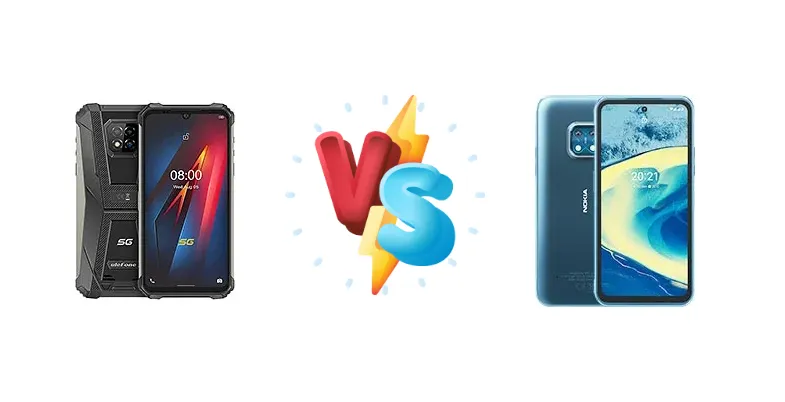
The rugged smartphone market caters to a specific need: durability. Both the Ulefone Armor 8 5G and the Nokia XR20 aim to deliver on that promise, but they diverge significantly in their approach to performance and features. The Ulefone prioritizes processing power with its Dimensity 800, while the Nokia XR20 focuses on a more balanced experience with a Qualcomm Snapdragon 480 and added convenience like wireless charging.
🏆 Quick Verdict
For users prioritizing raw performance and 5G connectivity for demanding tasks, the Ulefone Armor 8 5G is the better choice. However, the Nokia XR20’s wireless charging, more efficient chipset, and Nokia’s software support make it ideal for users seeking a reliable, long-lasting device with added convenience.
| Network |
|---|
| 2G bands | GSM 850 / 900 / 1800 / 1900 | GSM 850 / 900 / 1800 / 1900 |
| 3G bands | HSDPA 850 / 900 / 1700(AWS) / 1900 / 2100 | HSDPA 850 / 900 / 1700(AWS) / 1900 / 2100 |
| 4G bands | LTE | 1, 2, 3, 4, 5, 7, 8, 12, 13, 14, 20, 25, 26, 28, 30, 38, 40, 41, 48, 66, 71 |
| 5G bands | SA/NSA | 2, 5, 25, 38, 41, 48, 66, 77, 78 SA/NSA |
| Speed | HSPA, LTE, 5G | HSPA, LTE, 5G |
| Technology | GSM / HSPA / LTE / 5G | GSM / CDMA / HSPA / EVDO / LTE / 5G |
| | - | CDMA2000 1xEV-DO |
| Launch |
|---|
| Announced | 2020, September 21 | 2021, July 27 |
| Status | Cancelled | Available. Released 2021, August 04 |
| Body |
|---|
| Build | Front glass, aluminum back with rubber, aluminum frame | - |
| Dimensions | - | 171.6 x 81.5 x 10.6 mm (6.76 x 3.21 x 0.42 in) |
| SIM | Nano-SIM + Nano-SIM | · Nano-SIM· Nano-SIM + Nano-SIM |
| Weight | - | 248 g (8.75 oz) |
| | IP68 dust/water resistant (up to 1.5m for 30 mins)
Drop-to-concrete resistance from up to 1.2 m
MIL-STD-810G compliant | IP68 dust/water resistant (up to 1.5m for 60 min)
Drop-to-concrete resistance from up to 1.8m
MIL-STD-810H compliant |
| Display |
|---|
| Protection | Scratch-resistant glass, oleophobic coating | Corning Gorilla Glass Victus |
| Resolution | 720 x 1560 pixels, 19.5:9 ratio (~282 ppi density) | 1080 x 2400 pixels, 20:9 ratio (~395 ppi density) |
| Size | 6.1 inches, 91.3 cm2 | 6.67 inches, 107.4 cm2 (~76.8% screen-to-body ratio) |
| Type | IPS LCD | IPS LCD, 550 nits |
| Platform |
|---|
| CPU | Octa-core (4x2.0 GHz Cortex-A76 & 4x2.0 GHz Cortex-A55) | Octa-core (2x2.0 GHz Kryo 460 & 6x1.8 GHz Kryo 460) |
| Chipset | Mediatek Dimensity 800 (7 nm) | Qualcomm SM4350 Snapdragon 480 5G (8 nm) |
| GPU | Mali-G57 MP4 | Adreno 619 |
| OS | Android 10 | Android 11, upgradable to Android 13 |
| Memory |
|---|
| Card slot | microSDXC (uses shared SIM slot) | microSDXC (uses shared SIM slot) |
| Internal | 256GB 8GB RAM | 64GB 4GB RAM, 128GB 6GB RAM |
| Main Camera |
|---|
| Dual | - | 48 MP, f/1.8, (wide), 1/2.25", 0.8µm, PDAF
13 MP, f/2.4, 123˚ (ultrawide), 1/3.0", 1.12µm |
| Features | LED flash, Panorama, HDR | Zeiss optics, Dual-LED dual-tone flash, second LED flash, HDR, panorama |
| Single | - | 8 MP, f/2.0 (wide), 1/4.0", 1.12µm |
| Triple | 64 MP, f/1.8, (wide), 1/1.72", 0.8µm, PDAF
2 other unknown cameras | - |
| Video | 1080p@30fps | 1080p@30fps |
| Selfie camera |
|---|
| Single | - | 8 MP, f/2.0 (wide), 1/4.0", 1.12µm |
| Video | - | 1080p@30fps |
| | Unknown camera | - |
| Sound |
|---|
| 3.5mm jack | Yes | Yes |
| 35mm jack | Yes | Yes |
| Loudspeaker | Yes | Yes, with stereo speakers |
| Comms |
|---|
| Bluetooth | Yes | 5.1, A2DP, LE, aptX Adaptive |
| NFC | Yes | Yes |
| Positioning | GPS, GLONASS, GALILEO, BDS | GPS (L1+L5), GLONASS, BDS, GALILEO, QZSS, NavIC |
| Radio | FM radio, RDS, recording | Unspecified |
| USB | USB Type-C 2.0, OTG | USB Type-C 3.0 |
| WLAN | Wi-Fi 802.11 a/b/g/n/ac, Wi-Fi Direct | Wi-Fi 802.11 a/b/g/n/ac/6, dual-band, Wi-Fi Direct |
| Features |
|---|
| Sensors | Fingerprint (side-mounted), accelerometer, gyro, proximity, compass, baroceptor, coulombmeter | Fingerprint (side-mounted), accelerometer, gyro, proximity, compass, barometer |
| Battery |
|---|
| Charging | Wired | 18W wired
15W wireless |
| Type | Li-Po 5080 mAh | Li-Po 4630 mAh |
| Misc |
|---|
| Colors | Black, Orange, Red | Ultra Blue, Granite Gray |
| Models | - | TA-1368, TA-1362 |
| Price | - | About 270 EUR |
| SAR EU | - | 1.13 W/kg (head) 1.43 W/kg (body) |
Ulefone Armor 8 5G
- Significantly faster processor for demanding tasks
- Potentially better image processing capabilities
- Stronger 5G performance due to chipset
- Likely lower battery efficiency
- No wireless charging support
Nokia XR20
- More power-efficient chipset for longer battery life
- Convenient wireless charging support
- Nokia’s commitment to software updates
- Slower processor for demanding applications
- Less capable for gaming and video editing
Display Comparison
Neither device boasts a cutting-edge display. Details on panel type, resolution, and refresh rate are missing, but the focus here is durability. The absence of high refresh rates is typical for rugged phones to conserve battery. The real difference lies in the underlying processing power needed to drive a more advanced display, which the Ulefone has a better chance of handling if a higher resolution panel were present.
Camera Comparison
Without detailed camera specs beyond the chipsets, a direct comparison is difficult. However, the processing capabilities of the Dimensity 800 in the Ulefone Armor 8 5G suggest better image processing and potentially superior low-light performance. The Snapdragon 480 is capable, but the Ulefone has the headroom to handle more complex computational photography algorithms. The absence of information regarding sensor size and optical image stabilization (OIS) makes a definitive judgment impossible, but the Ulefone’s chipset gives it an edge.
Performance
The Ulefone Armor 8 5G’s Mediatek Dimensity 800 (7nm) significantly outperforms the Nokia XR20’s Qualcomm Snapdragon 480 5G (8nm) in raw processing power. The Dimensity 800’s octa-core configuration (4x2.0 GHz Cortex-A76 & 4x2.0 GHz Cortex-A55) offers a more robust architecture compared to the Snapdragon 480’s (2x2.0 GHz Kryo 460 & 6x1.8 GHz Kryo 460). The 7nm process node, while older, allows for higher clock speeds and more complex instructions. This translates to faster app loading times, smoother multitasking, and a better gaming experience on the Ulefone. However, the Snapdragon 480’s 8nm process is more power-efficient, potentially leading to longer battery life under moderate use.
Battery Life
Both phones offer wired charging, but the Nokia XR20 adds the convenience of 15W wireless charging, a feature absent on the Ulefone. While the Ulefone’s battery capacity is unknown, the Snapdragon 480’s efficiency in the Nokia XR20 means it will likely deliver comparable or even better real-world battery life despite potentially having a smaller battery. The 18W wired charging on the Nokia XR20 is also slightly faster than the Ulefone’s unspecified wired charging, and the addition of wireless charging provides flexibility.
Buying Guide
Buy the Ulefone Armor 8 5G if you need a rugged phone capable of handling demanding applications like mobile gaming, video editing, or running complex field work apps. Its Dimensity 800 chipset provides a significant performance advantage. Buy the Nokia XR20 if you prefer a more balanced experience with a focus on battery efficiency, software updates, and the convenience of wireless charging, making it ideal for everyday use and outdoor adventures where power outlets are scarce.
Frequently Asked Questions
❓ Will the Ulefone Armor 8 5G overheat during extended gaming sessions?
The Dimensity 800 is a capable chipset, but its 7nm process isn't as thermally efficient as newer nodes. While the Ulefone Armor 8 5G likely has thermal management solutions, prolonged gaming at maximum settings could lead to some throttling to prevent overheating. The rugged design may also limit passive cooling.
❓ How does Nokia’s software update policy benefit XR20 owners?
Nokia is known for providing timely software updates and security patches, even for its more affordable devices. This is a significant advantage for the XR20, ensuring it remains secure and receives new features for a longer period than many other Android phones in this price range. This is particularly important for a device intended for long-term use in challenging environments.
❓ Is the Snapdragon 480 in the Nokia XR20 powerful enough for everyday tasks and light multitasking?
Yes, the Snapdragon 480 is perfectly adequate for everyday tasks like browsing, social media, and email. It can also handle light multitasking without significant slowdowns. However, it will struggle with demanding applications or heavy gaming.