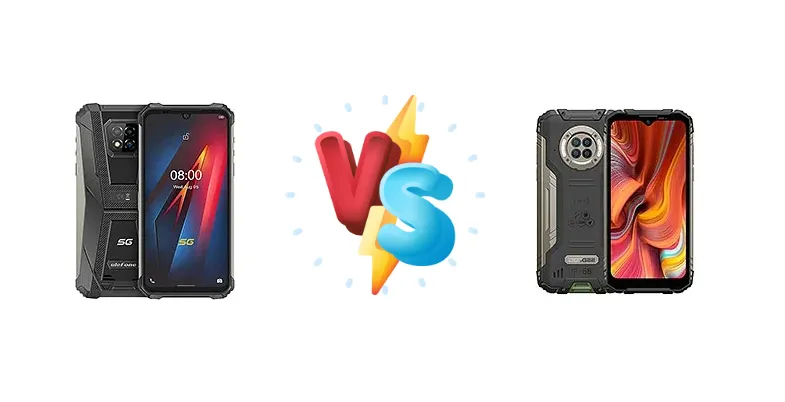
The rugged smartphone market caters to a specific user – those needing durability and reliability in challenging environments. Both the Ulefone Armor 8 5G and the Doogee S96 Pro aim to deliver this, but they take different approaches to performance and features. This comparison dissects their core components to determine which device offers the best blend of toughness and usability.
🏆 Quick Verdict
For the average user prioritizing 5G connectivity and sustained performance, the Ulefone Armor 8 5G emerges as the stronger choice. Its Dimensity 800 chipset, built on a more efficient 7nm process, provides a noticeable advantage in demanding tasks compared to the Doogee S96 Pro’s 12nm Helio G90, despite the latter offering wireless charging.
| Network |
|---|
| 2G bands | GSM 850 / 900 / 1800 / 1900 | GSM 850 / 900 / 1800 / 1900 |
| 3G bands | HSDPA 850 / 900 / 1700(AWS) / 1900 / 2100 | HSDPA 800 / 850 / 900 / 1700(AWS) / 1900 / 2100 |
| 4G bands | LTE | 1, 2, 3, 4, 5, 7, 8, 12, 13, 17, 18, 19, 20, 25, 26, 28, 38, 40, 66 |
| 5G bands | SA/NSA | - |
| Speed | HSPA, LTE, 5G | HSPA, LTE |
| Technology | GSM / HSPA / LTE / 5G | GSM / CDMA / HSPA / LTE |
| Launch |
|---|
| Announced | 2020, September 21 | 2020, October 26. Released 2020, November |
| Status | Cancelled | Discontinued |
| Body |
|---|
| Build | Front glass, aluminum back with rubber, aluminum frame | - |
| Dimensions | - | 167 x 81.4 x 15.5 mm (6.57 x 3.20 x 0.61 in) |
| SIM | Nano-SIM + Nano-SIM | Nano-SIM + Nano-SIM |
| Weight | - | 310 g (10.93 oz) |
| | IP68 dust/water resistant (up to 1.5m for 30 mins)
Drop-to-concrete resistance from up to 1.2 m
MIL-STD-810G compliant | - |
| Display |
|---|
| Protection | Scratch-resistant glass, oleophobic coating | Corning Gorilla Glass |
| Resolution | 720 x 1560 pixels, 19.5:9 ratio (~282 ppi density) | 720 x 1520 pixels, 19:9 ratio (~270 ppi density) |
| Size | 6.1 inches, 91.3 cm2 | 6.22 inches, 96.6 cm2 (~71.0% screen-to-body ratio) |
| Type | IPS LCD | IPS LCD |
| Platform |
|---|
| CPU | Octa-core (4x2.0 GHz Cortex-A76 & 4x2.0 GHz Cortex-A55) | Octa-core (2x2.0 GHz Cortex-A76 & 6x2.0 GHz Cortex-A55) |
| Chipset | Mediatek Dimensity 800 (7 nm) | Mediatek MT6785 Helio G90 (12 nm) |
| GPU | Mali-G57 MP4 | Mali-G76 MC4 |
| OS | Android 10 | Android 10 |
| Memory |
|---|
| Card slot | microSDXC (uses shared SIM slot) | microSDXC (dedicated slot) |
| Internal | 256GB 8GB RAM | 128GB 8GB RAM |
| Main Camera |
|---|
| Features | LED flash, Panorama, HDR | Quad-LED flash, HDR, panorama |
| Quad | - | 48 MP, f/1.8, (wide), PDAF
8 MP, f/2.2, 130˚, (ultrawide)
20 MP, f/2.8, (night vision), 4 infrared night vision lights
2 MP (macro) |
| Triple | 64 MP, f/1.8, (wide), 1/1.72", 0.8µm, PDAF
2 other unknown cameras | - |
| Video | 1080p@30fps | 1080p |
| Selfie camera |
|---|
| Single | - | 16 MP, f/2.0, (wide) |
| Video | - | 1080p |
| | Unknown camera | - |
| Sound |
|---|
| 3.5mm jack | Yes | - |
| 35mm jack | Yes | Yes |
| Loudspeaker | Yes | Yes |
| Comms |
|---|
| Bluetooth | Yes | 5.0, A2DP, LE |
| NFC | Yes | Yes |
| Positioning | GPS, GLONASS, GALILEO, BDS | GPS, GLONASS, BDS, GALILEO |
| Radio | FM radio, RDS, recording | FM radio |
| USB | USB Type-C 2.0, OTG | USB Type-C 2.0, OTG |
| WLAN | Wi-Fi 802.11 a/b/g/n/ac, Wi-Fi Direct | Wi-Fi 802.11 a/b/g/n/ac, dual-band |
| Features |
|---|
| Sensors | Fingerprint (side-mounted), accelerometer, gyro, proximity, compass, baroceptor, coulombmeter | Fingerprint (side-mounted), accelerometer, gyro, proximity, compass |
| Battery |
|---|
| Charging | Wired | 24W wired
10W wireless |
| Type | Li-Po 5080 mAh | 6350 mAh |
| Misc |
|---|
| Colors | Black, Orange, Red | Black, Orange, Green |
| Price | - | About 280 EUR |
Ulefone Armor 8 5G
- Superior chipset performance with the Dimensity 800
- More efficient 7nm fabrication process for better thermal management
- 5G connectivity for faster data speeds
- Lacks wireless charging
- Battery capacity and camera specs unknown
Doogee S96 Pro
- Convenient 10W wireless charging
- 24W wired charging for faster top-ups
- Helio G90 optimized for gaming
- Less efficient 12nm process may lead to throttling
- Potentially lower sustained performance compared to the Dimensity 800
Display Comparison
Neither device’s display specifications are provided, so a direct comparison is limited. However, given the rugged nature of both phones, we can assume both utilize durable, scratch-resistant glass. The Armor 8 5G’s target market likely benefits from a brighter display for outdoor visibility, while the S96 Pro may prioritize power efficiency. Without specific nit ratings, it’s difficult to determine which offers superior outdoor readability.
Camera Comparison
Camera specifications are absent, making a detailed comparison impossible. However, given the market segment, both phones likely feature a multi-camera setup focused on practicality. The absence of high-resolution sensors suggests a focus on durability and functionality over photographic excellence. Image processing will likely be a key differentiator, with each brand employing its own algorithms to enhance image quality.
Performance
The core difference lies in the chipsets. The Ulefone Armor 8 5G’s Mediatek Dimensity 800 (7nm) boasts a more modern architecture and a smaller fabrication process than the Doogee S96 Pro’s Helio G90 (12nm). While both are octa-core CPUs with a similar Cortex-A76/A55 configuration (4x2.0 GHz A76 & 4x2.0 GHz A55 vs 2x2.0 GHz A76 & 6x2.0 GHz A55), the 7nm process allows the Dimensity 800 to deliver more performance per watt. This translates to better thermal management and sustained performance during prolonged gaming or demanding applications. The S96 Pro’s G90 is geared towards gaming, but the larger process node suggests it may throttle more quickly under heavy load.
Battery Life
Battery capacity is not specified for either device. However, the Doogee S96 Pro gains an advantage with its 24W wired and 10W wireless charging capabilities. The Ulefone Armor 8 5G only offers wired charging. While wired charging is generally faster, the convenience of wireless charging is a significant benefit for users who frequently top up their devices. The Dimensity 800’s efficiency may partially offset the S96 Pro’s charging advantage, potentially leading to comparable real-world battery life despite any capacity differences.
Buying Guide
Buy the Ulefone Armor 8 5G if you need reliable 5G connectivity for fieldwork, streaming, or remote work, and value a chipset capable of handling extended use without significant throttling. Buy the Doogee S96 Pro if you prioritize the convenience of wireless charging and are primarily focused on casual gaming and everyday tasks, accepting a potential trade-off in sustained peak performance.
Frequently Asked Questions
❓ Will the Doogee S96 Pro’s Helio G90 struggle with graphically intensive games like PUBG or Genshin Impact over extended periods?
The Helio G90 is capable of running these games, but its 12nm process may lead to thermal throttling after prolonged gameplay. Expect frame rate drops and reduced performance during longer gaming sessions compared to the Ulefone Armor 8 5G’s Dimensity 800.
❓ How much does the 5G connectivity of the Ulefone Armor 8 5G impact real-world battery life compared to the Doogee S96 Pro?
5G inherently consumes more power than 4G. However, the Dimensity 800’s 7nm process is more power-efficient overall. The net impact on battery life will depend on 5G signal strength and usage patterns, but the Dimensity 800’s efficiency should mitigate some of the 5G power drain.
❓ Is the wireless charging on the Doogee S96 Pro significantly slower than the 24W wired charging?
Yes, 10W wireless charging is considerably slower than 24W wired charging. Expect a full charge via wireless to take several hours, while wired charging will be significantly faster. Wireless charging is best suited for overnight or occasional top-ups.