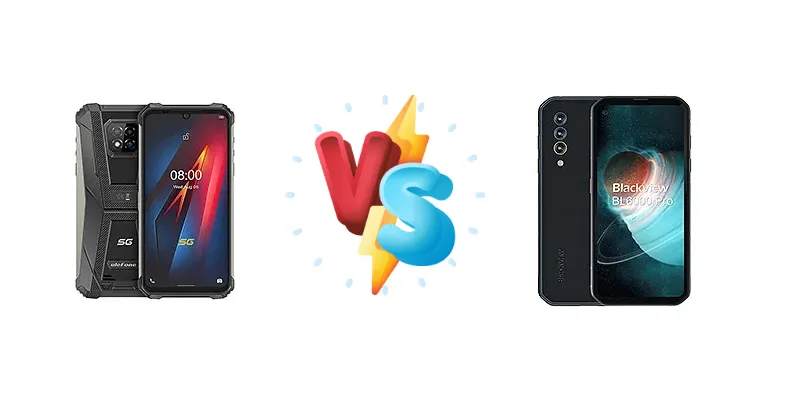
The rugged smartphone market is heating up, offering increasingly capable devices for outdoor enthusiasts and demanding work environments. Both the Ulefone Armor 8 5G and the Blackview BL6000 Pro center around the Mediatek Dimensity 800 chipset, promising 5G connectivity and solid performance. However, key differences in charging capabilities and potentially build quality separate these two contenders, making a direct comparison crucial for informed buyers.
🏆 Quick Verdict
For the average user prioritizing convenience, the Blackview BL6000 Pro emerges as the slightly better choice. The addition of wireless charging, alongside the Dimensity 800, provides a modern feature set that the Ulefone Armor 8 5G lacks. While both offer similar core performance, the BL6000 Pro’s charging versatility is a significant advantage.
| Network |
|---|
| 2G bands | GSM 850 / 900 / 1800 / 1900 | GSM 850 / 900 / 1800 / 1900 |
| 3G bands | HSDPA 850 / 900 / 1700(AWS) / 1900 / 2100 | HSDPA 800 / 850 / 900 / 1700(AWS) / 1900 / 2100 |
| 4G bands | LTE | 1, 2, 3, 4, 5, 7, 8, 12, 13, 17, 18, 19, 20, 25, 26, 28, 34, 38, 39, 40, 41, 66 |
| 5G bands | SA/NSA | 1, 3, 5, 8, 20, 28, 38, 41, 77, 78, 79 SA/NSA |
| Speed | HSPA, LTE, 5G | HSPA, LTE, 5G |
| Technology | GSM / HSPA / LTE / 5G | GSM / CDMA / HSPA / CDMA2000 / LTE / 5G |
| Launch |
|---|
| Announced | 2020, September 21 | 2020, November 17. Released 2020, November |
| Status | Cancelled | Discontinued |
| Body |
|---|
| Build | Front glass, aluminum back with rubber, aluminum frame | - |
| Dimensions | - | 166.7 x 81.3 x 12.8 mm (6.56 x 3.20 x 0.50 in) |
| SIM | Nano-SIM + Nano-SIM | Nano-SIM + Nano-SIM |
| Weight | - | 273 g (9.63 oz) |
| | IP68 dust/water resistant (up to 1.5m for 30 mins)
Drop-to-concrete resistance from up to 1.2 m
MIL-STD-810G compliant | - |
| Display |
|---|
| Protection | Scratch-resistant glass, oleophobic coating | Corning Gorilla Glass 3 |
| Resolution | 720 x 1560 pixels, 19.5:9 ratio (~282 ppi density) | 1080 x 2300 pixels (~400 ppi density) |
| Size | 6.1 inches, 91.3 cm2 | 6.36 inches, 100.4 cm2 (~74.1% screen-to-body ratio) |
| Type | IPS LCD | IPS LCD |
| Platform |
|---|
| CPU | Octa-core (4x2.0 GHz Cortex-A76 & 4x2.0 GHz Cortex-A55) | Octa-core (4x2.0 GHz Cortex-A76 & 4x2.0 GHz Cortex-A55) |
| Chipset | Mediatek Dimensity 800 (7 nm) | Mediatek Dimensity 800 (7 nm) |
| GPU | Mali-G57 MP4 | Mali-G57 MP4 |
| OS | Android 10 | Android 10, upgradable to Android 11 |
| Memory |
|---|
| Card slot | microSDXC (uses shared SIM slot) | No |
| Internal | 256GB 8GB RAM | 258GB 8GB RAM |
| Main Camera |
|---|
| Features | LED flash, Panorama, HDR | LED flash, HDR, panorama |
| Triple | 64 MP, f/1.8, (wide), 1/1.72", 0.8µm, PDAF
2 other unknown cameras | 48 MP, (wide), PDAF
13 MP, 125˚ (ultrawide)
0.3 MP |
| Video | 1080p@30fps | 4K@30fps |
| Selfie camera |
|---|
| Single | - | 16 MP, f/2.0, (wide) |
| Video | - | 1080p@30fps |
| | Unknown camera | - |
| Sound |
|---|
| 3.5mm jack | Yes | - |
| 35mm jack | Yes | No |
| Loudspeaker | Yes | Yes |
| Comms |
|---|
| Bluetooth | Yes | 5.1, A2DP, LE |
| NFC | Yes | Yes |
| Positioning | GPS, GLONASS, GALILEO, BDS | GPS, GLONASS, GALILEO, BDS, QZSS |
| Radio | FM radio, RDS, recording | FM radio |
| USB | USB Type-C 2.0, OTG | USB Type-C 2.0, OTG |
| WLAN | Wi-Fi 802.11 a/b/g/n/ac, Wi-Fi Direct | Wi-Fi 802.11 a/b/g/n/ac |
| Features |
|---|
| Sensors | Fingerprint (side-mounted), accelerometer, gyro, proximity, compass, baroceptor, coulombmeter | Fingerprint (side-mounted), accelerometer, gyro, proximity, compass, barometer |
| Battery |
|---|
| Charging | Wired | 18W wired
Wireless |
| Type | Li-Po 5080 mAh | 5280 mAh |
| Misc |
|---|
| Colors | Black, Orange, Red | Black, Gray, Silver |
| Price | - | About 380 EUR |
Ulefone Armor 8 5G
- Robust build quality expected from Ulefone's rugged line.
- Powered by the capable Mediatek Dimensity 800 chipset.
- Likely a more affordable option compared to the BL6000 Pro.
- Lacks wireless charging, a modern convenience feature.
- Limited information available regarding display quality.
Blackview BL6000 Pro
- Offers both wired (18W) and wireless charging for added convenience.
- Powered by the Mediatek Dimensity 800 chipset for 5G performance.
- Potentially more refined software experience (brand reputation).
- May be slightly more expensive than the Ulefone Armor 8 5G.
- Rugged design may be bulky for some users.
Display Comparison
Both devices are expected to feature similar LCD panels, typical for the rugged segment, prioritizing durability over cutting-edge display technology. Given the lack of specific display specs, it's reasonable to assume both offer adequate outdoor visibility, but neither will compete with flagship OLED displays in terms of color accuracy or contrast. Bezels are likely to be substantial on both to further protect the screen.
Camera Comparison
Without detailed camera specifications, a direct comparison is challenging. Both phones likely employ a multi-camera setup, but the quality will heavily depend on sensor size, lens aperture, and image processing algorithms. It’s probable that both devices include a primary sensor for general photography, an ultrawide lens, and potentially a macro lens. Given the market segment, image processing will likely prioritize clarity and dynamic range over natural color reproduction. The absence of OIS (Optical Image Stabilization) is a likely omission in both models.
Performance
At the heart of both the Ulefone Armor 8 5G and the Blackview BL6000 Pro lies the Mediatek Dimensity 800 (7nm). This octa-core CPU, with its 4x2.0 GHz Cortex-A76 and 4x2.0 GHz Cortex-A55 configuration, delivers comparable processing power. The 7nm process node ensures reasonable thermal efficiency, but sustained workloads in demanding applications will likely result in some throttling. The absence of information regarding RAM type (LPDDR4X vs LPDDR5) or storage speed (UFS 2.1 vs UFS 3.1) makes it difficult to definitively assess performance differences beyond the CPU itself. However, the core processing capability will be nearly identical.
Battery Life
While the exact battery capacities are unknown, the Blackview BL6000 Pro gains a significant advantage with its support for both 18W wired *and* wireless charging. The Ulefone Armor 8 5G is limited to wired charging only. This means the BL6000 Pro offers greater flexibility in how it's powered, particularly for users who frequently use wireless charging pads. The 18W charging speed, while not exceptionally fast, is adequate for topping up the battery overnight. The convenience of wireless charging, however, is a compelling differentiator.
Buying Guide
Buy the Ulefone Armor 8 5G if you need a straightforward, robust 5G rugged phone and prioritize a potentially simpler, more focused design. Buy the Blackview BL6000 Pro if you prefer the added convenience of wireless charging and appreciate a more feature-rich experience, even if it means a slightly higher price point. Both are excellent choices for those needing a durable device, but the BL6000 Pro caters to a user who values modern connectivity options.
Frequently Asked Questions
❓ Will the Dimensity 800 in either phone struggle with demanding games like Genshin Impact?
The Dimensity 800 is a capable mid-range chipset, but Genshin Impact is a particularly demanding title. Expect to play at medium settings with moderate frame rates. Thermal throttling may occur during extended gaming sessions on both devices, potentially reducing performance over time.
❓ How effective is the ruggedization on these phones? Can they survive a drop onto concrete?
Both the Ulefone Armor 8 5G and Blackview BL6000 Pro are built to withstand drops, dust, and water immersion. However, 'rugged' doesn't mean indestructible. While they can likely survive a drop onto concrete from a reasonable height, repeated or severe impacts could still cause damage. Check the specific IP rating (e.g., IP68, IP69K) for detailed protection levels.
❓ Does the Blackview BL6000 Pro's wireless charging work with any Qi-compatible charger?
Yes, the Blackview BL6000 Pro supports standard Qi wireless charging. This means it will work with any Qi-certified wireless charger, offering flexibility in how you power the device. However, charging speeds may vary depending on the wattage of the charger used.