
Ulefone Armor 7 vs. Ulefone Armor 8 Pro: Which Rugged Phone Reigns Supreme?
| Phones Images | |||||
|---|---|---|---|---|---|
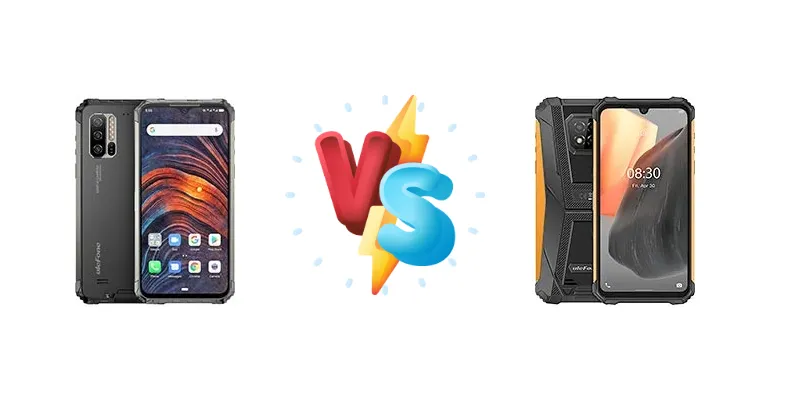
|
🏆 Quick Verdict
For most users prioritizing raw performance and responsiveness, the Ulefone Armor 7 emerges as the better choice. Its Helio P90 chipset, featuring Cortex-A75 cores, provides a noticeable advantage over the Armor 8 Pro’s Helio P60, despite the latter’s slightly newer architecture. However, the Armor 8 Pro may appeal to those seeking a potentially more power-efficient experience.
| PHONES | ||
|---|---|---|
| Phone Names | Ulefone Armor 7 | Ulefone Armor 8 Pro |
| Network | ||
|---|---|---|
| 2G bands | GSM 850 / 900 / 1800 / 1900 | GSM 850 / 900 / 1800 / 1900 |
| 3G bands | HSDPA 850 / 900 / 1700(AWS) / 1900 / 2100 | HSDPA 850 / 900 / 1700(AWS) / 1900 / 2100 |
| 4G bands | 1, 2, 3, 4, 5, 7, 8, 12, 13, 17, 18, 19, 20, 25, 26, 28, 34, 38, 39, 40, 41, 66, 71 | 1, 2, 3, 4, 5, 7, 8, 12, 13, 17, 18, 19, 20, 25, 26, 28, 66 |
| Speed | HSPA 42.2/11.5 Mbps, LTE (2CA) Cat13 600/150 Mbps | HSPA 42.2/11.5 Mbps, LTE Cat7 300/150 Mbps |
| Technology | GSM / CDMA / HSPA / EVDO / LTE | GSM / HSPA / LTE |
| CDMA2000 1xEV-DO | - | |
| Launch | ||
|---|---|---|
| Announced | 2019, October. Released 2019, October | 2021, April 28 |
| Status | Discontinued | Available. Released 2021, April 28 |
| Body | ||
|---|---|---|
| Build | - | Front glass, aluminum back with rubber, aluminum frame |
| Dimensions | 165.9 x 81 x 13.6 mm (6.53 x 3.19 x 0.54 in) | 166 x 81.8 x 15 mm (6.54 x 3.22 x 0.59 in) |
| SIM | Nano-SIM + Nano-SIM | Nano-SIM + Nano-SIM |
| Weight | 290 g (10.23 oz) | 282 g (9.95 oz) |
| IP69K dust/water resistant Drop-to-concrete resistance from up to 1.2m MIL-STD-810G compliant | IP68 dust/water resistant (up to 1.5m for 30 min) Drop-to-concrete resistance from up to 1.2m MIL-STD-810G compliant | |
| Display | ||
|---|---|---|
| Protection | - | Scratch-resistant glass, oleophobic coating |
| Resolution | 1080 x 2340 pixels, 19.5:9 ratio (~409 ppi density) | 720 x 1560 pixels, 19.5:9 ratio (~282 ppi density) |
| Size | 6.3 inches, 97.4 cm2 (~72.5% screen-to-body ratio) | 6.1 inches, 91.3 cm2 (~67.3% screen-to-body ratio) |
| Type | IPS LCD | IPS LCD |
| Platform | ||
|---|---|---|
| CPU | Octa-core (2x2.2 GHz Cortex-A75 & 6x2.0 GHz Cortex-A55) | Octa-core (4x2.0 GHz Cortex-A73 & 4x2.0 GHz Cortex-A53) |
| Chipset | Mediatek MT6779 Helio P90 (12 nm) | Mediatek MT6771 Helio P60 (12 nm) |
| GPU | PowerVR GM9446 | Mali-G72 MP3 |
| OS | Android 9.0 (Pie) | Android 11 |
| Memory | ||
|---|---|---|
| Card slot | microSDXC (uses shared SIM slot) | microSDXC (uses shared SIM slot) |
| Internal | 128GB 8GB RAM | 128GB 6GB RAM, 128GB 8GB RAM |
| Main Camera | ||
|---|---|---|
| Features | 5-LED flash, HDR, panorama | LED flash, Panorama, HDR |
| Single | - | 8 MP, f/2.2 |
| Triple | 48 MP, f/1.7, (wide), 1/2.0", 0.8µm, PDAF 16 MP, f/2.0, (wide), AF 8 MP, f/2.4, (telephoto) | 16 MP, f/2.2, (wide), PDAF 5 MP (macro) Auxiliary lens |
| Video | 4K@30fps, 1080p@30fps | 1080p@30fps |
| Selfie camera | ||
|---|---|---|
| Single | 16 MP, f/2.0, (wide), 1/3.06", 1.0µm | 8 MP, f/2.2 |
| Video | 1080p@30fps | 1080p@30fps |
| Sound | ||
|---|---|---|
| 3.5mm jack | No | Yes |
| 35mm jack | No | Yes |
| Loudspeaker | Yes | Yes |
| Comms | ||
|---|---|---|
| Bluetooth | 5.0, A2DP, LE | 4.2, A2DP, LE |
| NFC | Yes | Yes |
| Positioning | GPS, GLONASS, GALILEO, BDS | GPS, GLONASS, GALILEO, BDS |
| Radio | Stereo FM radio, RDS, recording | FM radio, RDS, recording |
| USB | USB Type-C 2.0, OTG | USB Type-C 2.0, OTG |
| WLAN | Wi-Fi 802.11 a/b/g/n/ac, dual-band, Wi-Fi Direct | Wi-Fi 802.11 a/b/g/n/ac, Wi-Fi Direct |
| Features | ||
|---|---|---|
| Sensors | Fingerprint (side-mounted), accelerometer, gyro, proximity, compass, heart rate, baroceptor, coulombmeter | Fingerprint (side-mounted), accelerometer, gyro, proximity, compass |
| Battery | ||
|---|---|---|
| Charging | 15W wired 10W wireless | 15W wired |
| Type | Li-Po 5500 mAh | Li-Po 5580 mAh |
| Misc | ||
|---|---|---|
| Colors | Black | Black, Orange, Red |
| Price | About 440 EUR | About 190 EUR |
| Tests | ||
|---|---|---|
| Audio quality | Noise -93.6dB / Crosstalk -72.0dB | - |
| Battery life | Endurance rating 140h | - |
| Camera | Photo / Video | - |
| Display | Contrast ratio: 1455:1 (nominal) | - |
| Loudspeaker | -31.6 LUFS (Below average) | - |
| Performance | AnTuTu: 163017 (v7), 216770 (v8) GeekBench: 6913 (v4.4), 1476 (v5.1) GFXBench: 7.5fps (ES 3.1 onscreen) | - |
Ulefone Armor 7
- More powerful Helio P90 processor
- Faster CPU cores (Cortex-A75)
- Higher measured display brightness
- Potentially higher power consumption under load
- No detailed camera specifications
Ulefone Armor 8 Pro
- Potentially better battery efficiency during light use
- Slightly newer chipset architecture (Helio P60)
- 15W wired charging
- Less powerful Helio P60 processor
- Slower CPU cores (Cortex-A73)
- Missing display specifications
Display Comparison
Both the Armor 7 and Armor 8 Pro feature displays designed for outdoor visibility, but the Armor 7 boasts a measured peak brightness of 406 nits and a 1455:1 contrast ratio. While the Armor 8 Pro’s display specifications aren’t provided, the Armor 7’s higher contrast ratio suggests deeper blacks and a more vibrant image. The lack of information on the Armor 8 Pro’s panel makes a direct comparison difficult, but the Armor 7’s measured brightness provides a concrete advantage for use in direct sunlight.
Camera Comparison
Both devices list 'Photo / Video' capabilities, but lack specific details regarding sensor size, aperture, or image processing. Without this information, a meaningful camera comparison is impossible. It’s reasonable to assume both phones target the mid-range camera experience, likely relying on software enhancements to improve image quality. The absence of details suggests neither phone is a standout performer in the camera department.
Performance
The core difference between these two phones lies in their chipsets. The Armor 7 utilizes the Mediatek Helio P90 (12nm), featuring a dual-cluster CPU configuration with two high-performance Cortex-A75 cores clocked at 2.2 GHz and six efficiency-focused Cortex-A55 cores at 2.0 GHz. The Armor 8 Pro, conversely, employs the Helio P60 (12nm) with four Cortex-A73 cores at 2.0 GHz and four Cortex-A53 cores, also at 2.0 GHz. The A75 cores in the P90 offer a significant architectural advantage over the A73 cores in the P60, resulting in faster single-core and multi-core performance. This translates to quicker app loading times, smoother multitasking, and a more responsive user interface on the Armor 7.
Battery Life
The Ulefone Armor 7 boasts an endurance rating of 140 hours, indicating strong battery life. While the Armor 8 Pro’s battery endurance isn’t specified, both phones share the same 15W wired charging and 10W wireless charging capabilities. The Armor 8 Pro’s Helio P60 chipset *may* offer slightly better power efficiency under light loads, potentially extending battery life during basic tasks. However, the Armor 7’s more powerful processor could consume more power during intensive use, negating any efficiency gains from the P60.
Buying Guide
Buy the Ulefone Armor 7 if you need a rugged phone capable of handling demanding tasks like gaming or running multiple apps simultaneously. Its stronger processor will translate to a smoother, more responsive experience. Buy the Ulefone Armor 8 Pro if you prioritize potentially longer battery life during lighter usage scenarios and are less concerned with peak performance. It's a good option for basic communication and essential apps.