
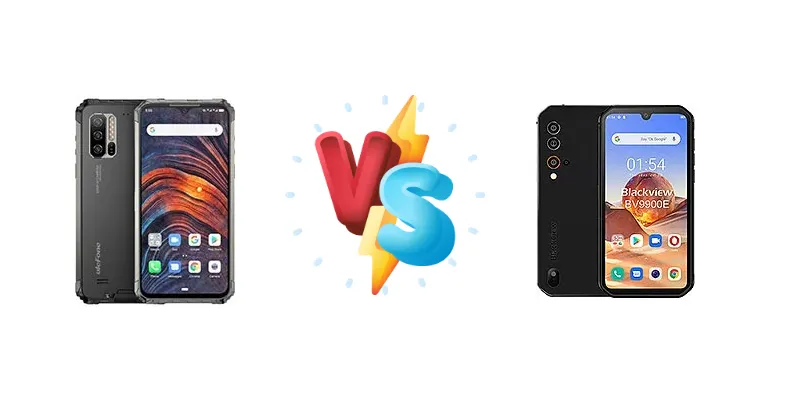
Ulefone Armor 7 vs. Blackview BV9900E: A Head-to-Head Rugged Phone Showdown
| Phones Images | |||||
|---|---|---|---|---|---|
|
🏆 Quick Verdict
For the average user prioritizing wireless charging convenience, the Blackview BV9900E edges out the Ulefone Armor 7. While both offer comparable performance thanks to the Helio P90, the BV9900E’s 18W wireless charging provides a faster top-up, a significant benefit for those frequently relying on this feature.
| PHONES | ||
|---|---|---|
| Phone Names | Ulefone Armor 7 | Blackview BV9900E |
| Network | ||
|---|---|---|
| 2G bands | GSM 850 / 900 / 1800 / 1900 | GSM 850 / 900 / 1800 / 1900 |
| 3G bands | HSDPA 850 / 900 / 1700(AWS) / 1900 / 2100 | HSDPA 800 / 850 / 900 / 1700(AWS) / 1900 / 2100 |
| 4G bands | 1, 2, 3, 4, 5, 7, 8, 12, 13, 17, 18, 19, 20, 25, 26, 28, 34, 38, 39, 40, 41, 66, 71 | 1, 2, 3, 4, 5, 7, 8, 12, 13, 17, 18, 19, 20, 25, 26, 28, 34, 38, 39, 40, 41, 66 |
| Speed | HSPA 42.2/11.5 Mbps, LTE (2CA) Cat13 600/150 Mbps | HSPA, LTE |
| Technology | GSM / CDMA / HSPA / EVDO / LTE | GSM / CDMA / HSPA / CDMA2000 / LTE |
| CDMA2000 1xEV-DO | - | |
| Launch | ||
|---|---|---|
| Announced | 2019, October. Released 2019, October | 2020, September 10. Released 2020, September |
| Status | Discontinued | Discontinued |
| Body | ||
|---|---|---|
| Dimensions | 165.9 x 81 x 13.6 mm (6.53 x 3.19 x 0.54 in) | 156.5 x 78.3 x 14.2 mm (6.16 x 3.08 x 0.56 in) |
| SIM | Nano-SIM + Nano-SIM | Nano-SIM + Nano-SIM |
| Weight | 290 g (10.23 oz) | 273 g (9.63 oz) |
| IP69K dust/water resistant Drop-to-concrete resistance from up to 1.2m MIL-STD-810G compliant | - | |
| Display | ||
|---|---|---|
| Protection | - | Corning Gorilla Glass 5 |
| Resolution | 1080 x 2340 pixels, 19.5:9 ratio (~409 ppi density) | 1080 x 2280 pixels, 19:9 ratio (~432 ppi density) |
| Size | 6.3 inches, 97.4 cm2 (~72.5% screen-to-body ratio) | 5.84 inches, 85.1 cm2 (~69.5% screen-to-body ratio) |
| Type | IPS LCD | IPS LCD |
| Platform | ||
|---|---|---|
| CPU | Octa-core (2x2.2 GHz Cortex-A75 & 6x2.0 GHz Cortex-A55) | Octa-core (2x2.2 GHz Cortex-A75 & 6x2.0 GHz Cortex-A55) |
| Chipset | Mediatek MT6779 Helio P90 (12 nm) | Mediatek MT6779V/CE Helio P90 (12 nm) |
| GPU | PowerVR GM9446 | PowerVR GM9446 |
| OS | Android 9.0 (Pie) | Android 10 |
| Memory | ||
|---|---|---|
| Card slot | microSDXC (uses shared SIM slot) | microSDXC |
| Internal | 128GB 8GB RAM | 128GB 6GB RAM |
| Main Camera | ||
|---|---|---|
| Features | 5-LED flash, HDR, panorama | LED flash, HDR, panorama |
| Quad | - | 48 MP, f/1.8, (wide), PDAF 16 MP, 120˚ (ultrawide) 2 MP (macro) Auxiliary lens |
| Triple | 48 MP, f/1.7, (wide), 1/2.0", 0.8µm, PDAF 16 MP, f/2.0, (wide), AF 8 MP, f/2.4, (telephoto) | - |
| Video | 4K@30fps, 1080p@30fps | 4K@30fps, 1080p@60fps |
| Selfie camera | ||
|---|---|---|
| Single | 16 MP, f/2.0, (wide), 1/3.06", 1.0µm | 16 MP, f/2.0, (wide) |
| Video | 1080p@30fps | 1080p@30fps |
| Sound | ||
|---|---|---|
| 3.5mm jack | No | - |
| 35mm jack | No | No |
| Loudspeaker | Yes | Yes |
| Comms | ||
|---|---|---|
| Bluetooth | 5.0, A2DP, LE | 5.0, A2DP, LE |
| NFC | Yes | Yes |
| Positioning | GPS, GLONASS, GALILEO, BDS | GPS, GLONASS, GALILEO, BDS |
| Radio | Stereo FM radio, RDS, recording | FM radio |
| USB | USB Type-C 2.0, OTG | USB Type-C 2.0, OTG |
| WLAN | Wi-Fi 802.11 a/b/g/n/ac, dual-band, Wi-Fi Direct | Wi-Fi 802.11 a/b/g/n/ac |
| Features | ||
|---|---|---|
| Sensors | Fingerprint (side-mounted), accelerometer, gyro, proximity, compass, heart rate, baroceptor, coulombmeter | Fingerprint (side-mounted), accelerometer, gyro, proximity, compass, barometer |
| Battery | ||
|---|---|---|
| Charging | 15W wired 10W wireless | 15W wired 18W wireless |
| Type | Li-Po 5500 mAh | 4380 mAh |
| Misc | ||
|---|---|---|
| Colors | Black | Black, Silver |
| Price | About 440 EUR | About 260 EUR |
| Tests | ||
|---|---|---|
| Audio quality | Noise -93.6dB / Crosstalk -72.0dB | - |
| Battery life | Endurance rating 140h | - |
| Camera | Photo / Video | - |
| Display | Contrast ratio: 1455:1 (nominal) | - |
| Loudspeaker | -31.6 LUFS (Below average) | - |
| Performance | AnTuTu: 163017 (v7), 216770 (v8) GeekBench: 6913 (v4.4), 1476 (v5.1) GFXBench: 7.5fps (ES 3.1 onscreen) | - |
Ulefone Armor 7
- Potentially better contrast ratio for outdoor visibility
- Established rugged phone brand
- Solid performance from Helio P90
- Slower 10W wireless charging
- Limited display information beyond brightness and contrast
- Camera specs are vague
Blackview BV9900E
- Faster 18W wireless charging
- Helio P90 provides adequate performance
- Competitive price point
- Display specs are unknown
- Camera specs are vague
- May have slightly lower contrast ratio than Armor 7
Display Comparison
Both the Ulefone Armor 7 and Blackview BV9900E lack detailed display specifications beyond the contrast ratio and peak brightness. The Ulefone Armor 7 boasts a measured peak brightness of 406 nits and a 1455:1 contrast ratio. While the BV9900E’s display specs are not provided, the Armor 7’s contrast ratio suggests potentially deeper blacks and more vibrant colors. However, without knowing the BV9900E’s brightness, it’s difficult to definitively say which display performs better in direct sunlight. Both will likely utilize IPS LCD technology, common in this price bracket, offering acceptable viewing angles.
Camera Comparison
Both phones list 'Photo / Video' capabilities, offering minimal insight into camera quality. Without sensor size, aperture, or image processing details, a meaningful comparison is impossible. The presence of a 2MP macro camera on either device is largely irrelevant; these sensors typically produce low-quality images. The primary camera’s performance will depend heavily on the sensor and software optimization, areas where neither manufacturer has a strong reputation. Expect adequate performance in good lighting conditions, but struggles in low light.
Performance
At the heart of both devices lies the Mediatek Helio P90 (12nm). Both phones feature the same CPU configuration: an octa-core setup with two Cortex-A75 cores clocked at 2.2 GHz and six Cortex-A55 cores at 2.0 GHz. This means real-world performance – app loading times, multitasking, and even moderate gaming – will be virtually identical. The lack of information regarding RAM type and speed prevents a deeper analysis, but given the price point, LPDDR4X is the likely standard. Thermal management will be crucial; the Helio P90 is known to throttle under sustained load, and the rugged design may limit passive cooling.
Battery Life
The Ulefone Armor 7 claims an endurance rating of 140 hours, a useful but imprecise metric. Both phones support 15W wired charging. The key differentiator is wireless charging: the Blackview BV9900E supports 18W wireless charging, while the Armor 7 is limited to 10W. This 8W difference translates to significantly faster wireless top-ups for the BV9900E, making it more convenient for users who frequently utilize wireless charging. While battery capacity isn’t specified, the endurance rating suggests similar real-world usage times, with the BV9900E potentially benefiting from faster wireless replenishment.
Buying Guide
Buy the Ulefone Armor 7 if you prioritize a slightly higher contrast ratio for potentially better outdoor visibility and are content with 15W wireless charging. Buy the Blackview BV9900E if you value faster wireless charging speeds (18W) and are willing to potentially trade a small amount of contrast for that convenience. Both are excellent choices for construction workers, outdoor enthusiasts, or anyone needing a phone that can withstand harsh conditions.