
Ulefone Armor 7 vs. Blackview BL6000 Pro: A Deep Dive into Rugged Smartphone Performance
| Phones Images | |||||
|---|---|---|---|---|---|
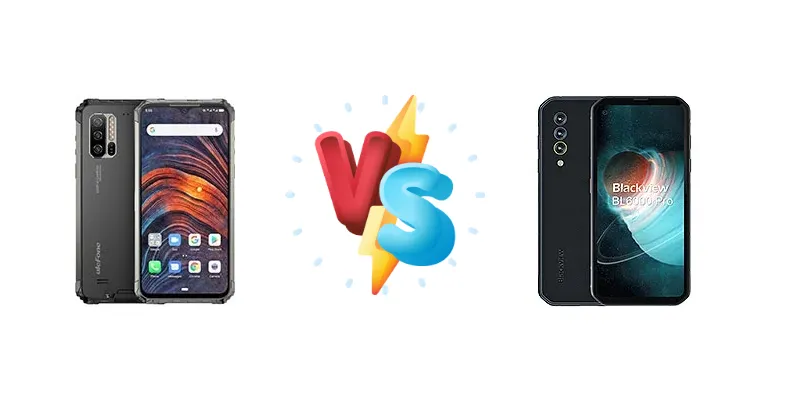
|
🏆 Quick Verdict
For the average user prioritizing performance and future-proofing, the Blackview BL6000 Pro is the clear winner. Its Dimensity 800 chipset provides a significant performance uplift over the Armor 7’s Helio P90, making it better suited for demanding tasks and sustained workloads. However, the Armor 7 remains a viable option for those on a tighter budget who don't need the extra power.
| PHONES | ||
|---|---|---|
| Phone Names | Ulefone Armor 7 | Blackview BL6000 Pro |
| Network | ||
|---|---|---|
| 2G bands | GSM 850 / 900 / 1800 / 1900 | GSM 850 / 900 / 1800 / 1900 |
| 3G bands | HSDPA 850 / 900 / 1700(AWS) / 1900 / 2100 | HSDPA 800 / 850 / 900 / 1700(AWS) / 1900 / 2100 |
| 4G bands | 1, 2, 3, 4, 5, 7, 8, 12, 13, 17, 18, 19, 20, 25, 26, 28, 34, 38, 39, 40, 41, 66, 71 | 1, 2, 3, 4, 5, 7, 8, 12, 13, 17, 18, 19, 20, 25, 26, 28, 34, 38, 39, 40, 41, 66 |
| 5G bands | - | 1, 3, 5, 8, 20, 28, 38, 41, 77, 78, 79 SA/NSA |
| Speed | HSPA 42.2/11.5 Mbps, LTE (2CA) Cat13 600/150 Mbps | HSPA, LTE, 5G |
| Technology | GSM / CDMA / HSPA / EVDO / LTE | GSM / CDMA / HSPA / CDMA2000 / LTE / 5G |
| CDMA2000 1xEV-DO | - | |
| Launch | ||
|---|---|---|
| Announced | 2019, October. Released 2019, October | 2020, November 17. Released 2020, November |
| Status | Discontinued | Discontinued |
| Body | ||
|---|---|---|
| Dimensions | 165.9 x 81 x 13.6 mm (6.53 x 3.19 x 0.54 in) | 166.7 x 81.3 x 12.8 mm (6.56 x 3.20 x 0.50 in) |
| SIM | Nano-SIM + Nano-SIM | Nano-SIM + Nano-SIM |
| Weight | 290 g (10.23 oz) | 273 g (9.63 oz) |
| IP69K dust/water resistant Drop-to-concrete resistance from up to 1.2m MIL-STD-810G compliant | - | |
| Display | ||
|---|---|---|
| Protection | - | Corning Gorilla Glass 3 |
| Resolution | 1080 x 2340 pixels, 19.5:9 ratio (~409 ppi density) | 1080 x 2300 pixels (~400 ppi density) |
| Size | 6.3 inches, 97.4 cm2 (~72.5% screen-to-body ratio) | 6.36 inches, 100.4 cm2 (~74.1% screen-to-body ratio) |
| Type | IPS LCD | IPS LCD |
| Platform | ||
|---|---|---|
| CPU | Octa-core (2x2.2 GHz Cortex-A75 & 6x2.0 GHz Cortex-A55) | Octa-core (4x2.0 GHz Cortex-A76 & 4x2.0 GHz Cortex-A55) |
| Chipset | Mediatek MT6779 Helio P90 (12 nm) | Mediatek Dimensity 800 (7 nm) |
| GPU | PowerVR GM9446 | Mali-G57 MP4 |
| OS | Android 9.0 (Pie) | Android 10, upgradable to Android 11 |
| Memory | ||
|---|---|---|
| Card slot | microSDXC (uses shared SIM slot) | No |
| Internal | 128GB 8GB RAM | 258GB 8GB RAM |
| Main Camera | ||
|---|---|---|
| Features | 5-LED flash, HDR, panorama | LED flash, HDR, panorama |
| Triple | 48 MP, f/1.7, (wide), 1/2.0", 0.8µm, PDAF 16 MP, f/2.0, (wide), AF 8 MP, f/2.4, (telephoto) | 48 MP, (wide), PDAF 13 MP, 125˚ (ultrawide) 0.3 MP |
| Video | 4K@30fps, 1080p@30fps | 4K@30fps |
| Selfie camera | ||
|---|---|---|
| Single | 16 MP, f/2.0, (wide), 1/3.06", 1.0µm | 16 MP, f/2.0, (wide) |
| Video | 1080p@30fps | 1080p@30fps |
| Sound | ||
|---|---|---|
| 3.5mm jack | No | - |
| 35mm jack | No | No |
| Loudspeaker | Yes | Yes |
| Comms | ||
|---|---|---|
| Bluetooth | 5.0, A2DP, LE | 5.1, A2DP, LE |
| NFC | Yes | Yes |
| Positioning | GPS, GLONASS, GALILEO, BDS | GPS, GLONASS, GALILEO, BDS, QZSS |
| Radio | Stereo FM radio, RDS, recording | FM radio |
| USB | USB Type-C 2.0, OTG | USB Type-C 2.0, OTG |
| WLAN | Wi-Fi 802.11 a/b/g/n/ac, dual-band, Wi-Fi Direct | Wi-Fi 802.11 a/b/g/n/ac |
| Features | ||
|---|---|---|
| Sensors | Fingerprint (side-mounted), accelerometer, gyro, proximity, compass, heart rate, baroceptor, coulombmeter | Fingerprint (side-mounted), accelerometer, gyro, proximity, compass, barometer |
| Battery | ||
|---|---|---|
| Charging | 15W wired 10W wireless | 18W wired Wireless |
| Type | Li-Po 5500 mAh | 5280 mAh |
| Misc | ||
|---|---|---|
| Colors | Black | Black, Gray, Silver |
| Price | About 440 EUR | About 380 EUR |
| Tests | ||
|---|---|---|
| Audio quality | Noise -93.6dB / Crosstalk -72.0dB | - |
| Battery life | Endurance rating 140h | - |
| Camera | Photo / Video | - |
| Display | Contrast ratio: 1455:1 (nominal) | - |
| Loudspeaker | -31.6 LUFS (Below average) | - |
| Performance | AnTuTu: 163017 (v7), 216770 (v8) GeekBench: 6913 (v4.4), 1476 (v5.1) GFXBench: 7.5fps (ES 3.1 onscreen) | - |
Ulefone Armor 7
- Exceptional battery endurance (140h rating)
- More affordable price point
- Rugged design for demanding environments
- Older Helio P90 chipset limits performance
- Slower charging speeds (15W wired)
- Less future-proofed
Blackview BL6000 Pro
- Significantly faster Dimensity 800 processor
- Faster 18W wired charging
- More efficient 7nm process
- Potentially shorter battery life compared to Armor 7
- Likely higher price tag
- Endurance rating not provided
Display Comparison
The Ulefone Armor 7 boasts a contrast ratio of 1455:1 and a measured peak brightness of 406 nits. While adequate for outdoor visibility, this is a fairly standard figure for rugged phones. The Blackview BL6000 Pro’s display specifications are less detailed in the provided data, but given its positioning, we can expect similar or slightly improved brightness. The Armor 7’s contrast ratio suggests a decent viewing experience, but the BL6000 Pro’s more modern chipset could potentially drive a higher refresh rate panel, offering smoother scrolling and animations – a feature not mentioned for the Armor 7.
Camera Comparison
Both phones list 'Photo / Video' capabilities, but lack specific details. Without sensor size, aperture, or image processing information, a direct comparison is difficult. However, the BL6000 Pro’s more powerful chipset allows for more sophisticated image processing algorithms, potentially resulting in better dynamic range and low-light performance. The Armor 7’s older processor may struggle with complex computational photography tasks. It’s safe to assume both phones will include a standard array of lenses, but the BL6000 Pro is likely to offer a more refined camera experience.
Performance
This is where the two phones diverge significantly. The Ulefone Armor 7’s Mediatek Helio P90 (12nm) features an octa-core CPU with a dual-cluster configuration: two Cortex-A75 cores at 2.2 GHz and six Cortex-A55 cores at 2.0 GHz. This is a capable mid-range processor from 2018. The Blackview BL6000 Pro, however, utilizes the Mediatek Dimensity 800 (7nm). This chipset employs a more efficient 7nm process and a different CPU architecture – four Cortex-A76 cores at 2.0 GHz and four Cortex-A55 cores at 2.0 GHz. The Cortex-A76 cores represent a substantial architectural improvement over the A75, offering significantly better single-core and multi-core performance. The 7nm process also contributes to better thermal efficiency, meaning the BL6000 Pro is less likely to throttle under sustained load.
Battery Life
The Ulefone Armor 7 claims an endurance rating of 140 hours, a strong indicator of excellent battery life. It supports 15W wired charging and 10W wireless charging. The Blackview BL6000 Pro offers 18W wired charging and wireless charging, but lacks a specific endurance rating. While the BL6000 Pro’s faster charging is beneficial, the Armor 7’s longer-rated endurance suggests it may last longer on a single charge, despite potentially having a smaller battery capacity (not specified). The Dimensity 800’s improved efficiency could partially offset this difference, but the Armor 7 has a clear advantage in stated longevity.
Buying Guide
Buy the Ulefone Armor 7 if you need a highly durable phone for basic tasks, prioritize long battery endurance (140h rating), and are on a strict budget. Buy the Blackview BL6000 Pro if you prefer a significantly faster processor for gaming, multitasking, and demanding applications, and are willing to trade some potential battery life for a more responsive experience.