
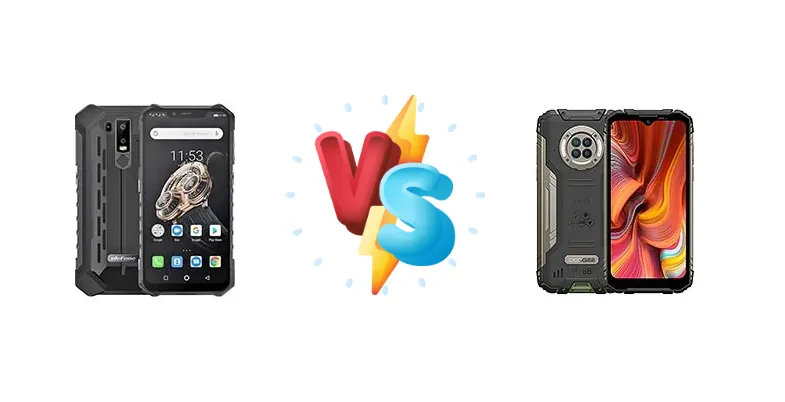
Ulefone Armor 6S vs. Doogee S96 Pro: A Deep Dive into Rugged Smartphone Performance
| Phones Images | |||||
|---|---|---|---|---|---|
|
🏆 Quick Verdict
For the average user prioritizing raw performance and faster charging, the Doogee S96 Pro is the clear winner. Its Helio G90 chipset offers a significant upgrade over the Armor 6S’s Helio P70, translating to smoother multitasking and gaming. However, the Armor 6S remains a viable option for those on a tighter budget who don't demand peak performance.
| PHONES | ||
|---|---|---|
| Phone Names | Ulefone Armor 6S | Doogee S96 Pro |
| Network | ||
|---|---|---|
| 2G bands | GSM 850 / 900 / 1800 / 1900 | GSM 850 / 900 / 1800 / 1900 |
| 3G bands | HSDPA 850 / 900 / 1700(AWS) / 1900 / 2100 | HSDPA 800 / 850 / 900 / 1700(AWS) / 1900 / 2100 |
| 4G bands | 1, 2, 3, 4, 5, 7, 8, 12, 13, 17, 18, 19, 20, 25, 26, 28, 34, 38, 39, 40, 41, 66 | 1, 2, 3, 4, 5, 7, 8, 12, 13, 17, 18, 19, 20, 25, 26, 28, 38, 40, 66 |
| Speed | HSPA 42.2/11.5 Mbps, LTE (2CA) Cat7 300/150 Mbps | HSPA, LTE |
| Technology | GSM / CDMA / HSPA / EVDO / LTE | GSM / CDMA / HSPA / LTE |
| CDMA2000 1xEV-DO | - | |
| Launch | ||
|---|---|---|
| Announced | 2019, September. Released 2019, October | 2020, October 26. Released 2020, November |
| Status | Discontinued | Discontinued |
| Body | ||
|---|---|---|
| Dimensions | 166 x 83 x 13.3 mm (6.54 x 3.27 x 0.52 in) | 167 x 81.4 x 15.5 mm (6.57 x 3.20 x 0.61 in) |
| SIM | Nano-SIM + Nano-SIM | Nano-SIM + Nano-SIM |
| Weight | 270 g (9.52 oz) | 310 g (10.93 oz) |
| IP68 dust/water resistant (up to 1.5m for 30 min) Drop-to-concrete resistance from up to 1.2m MIL-STD-810G compliant | - | |
| Display | ||
|---|---|---|
| Protection | - | Corning Gorilla Glass |
| Resolution | 1080 x 2246 pixels, 18.7:9 ratio (~402 ppi density) | 720 x 1520 pixels, 19:9 ratio (~270 ppi density) |
| Size | 6.2 inches, 96.9 cm2 (~70.3% screen-to-body ratio) | 6.22 inches, 96.6 cm2 (~71.0% screen-to-body ratio) |
| Type | IPS LCD | IPS LCD |
| Platform | ||
|---|---|---|
| CPU | Octa-core (4x2.1 GHz Cortex-A73 & 4x2.1 GHz Cortex-A53) | Octa-core (2x2.0 GHz Cortex-A76 & 6x2.0 GHz Cortex-A55) |
| Chipset | Mediatek MT6771 Helio P70 (12 nm) | Mediatek MT6785 Helio G90 (12 nm) |
| GPU | Mali-G72 MP3 | Mali-G76 MC4 |
| OS | Android 9.0 (Pie) | Android 10 |
| Memory | ||
|---|---|---|
| Card slot | microSDXC (uses shared SIM slot) | microSDXC (dedicated slot) |
| Internal | 128GB 6GB RAM | 128GB 8GB RAM |
| eMMC 5.1 | - | |
| Main Camera | ||
|---|---|---|
| Dual | 16 MP, f/2.0, (wide), AF 8 MP | - |
| Features | Dual-LED flash, HDR, panorama | Quad-LED flash, HDR, panorama |
| Quad | - | 48 MP, f/1.8, (wide), PDAF 8 MP, f/2.2, 130˚, (ultrawide) 20 MP, f/2.8, (night vision), 4 infrared night vision lights 2 MP (macro) |
| Video | 1080p@30fps | 1080p |
| Selfie camera | ||
|---|---|---|
| Single | 8 MP | 16 MP, f/2.0, (wide) |
| Video | 1080p@30fps | 1080p |
| Sound | ||
|---|---|---|
| 3.5mm jack | No | - |
| 35mm jack | No | Yes |
| Loudspeaker | Yes | Yes |
| Comms | ||
|---|---|---|
| Bluetooth | 4.2, A2DP, LE | 5.0, A2DP, LE |
| NFC | Yes | Yes |
| Positioning | GPS, GLONASS, BDS | GPS, GLONASS, BDS, GALILEO |
| Radio | Stereo FM radio, RDS, recording | FM radio |
| USB | USB Type-C 2.0, OTG | USB Type-C 2.0, OTG |
| WLAN | Wi-Fi 802.11 a/b/g/n/ac, dual-band, Wi-Fi Direct | Wi-Fi 802.11 a/b/g/n/ac, dual-band |
| Features | ||
|---|---|---|
| Sensors | Fingerprint (rear-mounted), accelerometer, gyro, proximity, compass, baroceptor, uv sensor | Fingerprint (side-mounted), accelerometer, gyro, proximity, compass |
| Battery | ||
|---|---|---|
| Charging | 18W wired 10W wireless | 24W wired 10W wireless |
| Type | Li-Po 5000 mAh | 6350 mAh |
| Misc | ||
|---|---|---|
| Colors | Black/Red | Black, Orange, Green |
| Price | - | About 280 EUR |
Ulefone Armor 6S
- More affordable price point
- Rugged design for durability
- Wireless charging support
- Less powerful processor
- Slower charging speeds
Doogee S96 Pro
- Significantly faster processor
- Faster wired charging (24W)
- Improved multitasking capabilities
- Higher price tag
- Potentially larger size due to more powerful components
Display Comparison
Neither Ulefone nor Doogee provide detailed display specifications beyond the basic panel type. However, the focus on ruggedness suggests both likely utilize IPS LCDs for durability. The lack of high refresh rates is expected in this segment. The real difference lies in the processing power driving the display; the G90 in the S96 Pro will handle UI elements and graphics rendering more smoothly than the P70 in the Armor 6S.
Camera Comparison
Detailed camera specs are absent from the provided data. However, given the market positioning, it’s reasonable to assume both phones feature multi-camera setups. The focus for both will likely be on providing functional, rather than flagship-level, photography. The S96 Pro’s more powerful chipset could translate to faster image processing and potentially better low-light performance, but without sensor size or aperture information, it’s difficult to make a definitive claim. The inclusion of a 2MP macro lens on either device is likely a marketing feature with limited real-world utility.
Performance
The core difference between these two phones is the chipset. The Doogee S96 Pro’s MediaTek Helio G90 (12nm) represents a substantial leap over the Ulefone Armor 6S’s Helio P70 (12nm). The G90 features a more modern CPU architecture – 2x2.0 GHz Cortex-A76 cores alongside 6x2.0 GHz Cortex-A55 cores – compared to the P70’s 4x2.1 GHz Cortex-A73 and 4x2.1 GHz Cortex-A53 configuration. The Cortex-A76 cores in the G90 offer significantly improved single-core performance, crucial for responsive app launches and general UI fluidity. While both are 12nm chips, the G90’s architecture is more efficient, potentially leading to better sustained performance under load. This benefits users who play mobile games or use demanding applications.
Battery Life
Both devices support 10W wireless charging, indicating a similar approach to convenience. However, the Doogee S96 Pro’s 24W wired charging is a significant advantage over the Ulefone Armor 6S’s 18W wired charging. This faster charging speed will drastically reduce the time needed to replenish the battery, crucial for users who rely on their phone throughout the day and don’t have extended periods to charge. While battery capacity isn’t specified, the faster charging of the S96 Pro effectively mitigates any potential disadvantage from a slightly smaller battery.
Buying Guide
Buy the Ulefone Armor 6S if you need a highly durable smartphone for basic tasks, prioritize affordability, and aren't heavily reliant on demanding applications. Buy the Doogee S96 Pro if you prefer a more responsive user experience, frequently engage in gaming or resource-intensive apps, and value faster charging speeds for extended field use.