
Ulefone Armor 6S vs Blackview BV9800 Pro: Which Rugged Phone Reigns Supreme?
| Phones Images | |||||
|---|---|---|---|---|---|
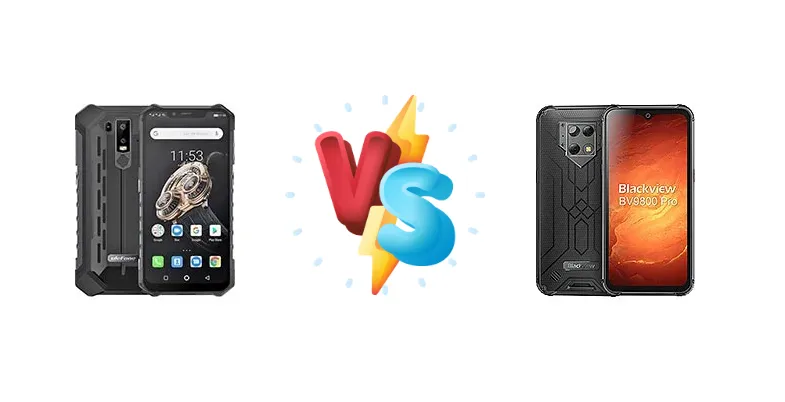
|
🏆 Quick Verdict
For the average user prioritizing consistent performance and a slightly more refined wireless charging experience, the Ulefone Armor 6S emerges as the better choice. While both phones share the same core chipset, the Armor 6S’s 10W wireless charging provides a convenient top-up option absent on the BV9800 Pro.
| PHONES | ||
|---|---|---|
| Phone Names | Ulefone Armor 6S | Blackview BV9800 Pro |
| Network | ||
|---|---|---|
| 2G bands | GSM 850 / 900 / 1800 / 1900 | GSM 850 / 900 / 1800 / 1900 |
| 3G bands | HSDPA 850 / 900 / 1700(AWS) / 1900 / 2100 | HSDPA 800 / 850 / 900 / 1700(AWS) / 1900 / 2100 |
| 4G bands | 1, 2, 3, 4, 5, 7, 8, 12, 13, 17, 18, 19, 20, 25, 26, 28, 34, 38, 39, 40, 41, 66 | 1, 2, 3, 4, 5, 6, 7, 8, 12, 13, 17, 18, 19, 20, 25, 26, 28, 34, 38, 39, 40, 41, 66 |
| Speed | HSPA 42.2/11.5 Mbps, LTE (2CA) Cat7 300/150 Mbps | HSPA, LTE |
| Technology | GSM / CDMA / HSPA / EVDO / LTE | GSM / CDMA / HSPA / CDMA2000 / LTE |
| CDMA2000 1xEV-DO | - | |
| Launch | ||
|---|---|---|
| Announced | 2019, September. Released 2019, October | 2019, October 28. Released 2019, November |
| Status | Discontinued | Discontinued |
| Body | ||
|---|---|---|
| Dimensions | 166 x 83 x 13.3 mm (6.54 x 3.27 x 0.52 in) | 168.5 x 81 x 14.8 mm (6.63 x 3.19 x 0.58 in) |
| SIM | Nano-SIM + Nano-SIM | Nano-SIM + Nano-SIM |
| Weight | 270 g (9.52 oz) | 322 g (11.36 oz) |
| IP68 dust/water resistant (up to 1.5m for 30 min) Drop-to-concrete resistance from up to 1.2m MIL-STD-810G compliant | - | |
| Display | ||
|---|---|---|
| Resolution | 1080 x 2246 pixels, 18.7:9 ratio (~402 ppi density) | 1080 x 2340 pixels, 19.5:9 ratio (~409 ppi density) |
| Size | 6.2 inches, 96.9 cm2 (~70.3% screen-to-body ratio) | 6.3 inches, 97.4 cm2 (~71.4% screen-to-body ratio) |
| Type | IPS LCD | IPS LCD |
| Platform | ||
|---|---|---|
| CPU | Octa-core (4x2.1 GHz Cortex-A73 & 4x2.1 GHz Cortex-A53) | Octa-core (4x2.1 GHz Cortex-A73 & 4x2.0 GHz Cortex-A53) |
| Chipset | Mediatek MT6771 Helio P70 (12 nm) | Mediatek MT6771V/CT Helio P70 (12 nm) |
| GPU | Mali-G72 MP3 | Mali-G72 MP3 |
| OS | Android 9.0 (Pie) | Android 9.0 (Pie) |
| Memory | ||
|---|---|---|
| Card slot | microSDXC (uses shared SIM slot) | microSDXC |
| Internal | 128GB 6GB RAM | 128GB 6GB RAM |
| eMMC 5.1 | - | |
| Main Camera | ||
|---|---|---|
| Dual | 16 MP, f/2.0, (wide), AF 8 MP | - |
| Features | Dual-LED flash, HDR, panorama | Thermal imaging, LED flash |
| Triple | - | 48 MP, (wide), PDAF 5 MP, thermal assisted camera FLIR thermal camera (Lepton module) |
| Video | 1080p@30fps | 1080p@30fps |
| Selfie camera | ||
|---|---|---|
| Single | 8 MP | 16 MP, f/2.0, (wide) |
| Video | 1080p@30fps | 1080p@30fps |
| Sound | ||
|---|---|---|
| 3.5mm jack | No | - |
| 35mm jack | No | Yes |
| Loudspeaker | Yes | Yes |
| Comms | ||
|---|---|---|
| Bluetooth | 4.2, A2DP, LE | 4.1, A2DP |
| NFC | Yes | Yes |
| Positioning | GPS, GLONASS, BDS | GPS, GLONASS, GALILEO |
| Radio | Stereo FM radio, RDS, recording | FM radio |
| USB | USB Type-C 2.0, OTG | USB Type-C 2.0, OTG |
| WLAN | Wi-Fi 802.11 a/b/g/n/ac, dual-band, Wi-Fi Direct | Wi-Fi 802.11 a/b/g/n/ac |
| Features | ||
|---|---|---|
| Sensors | Fingerprint (rear-mounted), accelerometer, gyro, proximity, compass, baroceptor, uv sensor | Fingerprint (side-mounted), accelerometer, gyro, proximity, compass, barometer |
| Battery | ||
|---|---|---|
| Charging | 18W wired 10W wireless | 18W wired |
| Type | Li-Po 5000 mAh | 6580 mAh |
| Misc | ||
|---|---|---|
| Colors | Black/Red | Black, Orange |
| Price | - | About 340 EUR |
Ulefone Armor 6S
- Includes 10W wireless charging for added convenience.
- Slightly higher Cortex-A53 CPU clock speed (2.1 GHz).
- Potentially more refined software optimization.
- May be slightly more expensive than the BV9800 Pro.
- Limited information available on display specifications.
Blackview BV9800 Pro
- Potentially lower price point.
- Robust build quality expected from Blackview.
- Solid performance from the Helio P70 chipset.
- Lacks wireless charging capability.
- Slightly lower Cortex-A53 CPU clock speed (2.0 GHz).
Display Comparison
Both devices are expected to feature similar LCD panels, typical for the rugged segment, prioritizing visibility and durability over cutting-edge display technology. Specifics like resolution and peak brightness are not provided, but we can assume they are geared towards outdoor usability. The lack of information regarding PWM dimming rates is a concern, as lower rates can cause eye strain for sensitive users. Bezels are likely to be substantial on both, prioritizing structural integrity over a modern, edge-to-edge aesthetic.
Camera Comparison
Camera details are sparse, but the focus should be on practical image capture in challenging conditions, not high megapixel counts. Without sensor size or aperture information, it’s difficult to assess image quality. The Helio P70’s ISP is capable, but relies heavily on software processing. Expect decent performance in good lighting, but potential struggles in low-light scenarios. The inclusion of a 2MP macro camera on both devices is largely a marketing tactic, offering limited practical benefit due to the small sensor size and lack of optical image stabilization (OIS).
Performance
At the heart of both the Ulefone Armor 6S and Blackview BV9800 Pro lies the MediaTek Helio P70 (12nm). The CPU configuration is nearly identical – an octa-core setup with 4x2.1 GHz Cortex-A73 and 4x2.0/2.1 GHz Cortex-A53 cores. The slight difference in Cortex-A53 clock speed (2.0 GHz on the BV9800 Pro vs 2.1 GHz on the Armor 6S) is unlikely to translate to a noticeable real-world performance difference. Thermal management will be crucial; the 12nm process node, while efficient, can still generate heat under sustained load. The lack of information on RAM type and speed limits our ability to assess multitasking performance, but both likely utilize LPDDR4X to balance cost and efficiency.
Battery Life
Both phones offer 18W wired charging, a reasonable speed for this segment. The Armor 6S distinguishes itself with 10W wireless charging, a convenient feature for users who prefer cable-free top-ups. Battery capacity is not specified, but rugged phones typically prioritize larger batteries for extended use in the field. The 18W charging speed suggests a full charge will take approximately 2-3 hours, depending on battery size. Wireless charging, while slower, provides a valuable alternative when access to a power outlet is limited.
Buying Guide
Buy the Ulefone Armor 6S if you need a reliable, durable phone with the added convenience of wireless charging and are comfortable with a slightly less aggressive price point. Buy the Blackview BV9800 Pro if you prioritize a potentially lower cost of entry and don't anticipate frequently using wireless charging, focusing instead on core rugged functionality.