
Ulefone Armor 6E vs. Ulefone Armor 8 Pro: A Deep Dive into Rugged Performance
| Phones Images | |||||
|---|---|---|---|---|---|
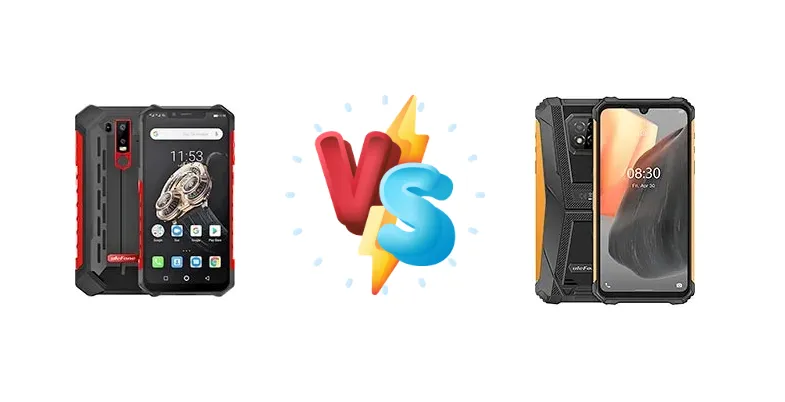
|
🏆 Quick Verdict
For most users prioritizing consistent performance and slightly faster charging, the Ulefone Armor 6E emerges as the better choice. Its Helio P70 chipset, while a generation older, offers a marginal CPU performance advantage. However, the Armor 8 Pro remains a viable option for those seeking wireless charging.
| PHONES | ||
|---|---|---|
| Phone Names | Ulefone Armor 6E | Ulefone Armor 8 Pro |
| Network | ||
|---|---|---|
| 2G bands | GSM 850 / 900 / 1800 / 1900 | GSM 850 / 900 / 1800 / 1900 |
| 3G bands | HSDPA 850 / 900 / 1700(AWS) / 1900 / 2100 | HSDPA 850 / 900 / 1700(AWS) / 1900 / 2100 |
| 4G bands | 1, 2, 3, 4, 5, 7, 8, 12, 17, 18, 19, 20, 25, 26, 28, 66, 34, 38, 39, 40, 41 | 1, 2, 3, 4, 5, 7, 8, 12, 13, 17, 18, 19, 20, 25, 26, 28, 66 |
| Speed | HSPA 42.2/11.5 Mbps, LTE (2CA) Cat7 300/150 Mbps | HSPA 42.2/11.5 Mbps, LTE Cat7 300/150 Mbps |
| Technology | GSM / CDMA / HSPA / EVDO / LTE | GSM / HSPA / LTE |
| CDMA2000 1xEV-DO | - | |
| Launch | ||
|---|---|---|
| Announced | 2019, May. Released 2019, May | 2021, April 28 |
| Status | Discontinued | Available. Released 2021, April 28 |
| Body | ||
|---|---|---|
| Build | - | Front glass, aluminum back with rubber, aluminum frame |
| Dimensions | 166 x 83 x 13.3 mm (6.54 x 3.27 x 0.52 in) | 166 x 81.8 x 15 mm (6.54 x 3.22 x 0.59 in) |
| SIM | Nano-SIM + Nano-SIM | Nano-SIM + Nano-SIM |
| Weight | 267.5 g (9.45 oz) | 282 g (9.95 oz) |
| IP68 dust/water resistant (up to 1.5m for 30 min) Drop-to-concrete resistance from up to 1.2m MIL-STD-810G compliant | IP68 dust/water resistant (up to 1.5m for 30 min) Drop-to-concrete resistance from up to 1.2m MIL-STD-810G compliant | |
| Display | ||
|---|---|---|
| Protection | - | Scratch-resistant glass, oleophobic coating |
| Resolution | 1080 x 2246 pixels, 18.7:9 ratio (~402 ppi density) | 720 x 1560 pixels, 19.5:9 ratio (~282 ppi density) |
| Size | 6.2 inches, 96.9 cm2 (~70.3% screen-to-body ratio) | 6.1 inches, 91.3 cm2 (~67.3% screen-to-body ratio) |
| Type | IPS LCD | IPS LCD |
| Platform | ||
|---|---|---|
| CPU | Octa-core (4x2.1 GHz Cortex-A73 & 4x2.1 GHz Cortex-A53) | Octa-core (4x2.0 GHz Cortex-A73 & 4x2.0 GHz Cortex-A53) |
| Chipset | Mediatek MT6771 Helio P70 (12 nm) | Mediatek MT6771 Helio P60 (12 nm) |
| GPU | Mali-G72 MP3 | Mali-G72 MP3 |
| OS | Android 9.0 (Pie) | Android 11 |
| Memory | ||
|---|---|---|
| Card slot | microSDXC (uses shared SIM slot) | microSDXC (uses shared SIM slot) |
| Internal | 64GB 4GB RAM | 128GB 6GB RAM, 128GB 8GB RAM |
| eMMC 5.1 | - | |
| Main Camera | ||
|---|---|---|
| Dual | 16 MP, f/1.8, (wide), AF 2 MP | - |
| Features | LED flash, HDR, panorama | LED flash, Panorama, HDR |
| Single | - | 8 MP, f/2.2 |
| Triple | - | 16 MP, f/2.2, (wide), PDAF 5 MP (macro) Auxiliary lens |
| Video | 1080p@30fps | 1080p@30fps |
| Selfie camera | ||
|---|---|---|
| Single | 8 MP | 8 MP, f/2.2 |
| Video | 1080p@30fps | 1080p@30fps |
| Sound | ||
|---|---|---|
| 3.5mm jack | No | Yes |
| 35mm jack | No | Yes |
| Loudspeaker | Yes | Yes |
| Comms | ||
|---|---|---|
| Bluetooth | 4.2, A2DP, LE | 4.2, A2DP, LE |
| NFC | Yes | Yes |
| Positioning | GPS, GLONASS, BDS | GPS, GLONASS, GALILEO, BDS |
| Radio | Stereo FM radio, RDS, recording | FM radio, RDS, recording |
| USB | USB Type-C 2.0, OTG | USB Type-C 2.0, OTG |
| WLAN | Wi-Fi 802.11 a/b/g/n/ac, dual-band, Wi-Fi Direct | Wi-Fi 802.11 a/b/g/n/ac, Wi-Fi Direct |
| Features | ||
|---|---|---|
| Sensors | Fingerprint (rear-mounted), accelerometer, gyro, proximity, compass, baroceptor, uv sensor | Fingerprint (side-mounted), accelerometer, gyro, proximity, compass |
| Battery | ||
|---|---|---|
| Charging | 18W wired 10W wireless | 15W wired |
| Type | Li-Po 5000 mAh | Li-Po 5580 mAh |
| Misc | ||
|---|---|---|
| Colors | Black, Red | Black, Orange, Red |
| Price | - | About 190 EUR |
Ulefone Armor 6E
- Slightly faster CPU performance with the Helio P70.
- Faster 18W wired charging.
- Offers both wired and 10W wireless charging.
- May be harder to find as newer models are released.
- Lacks the wireless charging convenience of the Armor 8 Pro.
Ulefone Armor 8 Pro
- Convenience of wireless charging.
- Potentially more readily available.
- Slightly more modern chipset (though performance is similar).
- Slower 15W wired charging.
- Marginally lower CPU performance compared to the Armor 6E.
Display Comparison
Neither Ulefone provides detailed display specifications beyond the basic panel type. Given the target market, both likely utilize IPS LCDs prioritizing durability and visibility in direct sunlight over color accuracy. Without nit brightness or color gamut data, a direct comparison is impossible. However, the focus on ruggedness suggests both displays are likely protected by Gorilla Glass or a similar toughened material.
Camera Comparison
Detailed camera specifications are absent. Given the price point and rugged phone segment, expect competent but not exceptional camera performance. The focus is likely on durability and functionality rather than cutting-edge image quality. Without sensor size, aperture, or image processing details, a meaningful comparison is impossible. The inclusion of a 2MP macro lens on both devices is a common, but often underwhelming, feature in this price range.
Performance
The core difference lies in the chipsets. The Armor 6E features the Mediatek Helio P70, built on a 12nm process, with an octa-core CPU configuration of 4x2.1 GHz Cortex-A73 and 4x2.1 GHz Cortex-A53 cores. The Armor 8 Pro steps down to the Helio P60, also 12nm, but with a slightly slower CPU clock speed of 4x2.0 GHz Cortex-A73 and 4x2.0 GHz Cortex-A53. While both utilize the same core architecture, the 100MHz clock speed difference on the A73 cores of the P70 translates to a marginal performance boost in CPU-intensive tasks. The GPU performance is likely similar, as both chipsets use a Mali-G72 MP3. Real-world differences will be most noticeable in demanding applications and multitasking.
Battery Life
Both phones offer substantial battery life, typical of rugged devices. The Armor 6E supports 18W wired charging and 10W wireless charging, providing flexibility in charging options. The Armor 8 Pro is limited to 15W wired charging, sacrificing some charging speed for the convenience of wireless charging. While the exact battery capacity isn’t specified, the 18W charging on the 6E will likely result in faster 0-100% charge times compared to the 8 Pro, making it more convenient for users who need to quickly top up their battery.
Buying Guide
Buy the Ulefone Armor 6E if you need a reliable, work-focused rugged phone where consistent processing power for apps and multitasking is paramount. It’s ideal for field workers, construction professionals, or anyone who demands a phone that can keep up with a busy day. Buy the Ulefone Armor 8 Pro if you prioritize the convenience of wireless charging and are willing to accept a slight performance trade-off. This makes it a good fit for users who frequently use wireless charging pads or prefer a clutter-free charging experience.