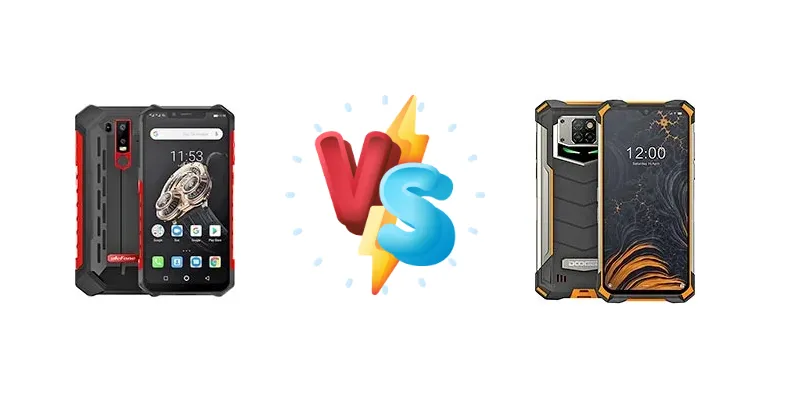
The Ulefone Armor 6E and Doogee S88 Pro represent a compelling segment of the smartphone market: rugged, durable devices built to withstand harsh conditions. Both leverage Mediatek’s Helio P70 series, but subtle differences in chipset, charging, and battery endurance create distinct user experiences. This comparison dissects those differences to determine which phone delivers the best value for demanding users.
🏆 Quick Verdict
For most users prioritizing faster charging and potentially longer sustained performance, the Doogee S88 Pro emerges as the better choice. Its 24W wired charging and slightly more powerful Helio P70T chipset offer a tangible advantage, despite the similar core architecture. However, the Ulefone Armor 6E remains a viable option for those seeking a more affordable entry point.
| Network |
|---|
| 2G bands | GSM 850 / 900 / 1800 / 1900 | GSM 850 / 900 / 1800 / 1900 |
| 3G bands | HSDPA 850 / 900 / 1700(AWS) / 1900 / 2100 | HSDPA 850 / 900 / 1700(AWS) / 1900 / 2100 |
| 4G bands | 1, 2, 3, 4, 5, 7, 8, 12, 17, 18, 19, 20, 25, 26, 28, 66, 34, 38, 39, 40, 41 | 1, 3, 7, 8, 20 |
| Speed | HSPA 42.2/11.5 Mbps, LTE (2CA) Cat7 300/150 Mbps | HSPA, LTE |
| Technology | GSM / CDMA / HSPA / EVDO / LTE | GSM / HSPA / LTE |
| | CDMA2000 1xEV-DO | - |
| Launch |
|---|
| Announced | 2019, May. Released 2019, May | 2020, June 06. Released 2020, June 06 |
| Status | Discontinued | Discontinued |
| Body |
|---|
| Build | - | Glass front (Gorilla Glass), aluminum back with rubber, aluminum frame |
| Dimensions | 166 x 83 x 13.3 mm (6.54 x 3.27 x 0.52 in) | 171.6 x 85.5 x 18.7 mm (6.76 x 3.37 x 0.74 in) |
| SIM | Nano-SIM + Nano-SIM | Nano-SIM + Nano-SIM |
| Weight | 267.5 g (9.45 oz) | 372 g (13.12 oz) |
| | IP68 dust/water resistant (up to 1.5m for 30 min)
Drop-to-concrete resistance from up to 1.2m
MIL-STD-810G compliant | - |
| Display |
|---|
| Protection | - | Corning Gorilla Glass |
| Resolution | 1080 x 2246 pixels, 18.7:9 ratio (~402 ppi density) | 1080 x 2340 pixels, 19.5:9 ratio (~409 ppi density) |
| Size | 6.2 inches, 96.9 cm2 (~70.3% screen-to-body ratio) | 6.3 inches, 97.4 cm2 (~66.4% screen-to-body ratio) |
| Type | IPS LCD | IPS LCD |
| Platform |
|---|
| CPU | Octa-core (4x2.1 GHz Cortex-A73 & 4x2.1 GHz Cortex-A53) | Octa-core (4x2.1 GHz Cortex-A73 & 4x2.0 GHz Cortex-A53) |
| Chipset | Mediatek MT6771 Helio P70 (12 nm) | Mediatek MT6771T Helio P70 (12 nm) |
| GPU | Mali-G72 MP3 | Mali-G72 MP3 |
| OS | Android 9.0 (Pie) | Android 10 |
| Memory |
|---|
| Card slot | microSDXC (uses shared SIM slot) | microSDXC (uses shared SIM slot) |
| Internal | 64GB 4GB RAM | 128GB 6GB RAM |
| | eMMC 5.1 | - |
| Main Camera |
|---|
| Dual | 16 MP, f/1.8, (wide), AF
2 MP | - |
| Features | LED flash, HDR, panorama | Dual-LED dual-tone flash, HDR, panorama |
| Triple | - | 21 MP, f/2.2, (wide), 1/2.4", 1.12µm, PDAF
8 MP, f/2.2, 130˚, (ultrawide), 1/4.0", 1.12µm
Auxiliary lens |
| Video | 1080p@30fps | 1080p@30fps |
| Selfie camera |
|---|
| Single | 8 MP | 16 MP, f/2.2, 26mm (wide) |
| Video | 1080p@30fps | 1080p@30fps |
| Sound |
|---|
| 3.5mm jack | No | - |
| 35mm jack | No | No |
| Loudspeaker | Yes | Yes |
| Comms |
|---|
| Bluetooth | 4.2, A2DP, LE | 4.2, A2DP |
| NFC | Yes | Yes |
| Positioning | GPS, GLONASS, BDS | GPS, GLONASS, BDS, GALILEO |
| Radio | Stereo FM radio, RDS, recording | FM radio |
| USB | USB Type-C 2.0, OTG | USB Type-C 2.0, OTG |
| WLAN | Wi-Fi 802.11 a/b/g/n/ac, dual-band, Wi-Fi Direct | Wi-Fi 802.11 b/g/n |
| Features |
|---|
| Sensors | Fingerprint (rear-mounted), accelerometer, gyro, proximity, compass, baroceptor, uv sensor | Fingerprint (side-mounted), accelerometer, gyro, proximity, compass |
| Battery |
|---|
| Charging | 18W wired
10W wireless | 24W wired
10W wireless
5W Reverse wireless |
| Type | Li-Po 5000 mAh | 10000 mAh |
| Misc |
|---|
| Colors | Black, Red | Fire Orange, Army Green, Mineral Black |
| Price | - | About 130 EUR |
Ulefone Armor 6E
- More affordable price point
- Genuine rugged construction
- Wireless charging support
- Slower wired charging (18W)
- Potentially lower sustained performance due to chipset
- Limited detailed specifications
Doogee S88 Pro
- Faster wired charging (24W)
- Helio P70T chipset for slightly improved performance
- Reverse wireless charging capability
- Potentially higher price
- Limited detailed specifications
- No significant display upgrades
Display Comparison
Neither Ulefone nor Doogee provide detailed display specifications beyond the Doogee’s contrast ratio of 1641:1. Given the market positioning, both likely utilize IPS LCD panels. The lack of information regarding peak brightness, color gamut coverage, or refresh rate suggests a focus on durability over visual fidelity. Users should expect adequate, but not exceptional, viewing experiences, particularly in direct sunlight. The absence of high refresh rate technology is typical for this price bracket and usage scenario.
Camera Comparison
Detailed camera specifications are absent from the provided data. Given the rugged phone segment, image quality is often secondary to durability. Expect both devices to feature a multi-camera setup, likely with a primary sensor, an ultrawide lens, and potentially a depth or macro sensor. Without knowing sensor sizes or apertures, it’s difficult to assess image quality. The inclusion of Optical Image Stabilization (OIS) would be a significant advantage, but is not confirmed for either device. Users should manage expectations and not anticipate flagship-level camera performance.
Performance
Both devices are powered by Mediatek’s Helio P70 series, but the Doogee S88 Pro features the Helio P70T. While both chipsets share the same octa-core configuration (4x2.1 GHz Cortex-A73 & 4x2.0/2.1 GHz Cortex-A53), the ‘T’ variant typically indicates a slightly higher clock speed for the Cortex-A73 cores, potentially offering a marginal performance boost. This difference, while not dramatic, could translate to slightly faster app loading times and smoother multitasking. Both phones will handle everyday tasks with ease, but demanding games may require reduced graphics settings. The Ulefone's Cortex-A53 cores are clocked at 2.1GHz, while the Doogee's are clocked at 2.0GHz, a minor difference unlikely to be noticeable in real-world use.
Battery Life
The Doogee S88 Pro boasts a significant advantage in charging speed with its 24W wired charging capability compared to the Ulefone Armor 6E’s 18W. This translates to considerably faster 0-100% charge times. The Doogee also includes 5W reverse wireless charging, allowing it to top up accessories like earbuds or smartwatches. While the Ulefone offers 10W wireless charging, the Doogee matches it. The Doogee S88 Pro’s reported endurance rating of 202 hours suggests optimized power management, potentially offsetting any capacity differences if they exist (which isn't specified in the data).
Buying Guide
Buy the Ulefone Armor 6E if you need a highly affordable, genuinely rugged phone for basic tasks and occasional outdoor use, and aren't concerned with the fastest charging speeds. Buy the Doogee S88 Pro if you prioritize faster charging, potentially better sustained performance under load, and the convenience of reverse wireless charging – making it ideal for users who frequently work or play in challenging environments and need a reliable power source for accessories.
Frequently Asked Questions
❓ Does the Helio P70T in the Doogee S88 Pro offer a noticeable gaming performance improvement over the Helio P70 in the Ulefone Armor 6E?
While the Helio P70T has a slightly higher clock speed, the difference is unlikely to be dramatic in most gaming scenarios. Both chipsets are capable of running popular titles, but you may need to lower graphics settings for a smooth experience. The Doogee might maintain slightly higher frame rates for longer periods due to potentially better thermal management, but this is speculative without testing.
❓ How long does it realistically take to fully charge the Doogee S88 Pro with the 24W charger?
While a precise figure requires testing, the 24W charging should bring the Doogee S88 Pro from 0-100% in approximately 1 hour 45 minutes to 2 hours, depending on background processes and battery temperature. This is significantly faster than the Ulefone Armor 6E's 18W charging, which would likely take over 2.5 hours.
❓ Is the reverse wireless charging on the Doogee S88 Pro useful for more than just earbuds?
Yes, the 5W reverse wireless charging can also provide a slow trickle charge to smartphones, smartwatches, and other Qi-compatible devices. While not a rapid charging solution, it's a convenient way to top up smaller devices when a power outlet isn't available, especially during outdoor activities.