
Ulefone Armor 6E vs. Cat S62 Pro: A Head-to-Head Rugged Smartphone Showdown
| Phones Images | |||||
|---|---|---|---|---|---|
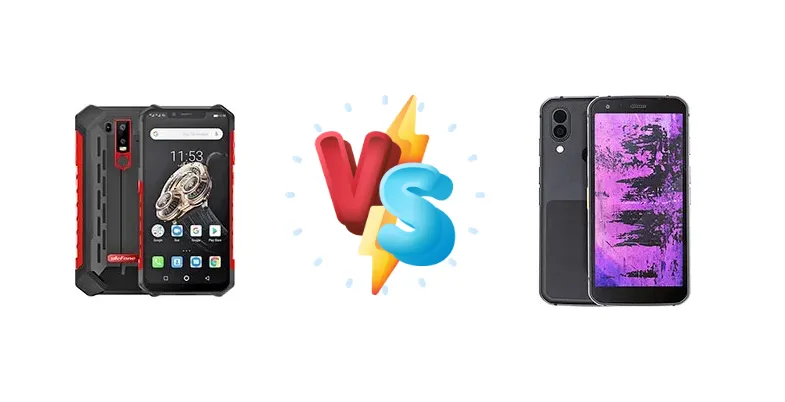
|
🏆 Quick Verdict
For the average user prioritizing consistent performance and a more established brand reputation, the Cat S62 Pro emerges as the better choice. While the Ulefone Armor 6E offers wireless charging and a potentially lower price point, the Snapdragon 660 in the Cat S62 Pro provides a smoother, more reliable experience for demanding tasks.
| PHONES | ||
|---|---|---|
| Phone Names | Ulefone Armor 6E | Cat S62 Pro |
| Network | ||
|---|---|---|
| 2G bands | GSM 850 / 900 / 1800 / 1900 | GSM 850 / 900 / 1800 / 1900 |
| 3G bands | HSDPA 850 / 900 / 1700(AWS) / 1900 / 2100 | HSDPA 850 / 900 / 1700(AWS) / 1900 / 2100 |
| 4G bands | 1, 2, 3, 4, 5, 7, 8, 12, 17, 18, 19, 20, 25, 26, 28, 66, 34, 38, 39, 40, 41 | 1, 2, 3, 4, 5, 7, 8, 20, 28, 38, 40 |
| Speed | HSPA 42.2/11.5 Mbps, LTE (2CA) Cat7 300/150 Mbps | HSPA 42.2/5.76 Mbps, LTE (2CA) Cat13 400/150 Mbps |
| Technology | GSM / CDMA / HSPA / EVDO / LTE | GSM / HSPA / LTE |
| CDMA2000 1xEV-DO | - | |
| Launch | ||
|---|---|---|
| Announced | 2019, May. Released 2019, May | 2020, June 28. Released 2020, August 17 |
| Status | Discontinued | Discontinued |
| Body | ||
|---|---|---|
| Build | - | Glass front (Gorilla Glass 6), plastic back, aluminum frame |
| Dimensions | 166 x 83 x 13.3 mm (6.54 x 3.27 x 0.52 in) | 158.5 x 76.7 x 11.9 mm (6.24 x 3.02 x 0.47 in) |
| SIM | Nano-SIM + Nano-SIM | · Nano-SIM· Nano-SIM + Nano-SIM |
| Weight | 267.5 g (9.45 oz) | 248 g (8.75 oz) |
| IP68 dust/water resistant (up to 1.5m for 30 min) Drop-to-concrete resistance from up to 1.2m MIL-STD-810G compliant | IP68/IP69 dust/water resistant (up to 1.5m for 35 mins) Drop-to-concrete resistance from up to 1.8m MIL-STD-810H compliant | |
| Display | ||
|---|---|---|
| Protection | - | Corning Gorilla Glass 6 |
| Resolution | 1080 x 2246 pixels, 18.7:9 ratio (~402 ppi density) | 1080 x 2160 pixels, 18:9 ratio (~424 ppi density) |
| Size | 6.2 inches, 96.9 cm2 (~70.3% screen-to-body ratio) | 5.7 inches, 83.8 cm2 (~69.0% screen-to-body ratio) |
| Type | IPS LCD | IPS LCD |
| Platform | ||
|---|---|---|
| CPU | Octa-core (4x2.1 GHz Cortex-A73 & 4x2.1 GHz Cortex-A53) | Octa-core (4x2.2 GHz Kryo 260 Gold & 4x1.8 GHz Kryo 260 Silver) |
| Chipset | Mediatek MT6771 Helio P70 (12 nm) | Qualcomm SDM660 Snapdragon 660 (14 nm) |
| GPU | Mali-G72 MP3 | Adreno 512 |
| OS | Android 9.0 (Pie) | Android 10 |
| Memory | ||
|---|---|---|
| Card slot | microSDXC (uses shared SIM slot) | microSDXC (dedicated slot) |
| Internal | 64GB 4GB RAM | 128GB 6GB RAM |
| eMMC 5.1 | - | |
| Main Camera | ||
|---|---|---|
| Dual | 16 MP, f/1.8, (wide), AF 2 MP | 12 MP, f/1.8, (wide), 1/2.55", 1.4µm, dual pixel PDAF FLIR thermal camera (Lepton 3.5 module) |
| Features | LED flash, HDR, panorama | Thermal imaging, heat palettes, temp. spot meter, LED flash |
| Video | 1080p@30fps | 1080p@30fps, gyro-EIS |
| Selfie camera | ||
|---|---|---|
| Single | 8 MP | 8 MP |
| Video | 1080p@30fps | 1080p@30fps |
| Sound | ||
|---|---|---|
| 3.5mm jack | No | No |
| 35mm jack | No | No |
| Loudspeaker | Yes | Yes |
| Comms | ||
|---|---|---|
| Bluetooth | 4.2, A2DP, LE | 5.0, A2DP, LE |
| NFC | Yes | Yes |
| Positioning | GPS, GLONASS, BDS | GPS, GLONASS, GALILEO, BDS |
| Radio | Stereo FM radio, RDS, recording | FM radio |
| USB | USB Type-C 2.0, OTG | USB Type-C 2.0, OTG |
| WLAN | Wi-Fi 802.11 a/b/g/n/ac, dual-band, Wi-Fi Direct | Wi-Fi 802.11 a/b/g/n/ac, dual-band, Wi-Fi Direct |
| Features | ||
|---|---|---|
| Sensors | Fingerprint (rear-mounted), accelerometer, gyro, proximity, compass, baroceptor, uv sensor | Fingerprint (rear-mounted), accelerometer, gyro, proximity, compass |
| Battery | ||
|---|---|---|
| Charging | 18W wired 10W wireless | - |
| Type | Li-Po 5000 mAh | Li-Ion 4000 mAh |
| Misc | ||
|---|---|---|
| Colors | Black, Red | Black |
| Price | - | About 530 EUR |
Ulefone Armor 6E
- Wireless charging offers added convenience.
- Potentially lower price point makes it more accessible.
- Rugged design provides excellent drop and water resistance.
- Helio P70 chipset may struggle with demanding tasks.
- Software experience may be less refined than the Cat S62 Pro.
- Limited information on display quality.
Cat S62 Pro
- Snapdragon 660 provides smoother and more reliable performance.
- Qualcomm’s ISP offers better image processing.
- Established brand reputation for rugged devices.
- Lacks wireless charging.
- May be more expensive than the Ulefone Armor 6E.
- Charging speed not explicitly stated.
Display Comparison
Neither Ulefone nor Cat provide detailed display specifications beyond basic resolution. However, the choice of panel technology and brightness are crucial for outdoor visibility. Given the target audience, both likely utilize IPS LCDs for durability. The lack of information makes a direct comparison difficult, but the Cat S62 Pro's brand positioning suggests a potentially higher quality panel with better color accuracy, while the Armor 6E may prioritize cost savings.
Camera Comparison
Detailed camera specs are absent, making a precise comparison challenging. However, the focus for both devices is likely on practicality rather than photographic excellence. The Snapdragon 660’s image signal processor (ISP) generally offers better image processing capabilities than the Helio P70’s, potentially resulting in more detailed and accurate photos, especially in challenging lighting conditions. Without sensor size information, it’s difficult to assess low-light performance, but the Cat S62 Pro’s chipset gives it an edge in image quality.
Performance
The core difference lies in the chipsets. The Ulefone Armor 6E utilizes the Mediatek MT6771 Helio P70, a 12nm process chip with a mix of Cortex-A73 and A53 cores. The Cat S62 Pro features the Qualcomm Snapdragon 660, built on a 14nm process. While the P70 boasts slightly higher clock speeds on its performance cores (2.1 GHz vs 2.2 GHz on the Kryo 260 Gold), the Snapdragon 660’s architecture and Qualcomm’s optimizations generally translate to superior sustained performance and more efficient power management. This means the Cat S62 Pro is likely to handle multitasking and demanding applications with greater ease, and experience less thermal throttling during prolonged use. The 14nm process, while older, is a mature technology known for stability.
Battery Life
Both phones offer substantial battery capacity, typical for rugged devices. The Ulefone Armor 6E supports both 18W wired and 10W wireless charging, a notable advantage. The Cat S62 Pro’s charging speed isn’t explicitly stated, but is likely around 15-18W wired. The wireless charging on the Ulefone is a convenience feature, but the Snapdragon 660’s power efficiency may allow the Cat S62 Pro to achieve comparable or even longer battery life despite potentially having a slightly smaller capacity. The 10W wireless charging on the Ulefone will be significantly slower than wired charging.
Buying Guide
Buy the Ulefone Armor 6E if you need a highly affordable rugged phone with the convenience of wireless charging and are comfortable with potentially less refined software. Buy the Cat S62 Pro if you prioritize a more polished user experience, a proven chipset from Qualcomm, and a brand known for its focus on durable devices for professional use.