
Ulefone Armor 6E vs Blackview BV9900E: A Deep Dive into Rugged Smartphone Performance
| Phones Images | |||||
|---|---|---|---|---|---|
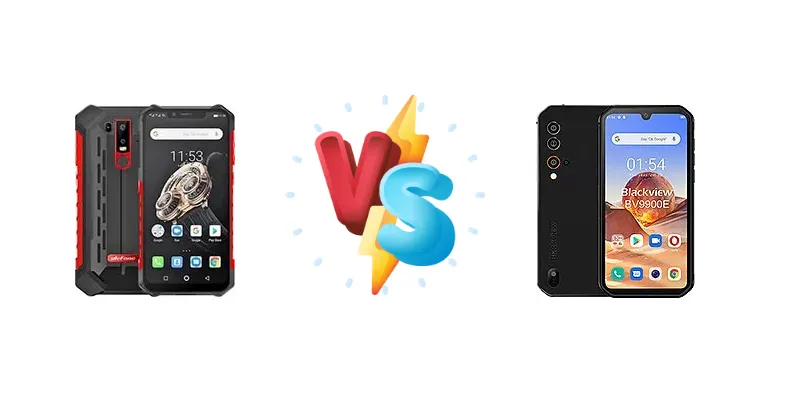
|
🏆 Quick Verdict
For the average user prioritizing raw performance and future-proofing, the Blackview BV9900E emerges as the better choice. Its Helio P90 chipset offers a noticeable performance uplift over the Armor 6E’s Helio P70, translating to smoother multitasking and gaming. However, the Armor 6E remains a viable option for budget-conscious buyers who don't demand the absolute fastest speeds.
| PHONES | ||
|---|---|---|
| Phone Names | Ulefone Armor 6E | Blackview BV9900E |
| Network | ||
|---|---|---|
| 2G bands | GSM 850 / 900 / 1800 / 1900 | GSM 850 / 900 / 1800 / 1900 |
| 3G bands | HSDPA 850 / 900 / 1700(AWS) / 1900 / 2100 | HSDPA 800 / 850 / 900 / 1700(AWS) / 1900 / 2100 |
| 4G bands | 1, 2, 3, 4, 5, 7, 8, 12, 17, 18, 19, 20, 25, 26, 28, 66, 34, 38, 39, 40, 41 | 1, 2, 3, 4, 5, 7, 8, 12, 13, 17, 18, 19, 20, 25, 26, 28, 34, 38, 39, 40, 41, 66 |
| Speed | HSPA 42.2/11.5 Mbps, LTE (2CA) Cat7 300/150 Mbps | HSPA, LTE |
| Technology | GSM / CDMA / HSPA / EVDO / LTE | GSM / CDMA / HSPA / CDMA2000 / LTE |
| CDMA2000 1xEV-DO | - | |
| Launch | ||
|---|---|---|
| Announced | 2019, May. Released 2019, May | 2020, September 10. Released 2020, September |
| Status | Discontinued | Discontinued |
| Body | ||
|---|---|---|
| Dimensions | 166 x 83 x 13.3 mm (6.54 x 3.27 x 0.52 in) | 156.5 x 78.3 x 14.2 mm (6.16 x 3.08 x 0.56 in) |
| SIM | Nano-SIM + Nano-SIM | Nano-SIM + Nano-SIM |
| Weight | 267.5 g (9.45 oz) | 273 g (9.63 oz) |
| IP68 dust/water resistant (up to 1.5m for 30 min) Drop-to-concrete resistance from up to 1.2m MIL-STD-810G compliant | - | |
| Display | ||
|---|---|---|
| Protection | - | Corning Gorilla Glass 5 |
| Resolution | 1080 x 2246 pixels, 18.7:9 ratio (~402 ppi density) | 1080 x 2280 pixels, 19:9 ratio (~432 ppi density) |
| Size | 6.2 inches, 96.9 cm2 (~70.3% screen-to-body ratio) | 5.84 inches, 85.1 cm2 (~69.5% screen-to-body ratio) |
| Type | IPS LCD | IPS LCD |
| Platform | ||
|---|---|---|
| CPU | Octa-core (4x2.1 GHz Cortex-A73 & 4x2.1 GHz Cortex-A53) | Octa-core (2x2.2 GHz Cortex-A75 & 6x2.0 GHz Cortex-A55) |
| Chipset | Mediatek MT6771 Helio P70 (12 nm) | Mediatek MT6779V/CE Helio P90 (12 nm) |
| GPU | Mali-G72 MP3 | PowerVR GM9446 |
| OS | Android 9.0 (Pie) | Android 10 |
| Memory | ||
|---|---|---|
| Card slot | microSDXC (uses shared SIM slot) | microSDXC |
| Internal | 64GB 4GB RAM | 128GB 6GB RAM |
| eMMC 5.1 | - | |
| Main Camera | ||
|---|---|---|
| Dual | 16 MP, f/1.8, (wide), AF 2 MP | - |
| Features | LED flash, HDR, panorama | LED flash, HDR, panorama |
| Quad | - | 48 MP, f/1.8, (wide), PDAF 16 MP, 120˚ (ultrawide) 2 MP (macro) Auxiliary lens |
| Video | 1080p@30fps | 4K@30fps, 1080p@60fps |
| Selfie camera | ||
|---|---|---|
| Single | 8 MP | 16 MP, f/2.0, (wide) |
| Video | 1080p@30fps | 1080p@30fps |
| Sound | ||
|---|---|---|
| 3.5mm jack | No | - |
| 35mm jack | No | No |
| Loudspeaker | Yes | Yes |
| Comms | ||
|---|---|---|
| Bluetooth | 4.2, A2DP, LE | 5.0, A2DP, LE |
| NFC | Yes | Yes |
| Positioning | GPS, GLONASS, BDS | GPS, GLONASS, GALILEO, BDS |
| Radio | Stereo FM radio, RDS, recording | FM radio |
| USB | USB Type-C 2.0, OTG | USB Type-C 2.0, OTG |
| WLAN | Wi-Fi 802.11 a/b/g/n/ac, dual-band, Wi-Fi Direct | Wi-Fi 802.11 a/b/g/n/ac |
| Features | ||
|---|---|---|
| Sensors | Fingerprint (rear-mounted), accelerometer, gyro, proximity, compass, baroceptor, uv sensor | Fingerprint (side-mounted), accelerometer, gyro, proximity, compass, barometer |
| Battery | ||
|---|---|---|
| Charging | 18W wired 10W wireless | 15W wired 18W wireless |
| Type | Li-Po 5000 mAh | 4380 mAh |
| Misc | ||
|---|---|---|
| Colors | Black, Red | Black, Silver |
| Price | - | About 260 EUR |
Ulefone Armor 6E
- More affordable price point
- 18W wired charging is faster than BV9900E's wired charging
- Rugged design provides excellent protection
- Less powerful Helio P70 chipset
- Slower overall performance
- Potentially lower image quality due to older ISP
Blackview BV9900E
- More powerful Helio P90 chipset
- Faster wireless charging (18W)
- Improved image processing capabilities
- Higher price tag
- Slower wired charging (15W)
- May experience slightly more heat under sustained load
Display Comparison
Neither device boasts a cutting-edge display. Both likely utilize IPS LCD panels, common in this price bracket. The key difference lies under the hood. While specific display specs are unavailable, the P90’s increased processing power in the BV9900E *could* allow for more sophisticated image processing, potentially resulting in slightly more vibrant colors. However, without detailed measurements of brightness and color accuracy, this remains speculative. Bezels are expected to be substantial on both, prioritizing durability over a modern, edge-to-edge design.
Camera Comparison
Without detailed camera specifications beyond the chipsets, a direct comparison is challenging. However, the P90’s integrated image signal processor (ISP) is more advanced than the P70’s. This translates to better noise reduction, dynamic range, and overall image quality, particularly in low-light conditions. The P90’s ISP also supports more sophisticated features like AI scene detection. While both phones likely feature multiple rear cameras, the quality of the primary sensor will be the most significant factor. The P90’s processing power allows it to extract more detail from the sensor, even if the sensor itself is similar in size.
Performance
The Blackview BV9900E’s Helio P90 chipset represents a significant architectural upgrade over the Ulefone Armor 6E’s Helio P70. The P90 utilizes a dual-core Cortex-A75 configuration clocked at 2.2 GHz alongside six Cortex-A55 cores at 2.0 GHz. This contrasts with the P70’s quad-core A73 and quad-core A53 setup, maxing out at 2.1 GHz. The A75 cores in the P90 offer substantially higher single-core performance, crucial for responsive app launches and smoother UI navigation. The P90 also benefits from an improved GPU, leading to better gaming performance. While both are 12nm chips, the P90’s architecture is more efficient, potentially leading to better sustained performance under load.
Battery Life
The Ulefone Armor 6E offers 18W wired and 10W wireless charging, while the Blackview BV9900E provides 15W wired and 18W wireless. While the Armor 6E has faster wired charging, the BV9900E’s 18W wireless charging is a significant advantage for convenience. The P90’s improved efficiency *could* translate to slightly better battery life in real-world usage, despite potentially having a similar battery capacity. The faster wireless charging on the BV9900E allows for quicker top-ups when a wall outlet isn’t available.
Buying Guide
Buy the Ulefone Armor 6E if you need a highly durable phone for basic tasks like communication, navigation, and occasional photography, and are on a tight budget. It’s ideal for users who prioritize affordability over peak performance. Buy the Blackview BV9900E if you prefer a more responsive experience for demanding applications, enjoy mobile gaming, and value faster charging speeds, even at a slightly higher price point. This phone suits users who need a rugged device that can also handle intensive workloads.