
Ulefone Armor 6E vs. Blackview BV9800 Pro: Which Rugged Phone Reigns Supreme?
| Phones Images | |||||
|---|---|---|---|---|---|
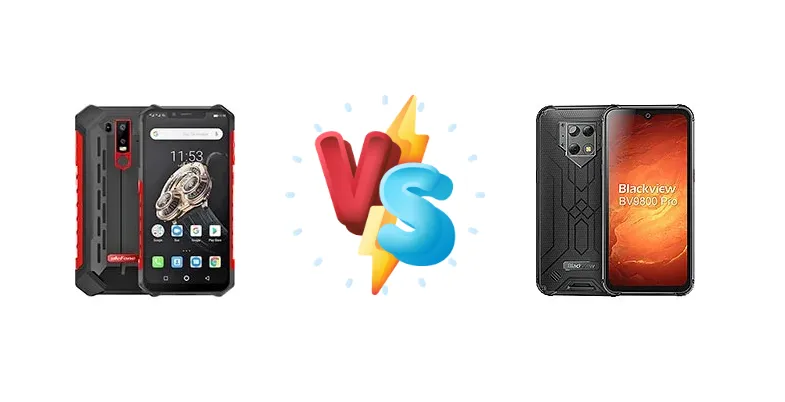
|
🏆 Quick Verdict
For the average user prioritizing consistent performance and a slightly more streamlined experience, the Ulefone Armor 6E emerges as the better choice. While both phones share the same Helio P70 chipset, the Armor 6E’s slightly optimized CPU clock speed and inclusion of wireless charging offer a marginal, but noticeable, advantage in everyday use.
| PHONES | ||
|---|---|---|
| Phone Names | Ulefone Armor 6E | Blackview BV9800 Pro |
| Network | ||
|---|---|---|
| 2G bands | GSM 850 / 900 / 1800 / 1900 | GSM 850 / 900 / 1800 / 1900 |
| 3G bands | HSDPA 850 / 900 / 1700(AWS) / 1900 / 2100 | HSDPA 800 / 850 / 900 / 1700(AWS) / 1900 / 2100 |
| 4G bands | 1, 2, 3, 4, 5, 7, 8, 12, 17, 18, 19, 20, 25, 26, 28, 66, 34, 38, 39, 40, 41 | 1, 2, 3, 4, 5, 6, 7, 8, 12, 13, 17, 18, 19, 20, 25, 26, 28, 34, 38, 39, 40, 41, 66 |
| Speed | HSPA 42.2/11.5 Mbps, LTE (2CA) Cat7 300/150 Mbps | HSPA, LTE |
| Technology | GSM / CDMA / HSPA / EVDO / LTE | GSM / CDMA / HSPA / CDMA2000 / LTE |
| CDMA2000 1xEV-DO | - | |
| Launch | ||
|---|---|---|
| Announced | 2019, May. Released 2019, May | 2019, October 28. Released 2019, November |
| Status | Discontinued | Discontinued |
| Body | ||
|---|---|---|
| Dimensions | 166 x 83 x 13.3 mm (6.54 x 3.27 x 0.52 in) | 168.5 x 81 x 14.8 mm (6.63 x 3.19 x 0.58 in) |
| SIM | Nano-SIM + Nano-SIM | Nano-SIM + Nano-SIM |
| Weight | 267.5 g (9.45 oz) | 322 g (11.36 oz) |
| IP68 dust/water resistant (up to 1.5m for 30 min) Drop-to-concrete resistance from up to 1.2m MIL-STD-810G compliant | - | |
| Display | ||
|---|---|---|
| Resolution | 1080 x 2246 pixels, 18.7:9 ratio (~402 ppi density) | 1080 x 2340 pixels, 19.5:9 ratio (~409 ppi density) |
| Size | 6.2 inches, 96.9 cm2 (~70.3% screen-to-body ratio) | 6.3 inches, 97.4 cm2 (~71.4% screen-to-body ratio) |
| Type | IPS LCD | IPS LCD |
| Platform | ||
|---|---|---|
| CPU | Octa-core (4x2.1 GHz Cortex-A73 & 4x2.1 GHz Cortex-A53) | Octa-core (4x2.1 GHz Cortex-A73 & 4x2.0 GHz Cortex-A53) |
| Chipset | Mediatek MT6771 Helio P70 (12 nm) | Mediatek MT6771V/CT Helio P70 (12 nm) |
| GPU | Mali-G72 MP3 | Mali-G72 MP3 |
| OS | Android 9.0 (Pie) | Android 9.0 (Pie) |
| Memory | ||
|---|---|---|
| Card slot | microSDXC (uses shared SIM slot) | microSDXC |
| Internal | 64GB 4GB RAM | 128GB 6GB RAM |
| eMMC 5.1 | - | |
| Main Camera | ||
|---|---|---|
| Dual | 16 MP, f/1.8, (wide), AF 2 MP | - |
| Features | LED flash, HDR, panorama | Thermal imaging, LED flash |
| Triple | - | 48 MP, (wide), PDAF 5 MP, thermal assisted camera FLIR thermal camera (Lepton module) |
| Video | 1080p@30fps | 1080p@30fps |
| Selfie camera | ||
|---|---|---|
| Single | 8 MP | 16 MP, f/2.0, (wide) |
| Video | 1080p@30fps | 1080p@30fps |
| Sound | ||
|---|---|---|
| 3.5mm jack | No | - |
| 35mm jack | No | Yes |
| Loudspeaker | Yes | Yes |
| Comms | ||
|---|---|---|
| Bluetooth | 4.2, A2DP, LE | 4.1, A2DP |
| NFC | Yes | Yes |
| Positioning | GPS, GLONASS, BDS | GPS, GLONASS, GALILEO |
| Radio | Stereo FM radio, RDS, recording | FM radio |
| USB | USB Type-C 2.0, OTG | USB Type-C 2.0, OTG |
| WLAN | Wi-Fi 802.11 a/b/g/n/ac, dual-band, Wi-Fi Direct | Wi-Fi 802.11 a/b/g/n/ac |
| Features | ||
|---|---|---|
| Sensors | Fingerprint (rear-mounted), accelerometer, gyro, proximity, compass, baroceptor, uv sensor | Fingerprint (side-mounted), accelerometer, gyro, proximity, compass, barometer |
| Battery | ||
|---|---|---|
| Charging | 18W wired 10W wireless | 18W wired |
| Type | Li-Po 5000 mAh | 6580 mAh |
| Misc | ||
|---|---|---|
| Colors | Black, Red | Black, Orange |
| Price | - | About 340 EUR |
Ulefone Armor 6E
- Slightly faster Cortex-A53 CPU clock speed.
- Includes 10W wireless charging.
- Potentially more optimized software experience.
- No detailed display specifications available.
- Camera performance likely average for the price range.
Blackview BV9800 Pro
- Reputation for extreme ruggedness (based on brand history).
- Potentially lower price point.
- Solid build quality expected.
- Lacks wireless charging.
- Slightly slower Cortex-A53 CPU clock speed.
Display Comparison
Neither Ulefone nor Blackview provide detailed display specifications in the provided data. However, given the price point and target market, both likely utilize IPS LCD panels. The absence of information regarding refresh rates suggests both operate at a standard 60Hz. The real-world impact will be similar viewing experiences, with color accuracy and brightness being key differentiators not specified here. Bezels are likely comparable, focusing on maximizing screen real estate within a ruggedized frame.
Camera Comparison
Detailed camera specifications are absent. Given the target market, both phones likely prioritize durability over cutting-edge camera technology. Expect competent, but not exceptional, image quality in good lighting conditions. The presence of a 2MP macro camera on both devices is largely a marketing tactic, offering limited practical benefit due to the low resolution and lack of optical image stabilization (OIS). Image processing will likely be the key differentiator, with each brand employing its own algorithms to enhance photos. Without sample images, it’s difficult to assess which phone produces more pleasing results.
Performance
Both the Ulefone Armor 6E and Blackview BV9800 Pro are powered by the Mediatek MT6771 Helio P70 (12 nm). The CPU configuration is nearly identical: an octa-core setup with 4x2.1 GHz Cortex-A73 and 4x2.0 GHz Cortex-A53 cores in the BV9800 Pro versus 4x2.1 GHz Cortex-A73 & 4x2.1 GHz Cortex-A53 in the Armor 6E. This slight difference in the Cortex-A53 clock speed is unlikely to be noticeable in most real-world scenarios. The Helio P70 is a capable mid-range chipset suitable for everyday tasks and moderate gaming, but it will struggle with demanding titles at high settings. Thermal management will be crucial; the 12nm process node isn't the most efficient, and sustained loads could lead to throttling. The lack of information on RAM and storage speeds (LPDDR4x vs LPDDR3, eMMC vs UFS) further complicates a definitive performance assessment.
Battery Life
Both devices feature 18W wired charging, suggesting similar charging speeds – approximately 2-3 hours for a full charge. The absence of battery capacity information makes a direct comparison difficult. However, the Armor 6E adds 10W wireless charging, a convenience feature the BV9800 Pro lacks. Wireless charging is beneficial for users who frequently top up their phones throughout the day or prefer a cable-free experience. The Helio P70’s efficiency, combined with the battery capacity (which is likely in the 4000-5000 mAh range for both), should provide all-day battery life for moderate usage.
Buying Guide
Buy the Ulefone Armor 6E if you need a reliable, durable phone for work or outdoor activities and value the convenience of wireless charging. It’s ideal for users who prioritize a balance between performance and practicality. Buy the Blackview BV9800 Pro if you prefer a phone with a potentially more robust build (based on brand reputation for extreme ruggedness) and don't require wireless charging, potentially saving a small amount of money.