
Ulefone Armor 5S vs. Ulefone Armor 6E: A Deep Dive into Rugged Performance
| Phones Images | |||||
|---|---|---|---|---|---|
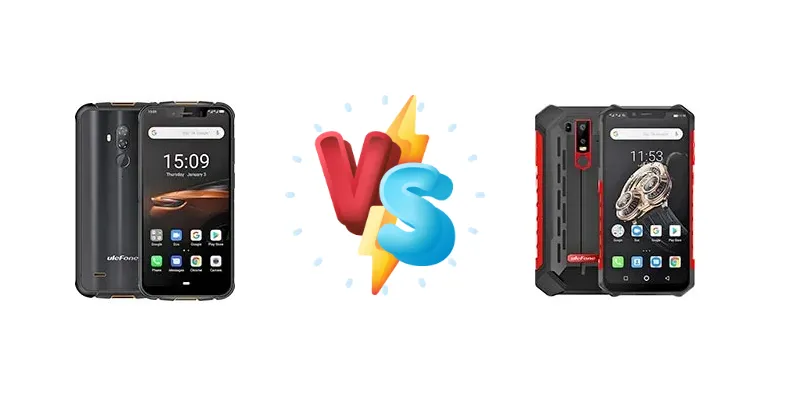
|
🏆 Quick Verdict
For most users, the Ulefone Armor 6E is the superior choice. Its Helio P70 chipset, built on a more efficient 12nm process, delivers noticeably improved performance over the Armor 5S’s Helio P23. The faster 18W charging further enhances usability, making the 6E a more compelling all-around rugged device.
| PHONES | ||
|---|---|---|
| Phone Names | Ulefone Armor 5S | Ulefone Armor 6E |
| Network | ||
|---|---|---|
| 2G bands | GSM 850 / 900 / 1800 / 1900 | GSM 850 / 900 / 1800 / 1900 |
| 3G bands | HSDPA 850 / 900 / 1700(AWS) / 1900 / 2100 | HSDPA 850 / 900 / 1700(AWS) / 1900 / 2100 |
| 4G bands | 1, 2, 3, 4, 5, 7, 8, 12, 17, 19, 20 | 1, 2, 3, 4, 5, 7, 8, 12, 17, 18, 19, 20, 25, 26, 28, 66, 34, 38, 39, 40, 41 |
| Speed | HSPA 21.1/5.76 Mbps, LTE (2CA) Cat7 300/150 Mbps | HSPA 42.2/11.5 Mbps, LTE (2CA) Cat7 300/150 Mbps |
| Technology | GSM / HSPA / LTE | GSM / CDMA / HSPA / EVDO / LTE |
| - | CDMA2000 1xEV-DO | |
| Launch | ||
|---|---|---|
| Announced | 2019, July. Released 2019, July | 2019, May. Released 2019, May |
| Status | Discontinued | Discontinued |
| Body | ||
|---|---|---|
| Dimensions | 158.3 x 76 x 12.6 mm (6.23 x 2.99 x 0.50 in) | 166 x 83 x 13.3 mm (6.54 x 3.27 x 0.52 in) |
| SIM | Nano-SIM + Nano-SIM | Nano-SIM + Nano-SIM |
| Weight | 228 g (8.04 oz) | 267.5 g (9.45 oz) |
| IP68 dust/water resistant (up to 1.5m for 30 min) Drop-to-concrete resistance from up to 1.2m MIL-STD-810G compliant | IP68 dust/water resistant (up to 1.5m for 30 min) Drop-to-concrete resistance from up to 1.2m MIL-STD-810G compliant | |
| Display | ||
|---|---|---|
| Resolution | 720 x 1512 pixels, 19:9 ratio (~286 ppi density) | 1080 x 2246 pixels, 18.7:9 ratio (~402 ppi density) |
| Size | 5.85 inches, 85.7 cm2 (~71.2% screen-to-body ratio) | 6.2 inches, 96.9 cm2 (~70.3% screen-to-body ratio) |
| Type | IPS LCD | IPS LCD |
| Platform | ||
|---|---|---|
| CPU | Octa-core (4x2.3 GHz Cortex-A53 & 4x1.5 GHz Cortex-A53) | Octa-core (4x2.1 GHz Cortex-A73 & 4x2.1 GHz Cortex-A53) |
| Chipset | Mediatek MT6763 Helio P23 (16 nm) | Mediatek MT6771 Helio P70 (12 nm) |
| GPU | Mali-G71 MP2 | Mali-G72 MP3 |
| OS | Android 9.0 (Pie) | Android 9.0 (Pie) |
| Memory | ||
|---|---|---|
| Card slot | microSDXC (uses shared SIM slot) | microSDXC (uses shared SIM slot) |
| Internal | 64GB 4GB RAM | 64GB 4GB RAM |
| eMMC 5.1 | eMMC 5.1 | |
| Main Camera | ||
|---|---|---|
| Dual | 13 MP, f/1.8, (wide), AF 2 MP | 16 MP, f/1.8, (wide), AF 2 MP |
| Features | Dual-LED dual-tone flash, HDR, panorama | LED flash, HDR, panorama |
| Video | 1080p@30fps | 1080p@30fps |
| Selfie camera | ||
|---|---|---|
| Single | 8 MP | 8 MP |
| Video | 1080p@30fps | 1080p@30fps |
| Sound | ||
|---|---|---|
| 3.5mm jack | No | No |
| 35mm jack | No | No |
| Loudspeaker | Yes | Yes |
| Comms | ||
|---|---|---|
| Bluetooth | 4.0, A2DP | 4.2, A2DP, LE |
| NFC | Yes | Yes |
| Positioning | GPS, GLONASS | GPS, GLONASS, BDS |
| Radio | Stereo FM radio, RDS, recording | Stereo FM radio, RDS, recording |
| USB | USB Type-C 2.0, OTG | USB Type-C 2.0, OTG |
| WLAN | Wi-Fi 802.11 a/b/g/n, dual-band, Wi-Fi Direct | Wi-Fi 802.11 a/b/g/n/ac, dual-band, Wi-Fi Direct |
| Features | ||
|---|---|---|
| Sensors | Fingerprint (rear-mounted), accelerometer, gyro, proximity, compass, coulombmeter | Fingerprint (rear-mounted), accelerometer, gyro, proximity, compass, baroceptor, uv sensor |
| Battery | ||
|---|---|---|
| Charging | 10W wired 10W wireless | 18W wired 10W wireless |
| Type | Li-Po 5000 mAh | Li-Po 5000 mAh |
| Misc | ||
|---|---|---|
| Colors | Black | Black, Red |
Ulefone Armor 5S
- Lower price point
- Rugged design and build quality
- Wireless charging support
- Older, less powerful chipset
- Slower charging speed (10W wired)
- Potential for throttling under heavy load
Ulefone Armor 6E
- More powerful and efficient Helio P70 chipset
- Faster 18W wired charging
- Improved multitasking and app responsiveness
- Slightly higher price
- Rugged design (may be bulky for some)
- Similar camera performance to Armor 5S
Display Comparison
Neither Ulefone provides detailed display specifications beyond resolution. However, the focus of these phones isn't display quality, but durability. Expect similar LCD panels on both, likely with comparable brightness levels suitable for outdoor visibility. The absence of high refresh rates or advanced panel technologies like LTPO is typical for this price segment and ruggedized design.
Camera Comparison
Ulefone doesn’t emphasize camera prowess in this series. Both phones likely feature similar camera setups, with the primary sensor being the most important factor. Without specific sensor details, it’s difficult to make a definitive judgment. However, the improved image signal processor (ISP) within the Helio P70 of the Armor 6E *could* lead to slightly better image processing, particularly in low-light conditions. The inclusion of a 2MP macro lens on both is largely a marketing tactic, offering limited practical benefit.
Performance
The core difference lies in the chipsets. The Armor 5S utilizes the Mediatek MT6763 Helio P23, a 16nm chip with an octa-core CPU configuration split between 2.3 GHz and 1.5 GHz Cortex-A53 cores. The Armor 6E steps up to the MT6771 Helio P70, fabricated on a more efficient 12nm process. The P70’s CPU features 2.1 GHz Cortex-A73 cores alongside 2.1 GHz Cortex-A53 cores. This architectural shift to the A73 cores provides a substantial performance boost in single-core tasks and overall responsiveness. The 12nm process also translates to better thermal management, reducing the likelihood of throttling during sustained workloads. While both phones likely share similar RAM configurations, the P70’s superior processing power will result in a smoother user experience.
Battery Life
Both phones support 10W wireless charging, but the Armor 6E gains a significant advantage with its 18W wired charging capability. While battery capacity isn’t specified, the faster charging speed will dramatically reduce the time required to replenish the battery. The Armor 5S’s 10W charging will feel noticeably slower, especially for users who frequently use power-intensive applications. The efficiency gains of the Helio P70 in the 6E may also contribute to slightly better battery life, even with a similar capacity.
Buying Guide
Buy the Ulefone Armor 5S if you prioritize a lower initial cost and are primarily focused on basic smartphone tasks like calls, texts, and light app usage. Its older chipset is sufficient for these needs. Buy the Ulefone Armor 6E if you demand smoother multitasking, faster app loading times, and quicker charging – essential for users who rely on their phone for work, navigation, or occasional gaming in demanding environments.