
Ulefone Armor 5S vs Oukitel WP100 Titan: A Rugged Smartphone Face-Off
| Phones Images | |||||
|---|---|---|---|---|---|
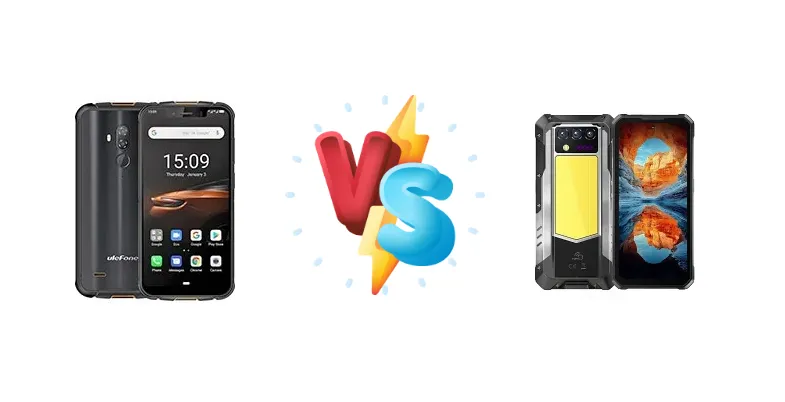
|
🏆 Quick Verdict
For the average user prioritizing performance and future-proofing, the Oukitel WP100 Titan is the clear winner. Its Dimensity 7300 chipset offers a massive upgrade over the Armor 5S's Helio P23, translating to smoother multitasking and gaming. While the Armor 5S remains a viable budget option, the WP100 Titan justifies its higher price with significantly improved capabilities.
| PHONES | ||
|---|---|---|
| Phone Names | Ulefone Armor 5S | Oukitel WP100 Titan |
| Network | ||
|---|---|---|
| 2G bands | GSM 850 / 900 / 1800 / 1900 | GSM 850 / 900 / 1800 / 1900 |
| 3G bands | HSDPA 850 / 900 / 1700(AWS) / 1900 / 2100 | HSDPA 800 / 850 / 900 / 1700(AWS) / 1900 / 2100 |
| 4G bands | 1, 2, 3, 4, 5, 7, 8, 12, 17, 19, 20 | 1, 2, 3, 4, 5, 7, 8, 12, 13, 17, 18, 19, 20, 25, 26, 28, 34, 38, 40, 41, 66 LTE |
| 5G bands | - | 1, 2, 3, 5, 7, 8, 12, 20, 28, 38, 40, 41, 66, 71, 77, 78, 79 |
| Speed | HSPA 21.1/5.76 Mbps, LTE (2CA) Cat7 300/150 Mbps | HSPA, LTE |
| Technology | GSM / HSPA / LTE | GSM / HSPA / EVDO / LTE / 5G |
| Launch | ||
|---|---|---|
| Announced | 2019, July. Released 2019, July | 2025, February 18 |
| Status | Discontinued | Available. Released 2025, February 18 |
| Body | ||
|---|---|---|
| Build | - | Glass front, aluminum with plastic frame and back |
| Dimensions | 158.3 x 76 x 12.6 mm (6.23 x 2.99 x 0.50 in) | 178.3 x 84.3 x 35.6 mm (7.02 x 3.32 x 1.40 in) |
| SIM | Nano-SIM + Nano-SIM | Nano-SIM + Nano-SIM |
| Weight | 228 g (8.04 oz) | 876.6 g (1.93 lb) |
| IP68 dust/water resistant (up to 1.5m for 30 min) Drop-to-concrete resistance from up to 1.2m MIL-STD-810G compliant | - | |
| Display | ||
|---|---|---|
| Protection | - | Corning Gorilla Glass 5, Mohs level 5 |
| Resolution | 720 x 1512 pixels, 19:9 ratio (~286 ppi density) | 1080 x 2460 pixels (~395 ppi density) |
| Size | 5.85 inches, 85.7 cm2 (~71.2% screen-to-body ratio) | 6.8 inches, 109.8 cm2 (~73.1% screen-to-body ratio) |
| Type | IPS LCD | IPS LCD, 120Hz, 450 nits |
| Platform | ||
|---|---|---|
| CPU | Octa-core (4x2.3 GHz Cortex-A53 & 4x1.5 GHz Cortex-A53) | Octa-core (4x2.5 GHz Cortex-A78 & 4x2.0 GHz Cortex-A55) |
| Chipset | Mediatek MT6763 Helio P23 (16 nm) | Mediatek Dimensity 7300 (4 nm) |
| GPU | Mali-G71 MP2 | Mali-G615 MP2 |
| OS | Android 9.0 (Pie) | Android 14 |
| Memory | ||
|---|---|---|
| Card slot | microSDXC (uses shared SIM slot) | microSDXC (uses shared SIM slot) |
| Internal | 64GB 4GB RAM | 512GB 16GB RAM |
| eMMC 5.1 | - | |
| Main Camera | ||
|---|---|---|
| Dual | 13 MP, f/1.8, (wide), AF 2 MP | - |
| Features | Dual-LED dual-tone flash, HDR, panorama | LED flash, HDR, portrait, panorama |
| Triple | - | 200 MP (wide), 1/1.4", PDAF, LED 20 MP (Night Vision), 1/2.78", AF 2 MP (macro) |
| Video | 1080p@30fps | 4K@30fps |
| Selfie camera | ||
|---|---|---|
| Single | 8 MP | 32MP, 1/2.74" |
| Video | 1080p@30fps | 1080p@30fps |
| Sound | ||
|---|---|---|
| 3.5mm jack | No | - |
| 35mm jack | No | No |
| Loudspeaker | Yes | Yes |
| Comms | ||
|---|---|---|
| Bluetooth | 4.0, A2DP | 5.4, A2DP, LE |
| NFC | Yes | Yes |
| Positioning | GPS, GLONASS | GPS, GLONASS, GALILEO, BDS |
| Radio | Stereo FM radio, RDS, recording | FM radio, FM recording |
| USB | USB Type-C 2.0, OTG | USB Type-C 2.0, OTG |
| WLAN | Wi-Fi 802.11 a/b/g/n, dual-band, Wi-Fi Direct | Wi-Fi 802.11 a/b/g/n/ac/6e, dual-band |
| Features | ||
|---|---|---|
| Sensors | Fingerprint (rear-mounted), accelerometer, gyro, proximity, compass, coulombmeter | Fingerprint (side-mounted), accelerometer, gyro, proximity, compass |
| Battery | ||
|---|---|---|
| Charging | 10W wired 10W wireless | 66W wired 18W reverse wired |
| Type | Li-Po 5000 mAh | Li-Po 33000 mAh |
| Misc | ||
|---|---|---|
| Colors | Black | Black |
| Price | - | About 780 EUR |
| EU LABEL | ||
|---|---|---|
| Battery | - | 166:39h endurance, 1400 cycles |
| Energy | - | Class B |
| Free fall | - | Class A (270 falls) |
| Repairability | - | Class C |
Ulefone Armor 5S
- Affordable price point
- Wireless charging support
- Rugged build quality
- Outdated Helio P23 chipset
- Slow 10W charging
- Limited performance for demanding tasks
Oukitel WP100 Titan
- Powerful Dimensity 7300 chipset
- Ultra-fast 66W wired charging
- Long battery life and cycle count
- Reverse wired charging
- Higher price tag
- No wireless charging
Display Comparison
Neither device's display specifications are provided, so a direct comparison is limited. However, given the WP100 Titan's focus on modern hardware, it's reasonable to expect a higher resolution and potentially a higher refresh rate panel than the Armor 5S. The Armor 5S, being an older model, likely utilizes a standard LCD, while the WP100 Titan may incorporate a more advanced panel technology for improved color accuracy and viewing angles. Bezels are likely larger on the Armor 5S due to its age.
Camera Comparison
Without detailed camera specifications, a precise comparison is difficult. However, the WP100 Titan's modern chipset likely includes a more advanced image signal processor (ISP), enabling superior image processing capabilities. While both phones likely feature multiple cameras, the WP100 Titan is more likely to have a larger main sensor and optical image stabilization (OIS), resulting in better low-light performance and sharper images. The Armor 5S likely relies on software processing to compensate for its less capable hardware.
Performance
The performance gap between these two devices is substantial. The Oukitel WP100 Titan's Mediatek Dimensity 7300 (4nm) is a modern, high-performance chipset featuring Cortex-A78 cores clocked at 2.5 GHz, paired with Cortex-A55 cores at 2.0 GHz. This contrasts sharply with the Ulefone Armor 5S's Mediatek MT6763 Helio P23 (16nm) and its Cortex-A53 cores clocked at 2.3 GHz and 1.5 GHz. The Dimensity 7300's 4nm process node delivers significantly improved power efficiency and thermal management, reducing throttling during sustained workloads. The architectural improvements of the A78/A55 cores over the A53 cores also contribute to a much smoother user experience, especially in multitasking and graphically intensive applications. The WP100 Titan will handle modern games and apps with ease, while the Armor 5S will struggle with demanding tasks.
Battery Life
The Oukitel WP100 Titan boasts a significant advantage in charging speed with its 66W wired charging, compared to the Ulefone Armor 5S's 10W wired and 10W wireless charging. This translates to drastically faster top-up times. While the Armor 5S offers the convenience of wireless charging, the WP100 Titan's 66W charging will get you from 0-100% much quicker. The WP100 Titan also claims 166:39h endurance and 1400 cycles, suggesting a longer lifespan and better overall battery health over time, though real-world usage will vary.
Buying Guide
Buy the Ulefone Armor 5S if you need a highly affordable, basic rugged phone for essential communication and light tasks, and wireless charging is a must-have. Buy the Oukitel WP100 Titan if you prioritize performance for demanding apps, gaming, and content creation, and require the fastest possible charging speeds and extended battery longevity. The WP100 Titan is for users who want a phone that won't feel outdated quickly.