
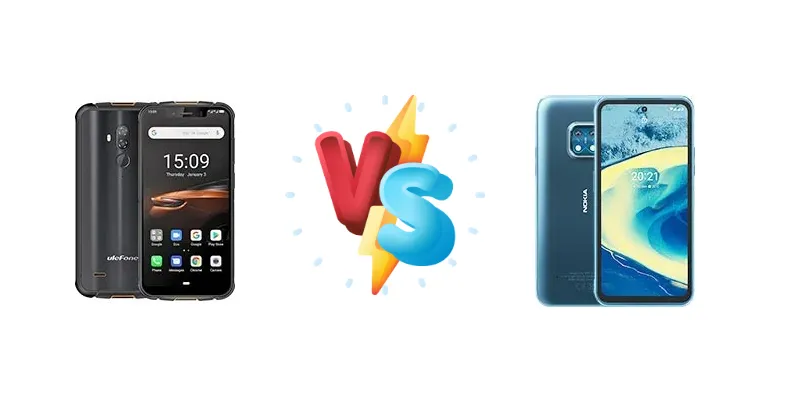
Ulefone Armor 5S vs Nokia XR20: A Head-to-Head Rugged Smartphone Showdown
| Phones Images | |||||
|---|---|---|---|---|---|
|
🏆 Quick Verdict
For the average user prioritizing future-proofing and smoother performance, the Nokia XR20 is the better choice. Its Snapdragon 480 5G chipset, built on an 8nm process, offers a substantial performance and efficiency advantage over the Ulefone Armor 5S’s older Helio P23. While the Armor 5S is more affordable, the XR20’s 5G connectivity and faster charging justify the price difference.
| PHONES | ||
|---|---|---|
| Phone Names | Ulefone Armor 5S | Nokia XR20 |
| Network | ||
|---|---|---|
| 2G bands | GSM 850 / 900 / 1800 / 1900 | GSM 850 / 900 / 1800 / 1900 |
| 3G bands | HSDPA 850 / 900 / 1700(AWS) / 1900 / 2100 | HSDPA 850 / 900 / 1700(AWS) / 1900 / 2100 |
| 4G bands | 1, 2, 3, 4, 5, 7, 8, 12, 17, 19, 20 | 1, 2, 3, 4, 5, 7, 8, 12, 13, 14, 20, 25, 26, 28, 30, 38, 40, 41, 48, 66, 71 |
| 5G bands | - | 2, 5, 25, 38, 41, 48, 66, 77, 78 SA/NSA |
| Speed | HSPA 21.1/5.76 Mbps, LTE (2CA) Cat7 300/150 Mbps | HSPA, LTE, 5G |
| Technology | GSM / HSPA / LTE | GSM / CDMA / HSPA / EVDO / LTE / 5G |
| - | CDMA2000 1xEV-DO | |
| Launch | ||
|---|---|---|
| Announced | 2019, July. Released 2019, July | 2021, July 27 |
| Status | Discontinued | Available. Released 2021, August 04 |
| Body | ||
|---|---|---|
| Dimensions | 158.3 x 76 x 12.6 mm (6.23 x 2.99 x 0.50 in) | 171.6 x 81.5 x 10.6 mm (6.76 x 3.21 x 0.42 in) |
| SIM | Nano-SIM + Nano-SIM | · Nano-SIM· Nano-SIM + Nano-SIM |
| Weight | 228 g (8.04 oz) | 248 g (8.75 oz) |
| IP68 dust/water resistant (up to 1.5m for 30 min) Drop-to-concrete resistance from up to 1.2m MIL-STD-810G compliant | IP68 dust/water resistant (up to 1.5m for 60 min) Drop-to-concrete resistance from up to 1.8m MIL-STD-810H compliant | |
| Display | ||
|---|---|---|
| Protection | - | Corning Gorilla Glass Victus |
| Resolution | 720 x 1512 pixels, 19:9 ratio (~286 ppi density) | 1080 x 2400 pixels, 20:9 ratio (~395 ppi density) |
| Size | 5.85 inches, 85.7 cm2 (~71.2% screen-to-body ratio) | 6.67 inches, 107.4 cm2 (~76.8% screen-to-body ratio) |
| Type | IPS LCD | IPS LCD, 550 nits |
| Platform | ||
|---|---|---|
| CPU | Octa-core (4x2.3 GHz Cortex-A53 & 4x1.5 GHz Cortex-A53) | Octa-core (2x2.0 GHz Kryo 460 & 6x1.8 GHz Kryo 460) |
| Chipset | Mediatek MT6763 Helio P23 (16 nm) | Qualcomm SM4350 Snapdragon 480 5G (8 nm) |
| GPU | Mali-G71 MP2 | Adreno 619 |
| OS | Android 9.0 (Pie) | Android 11, upgradable to Android 13 |
| Memory | ||
|---|---|---|
| Card slot | microSDXC (uses shared SIM slot) | microSDXC (uses shared SIM slot) |
| Internal | 64GB 4GB RAM | 64GB 4GB RAM, 128GB 6GB RAM |
| eMMC 5.1 | - | |
| Main Camera | ||
|---|---|---|
| Dual | 13 MP, f/1.8, (wide), AF 2 MP | 48 MP, f/1.8, (wide), 1/2.25", 0.8µm, PDAF 13 MP, f/2.4, 123˚ (ultrawide), 1/3.0", 1.12µm |
| Features | Dual-LED dual-tone flash, HDR, panorama | Zeiss optics, Dual-LED dual-tone flash, second LED flash, HDR, panorama |
| Single | - | 8 MP, f/2.0 (wide), 1/4.0", 1.12µm |
| Video | 1080p@30fps | 1080p@30fps |
| Selfie camera | ||
|---|---|---|
| Single | 8 MP | 8 MP, f/2.0 (wide), 1/4.0", 1.12µm |
| Video | 1080p@30fps | 1080p@30fps |
| Sound | ||
|---|---|---|
| 3.5mm jack | No | Yes |
| 35mm jack | No | Yes |
| Loudspeaker | Yes | Yes, with stereo speakers |
| Comms | ||
|---|---|---|
| Bluetooth | 4.0, A2DP | 5.1, A2DP, LE, aptX Adaptive |
| NFC | Yes | Yes |
| Positioning | GPS, GLONASS | GPS (L1+L5), GLONASS, BDS, GALILEO, QZSS, NavIC |
| Radio | Stereo FM radio, RDS, recording | Unspecified |
| USB | USB Type-C 2.0, OTG | USB Type-C 3.0 |
| WLAN | Wi-Fi 802.11 a/b/g/n, dual-band, Wi-Fi Direct | Wi-Fi 802.11 a/b/g/n/ac/6, dual-band, Wi-Fi Direct |
| Features | ||
|---|---|---|
| Sensors | Fingerprint (rear-mounted), accelerometer, gyro, proximity, compass, coulombmeter | Fingerprint (side-mounted), accelerometer, gyro, proximity, compass, barometer |
| Battery | ||
|---|---|---|
| Charging | 10W wired 10W wireless | 18W wired 15W wireless |
| Type | Li-Po 5000 mAh | Li-Po 4630 mAh |
| Misc | ||
|---|---|---|
| Colors | Black | Ultra Blue, Granite Gray |
| Models | - | TA-1368, TA-1362 |
| Price | - | About 270 EUR |
| SAR EU | - | 1.13 W/kg (head) 1.43 W/kg (body) |
Ulefone Armor 5S
- Significantly more affordable
- Extremely rugged and durable build
- Wireless charging support
- Outdated and less powerful processor
- Slow charging speeds (10W)
- Lacks 5G connectivity
Nokia XR20
- Modern and efficient Snapdragon 480 5G chipset
- Faster charging (18W wired, 15W wireless)
- 5G connectivity for future-proofing
- Higher price point
- May not be as aggressively priced as the Armor 5S
- Rugged design may feel bulky
Display Comparison
Neither Ulefone nor Nokia provide detailed display specs beyond resolution. However, the core difference lies elsewhere. The Armor 5S likely utilizes an IPS LCD, common in its price bracket, while the XR20’s panel is unspecified but benefits from the more modern chipset’s image signal processor for potentially better color accuracy. The lack of high refresh rates on either device suggests a focus on power efficiency, crucial for extended outdoor use. Bezels are expected to be substantial on both, prioritizing screen protection over a sleek aesthetic.
Camera Comparison
Detailed camera specs are unavailable for both devices. However, given the target market, image quality is likely secondary to durability. Both phones likely feature a primary camera for basic photography, but image processing will be where the XR20 shines. The Snapdragon 480’s ISP offers superior noise reduction and dynamic range compared to the Helio P23’s ISP. Expect the XR20 to produce more usable images in challenging lighting conditions. Any secondary cameras (likely macro or depth sensors) will be of limited utility on both devices.
Performance
The performance gap is the most significant differentiator. The Nokia XR20’s Qualcomm Snapdragon 480 5G (8nm) is a clear upgrade over the Ulefone Armor 5S’s MediaTek Helio P23 (16nm). The 8nm process node translates to better thermal efficiency, reducing throttling during sustained tasks. The Snapdragon 480’s Kryo 460 cores, with a 2x2.0 GHz + 6x1.8 GHz configuration, offer a more balanced and efficient performance profile than the Helio P23’s 4x2.3 GHz + 4x1.5 GHz Cortex-A53 setup. This means the XR20 will handle multitasking, app loading, and light gaming noticeably faster. The XR20 also benefits from 5G connectivity, a feature absent in the Armor 5S.
Battery Life
While specific battery capacities aren't provided, the XR20’s 18W wired charging and 15W wireless charging offer a significant advantage over the Armor 5S’s 10W wired and 10W wireless charging. The more efficient Snapdragon 480 chipset will also contribute to longer battery life under typical usage. The faster charging speeds on the XR20 mean less downtime, crucial for users who rely on their phone throughout the day. The Armor 5S’s slower charging will require more patience to replenish the battery.
Buying Guide
Buy the Ulefone Armor 5S if you need a highly affordable, extremely durable phone for basic tasks and aren't concerned with 5G or demanding applications. It's ideal for construction workers or outdoor enthusiasts on a tight budget. Buy the Nokia XR20 if you prioritize 5G connectivity, smoother multitasking, and faster charging, and are willing to spend a bit more for a more modern and capable rugged device. This is the better option for users who rely on their phone for navigation, communication, and occasional media consumption in challenging environments.