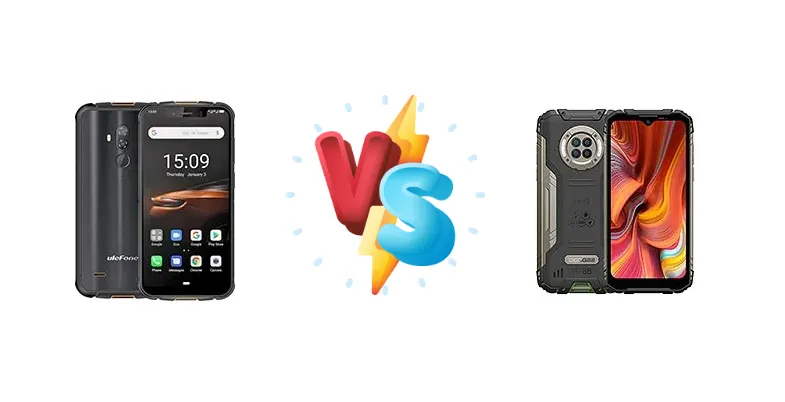
The rugged smartphone market caters to a specific user: those needing durability and reliability in challenging environments. Both the Ulefone Armor 5S and Doogee S96 Pro aim to deliver this, but they take different approaches to performance and features. The Armor 5S represents a more budget-conscious entry point, while the S96 Pro targets users who prioritize processing power for demanding tasks.
🏆 Quick Verdict
For the average user needing a dependable, affordable rugged phone, the Doogee S96 Pro is the clear winner. Its Helio G90 chipset provides a significant performance boost over the Armor 5S’s Helio P23, making it better suited for gaming and multitasking. While both offer wireless charging, the S96 Pro’s faster wired charging is a practical advantage.
| Network |
|---|
| 2G bands | GSM 850 / 900 / 1800 / 1900 | GSM 850 / 900 / 1800 / 1900 |
| 3G bands | HSDPA 850 / 900 / 1700(AWS) / 1900 / 2100 | HSDPA 800 / 850 / 900 / 1700(AWS) / 1900 / 2100 |
| 4G bands | 1, 2, 3, 4, 5, 7, 8, 12, 17, 19, 20 | 1, 2, 3, 4, 5, 7, 8, 12, 13, 17, 18, 19, 20, 25, 26, 28, 38, 40, 66 |
| Speed | HSPA 21.1/5.76 Mbps, LTE (2CA) Cat7 300/150 Mbps | HSPA, LTE |
| Technology | GSM / HSPA / LTE | GSM / CDMA / HSPA / LTE |
| Launch |
|---|
| Announced | 2019, July. Released 2019, July | 2020, October 26. Released 2020, November |
| Status | Discontinued | Discontinued |
| Body |
|---|
| Dimensions | 158.3 x 76 x 12.6 mm (6.23 x 2.99 x 0.50 in) | 167 x 81.4 x 15.5 mm (6.57 x 3.20 x 0.61 in) |
| SIM | Nano-SIM + Nano-SIM | Nano-SIM + Nano-SIM |
| Weight | 228 g (8.04 oz) | 310 g (10.93 oz) |
| | IP68 dust/water resistant (up to 1.5m for 30 min)
Drop-to-concrete resistance from up to 1.2m
MIL-STD-810G compliant | - |
| Display |
|---|
| Protection | - | Corning Gorilla Glass |
| Resolution | 720 x 1512 pixels, 19:9 ratio (~286 ppi density) | 720 x 1520 pixels, 19:9 ratio (~270 ppi density) |
| Size | 5.85 inches, 85.7 cm2 (~71.2% screen-to-body ratio) | 6.22 inches, 96.6 cm2 (~71.0% screen-to-body ratio) |
| Type | IPS LCD | IPS LCD |
| Platform |
|---|
| CPU | Octa-core (4x2.3 GHz Cortex-A53 & 4x1.5 GHz Cortex-A53) | Octa-core (2x2.0 GHz Cortex-A76 & 6x2.0 GHz Cortex-A55) |
| Chipset | Mediatek MT6763 Helio P23 (16 nm) | Mediatek MT6785 Helio G90 (12 nm) |
| GPU | Mali-G71 MP2 | Mali-G76 MC4 |
| OS | Android 9.0 (Pie) | Android 10 |
| Memory |
|---|
| Card slot | microSDXC (uses shared SIM slot) | microSDXC (dedicated slot) |
| Internal | 64GB 4GB RAM | 128GB 8GB RAM |
| | eMMC 5.1 | - |
| Main Camera |
|---|
| Dual | 13 MP, f/1.8, (wide), AF
2 MP | - |
| Features | Dual-LED dual-tone flash, HDR, panorama | Quad-LED flash, HDR, panorama |
| Quad | - | 48 MP, f/1.8, (wide), PDAF
8 MP, f/2.2, 130˚, (ultrawide)
20 MP, f/2.8, (night vision), 4 infrared night vision lights
2 MP (macro) |
| Video | 1080p@30fps | 1080p |
| Selfie camera |
|---|
| Single | 8 MP | 16 MP, f/2.0, (wide) |
| Video | 1080p@30fps | 1080p |
| Sound |
|---|
| 3.5mm jack | No | - |
| 35mm jack | No | Yes |
| Loudspeaker | Yes | Yes |
| Comms |
|---|
| Bluetooth | 4.0, A2DP | 5.0, A2DP, LE |
| NFC | Yes | Yes |
| Positioning | GPS, GLONASS | GPS, GLONASS, BDS, GALILEO |
| Radio | Stereo FM radio, RDS, recording | FM radio |
| USB | USB Type-C 2.0, OTG | USB Type-C 2.0, OTG |
| WLAN | Wi-Fi 802.11 a/b/g/n, dual-band, Wi-Fi Direct | Wi-Fi 802.11 a/b/g/n/ac, dual-band |
| Features |
|---|
| Sensors | Fingerprint (rear-mounted), accelerometer, gyro, proximity, compass, coulombmeter | Fingerprint (side-mounted), accelerometer, gyro, proximity, compass |
| Battery |
|---|
| Charging | 10W wired
10W wireless | 24W wired
10W wireless |
| Type | Li-Po 5000 mAh | 6350 mAh |
| Misc |
|---|
| Colors | Black | Black, Orange, Green |
| Price | - | About 280 EUR |
Ulefone Armor 5S
- More affordable price point
- Rugged design for durability
- Wireless charging support
- Outdated Helio P23 chipset
- Slow 10W wired charging
- Likely lower camera performance
Doogee S96 Pro
- Powerful Helio G90 chipset
- Fast 24W wired charging
- Potentially superior camera system
- Higher price compared to Armor 5S
- Rugged design may be bulky
- Wireless charging is slower than wired
Display Comparison
Neither device's display specifications are provided, so a direct comparison is limited. However, given the Armor 5S's positioning, it likely utilizes a standard IPS LCD panel. The S96 Pro, being a more recent and higher-tier device, may incorporate features like higher peak brightness for outdoor visibility. The absence of details like resolution and refresh rate makes a definitive assessment impossible, but the S96 Pro likely offers a more visually appealing experience due to its higher market segment.
Camera Comparison
Without specific camera sensor details, a detailed comparison is challenging. However, the S96 Pro’s higher price point suggests a more capable camera system. While both phones likely feature multiple rear cameras, the S96 Pro is more likely to have a larger primary sensor with a wider aperture, resulting in better low-light performance and dynamic range. The Armor 5S likely prioritizes affordability over camera quality, potentially resulting in softer images and less detail in challenging lighting conditions. The presence of OIS (Optical Image Stabilization) is also more probable on the S96 Pro, further enhancing image clarity.
Performance
The core difference lies in the chipsets. The Ulefone Armor 5S utilizes the Mediatek MT6763 Helio P23, a 16nm processor with an octa-core configuration split between 2.3 GHz and 1.5 GHz Cortex-A53 cores. This is a relatively older architecture focused on efficiency. Conversely, the Doogee S96 Pro boasts the Mediatek MT6785 Helio G90, built on a more efficient 12nm process. Its CPU configuration – 2x2.0 GHz Cortex-A76 and 6x2.0 GHz Cortex-A55 – represents a significant architectural leap. The Cortex-A76 cores deliver substantially higher single-core performance, crucial for responsive app launches and smoother multitasking. This translates to a noticeably faster and more fluid user experience on the S96 Pro, particularly for gaming and resource-intensive applications.
Battery Life
Both devices support 10W wireless charging, but the charging speeds differ significantly when wired. The Ulefone Armor 5S is limited to 10W wired charging, while the Doogee S96 Pro supports a much faster 24W wired charging. This means the S96 Pro can replenish its battery significantly quicker, reducing downtime. While battery capacity isn’t specified, the faster charging of the S96 Pro mitigates any potential disadvantage from a slightly smaller battery size, offering a more convenient charging experience for users on the go.
Buying Guide
Buy the Ulefone Armor 5S if you need a highly affordable, basic rugged phone for essential communication and light tasks, prioritizing cost savings over raw performance. Buy the Doogee S96 Pro if you prefer a more powerful device capable of handling demanding applications, gaming, and faster charging, even if it comes at a higher price point. The S96 Pro is for users who want a rugged phone that doesn't compromise on usability.
Frequently Asked Questions
❓ Will the Doogee S96 Pro handle demanding games like PUBG or Call of Duty Mobile smoothly?
The Helio G90 chipset in the Doogee S96 Pro is specifically designed for gaming. It offers a substantial performance increase over the Armor 5S’s Helio P23, allowing for smoother frame rates and a more enjoyable gaming experience in titles like PUBG and Call of Duty Mobile, likely at medium to high settings.
❓ How much faster is the 24W charging on the Doogee S96 Pro compared to the 10W charging on the Ulefone Armor 5S?
24W charging is significantly faster than 10W. While exact 0-100% times depend on battery capacity (which isn't specified), you can expect the S96 Pro to charge roughly 2.4 times faster than the Armor 5S. This means less time tethered to a charger and more time using your phone.
❓ Is the performance difference between the Helio P23 and Helio G90 noticeable for everyday tasks like browsing and social media?
Yes, the difference is noticeable. While both chips can handle basic tasks, the Helio G90’s more modern architecture and faster cores result in snappier app launches, smoother scrolling, and a more responsive overall user experience. The Armor 5S may exhibit slight lag or stuttering during multitasking, which the S96 Pro should avoid.