
Ulefone Armor 3WT vs Doogee S96 Pro: A Head-to-Head Rugged Smartphone Showdown
| Phones Images | |||||
|---|---|---|---|---|---|
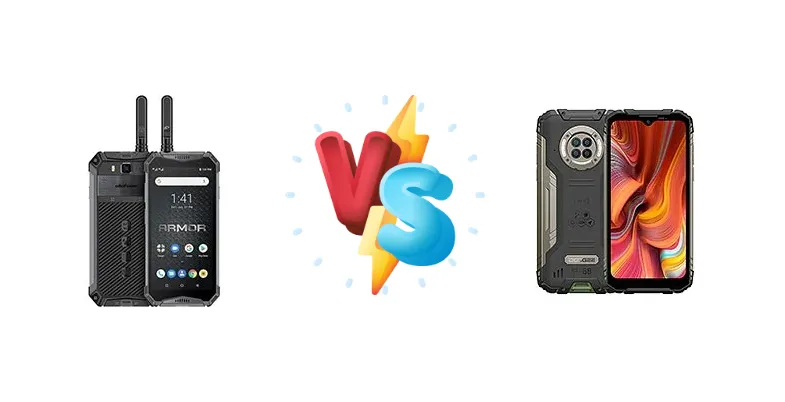
|
🏆 Quick Verdict
For most users prioritizing performance and faster charging, the Doogee S96 Pro is the clear winner. Its Helio G90 chipset offers a substantial performance uplift over the Armor 3WT’s Helio P70, and the inclusion of wireless charging adds convenience. However, the Armor 3WT remains a viable option for budget-conscious buyers.
| PHONES | ||
|---|---|---|
| Phone Names | Ulefone Armor 3WT | Doogee S96 Pro |
| Network | ||
|---|---|---|
| 2G bands | GSM 850 / 900 / 1800 / 1900 | GSM 850 / 900 / 1800 / 1900 |
| 3G bands | HSDPA 800 / 850 / 900 / 1700(AWS) / 1900 / 2100 | HSDPA 800 / 850 / 900 / 1700(AWS) / 1900 / 2100 |
| 4G bands | 1, 2, 3, 4, 5, 7, 8, 12, 13, 17, 18, 19, 20, 25, 26, 28, 34, 38, 39, 40, 41 | 1, 2, 3, 4, 5, 7, 8, 12, 13, 17, 18, 19, 20, 25, 26, 28, 38, 40, 66 |
| Speed | HSPA 42.2/11.5 Mbps, LTE (2CA) Cat7 300/150 Mbps | HSPA, LTE |
| Technology | GSM / CDMA / HSPA / EVDO / LTE | GSM / CDMA / HSPA / LTE |
| CDMA2000 1xEV-DO | - | |
| Launch | ||
|---|---|---|
| Announced | 2019, September. Released 2019, September | 2020, October 26. Released 2020, November |
| Status | Discontinued | Discontinued |
| Body | ||
|---|---|---|
| Dimensions | 164.8 x 79.2 x 18.2 mm (6.49 x 3.12 x 0.72 in) | 167 x 81.4 x 15.5 mm (6.57 x 3.20 x 0.61 in) |
| SIM | Nano-SIM + Nano-SIM | Nano-SIM + Nano-SIM |
| Weight | 373.7 g (13.33 oz) | 310 g (10.93 oz) |
| IP68 dust/water resistant (up to 1.5m for 30 min) Drop-to-concrete resistance from up to 1.2m MIL-STD-810G compliant External antenna | - | |
| Display | ||
|---|---|---|
| Protection | - | Corning Gorilla Glass |
| Resolution | 1080 x 2160 pixels, 18:9 ratio (~424 ppi density) | 720 x 1520 pixels, 19:9 ratio (~270 ppi density) |
| Size | 5.7 inches, 83.8 cm2 (~64.2% screen-to-body ratio) | 6.22 inches, 96.6 cm2 (~71.0% screen-to-body ratio) |
| Type | IPS LCD | IPS LCD |
| Platform | ||
|---|---|---|
| CPU | Octa-core (4x2.1 GHz Cortex-A73 & 4x2.1 GHz Cortex-A53) | Octa-core (2x2.0 GHz Cortex-A76 & 6x2.0 GHz Cortex-A55) |
| Chipset | Mediatek MT6771 Helio P70 (12 nm) | Mediatek MT6785 Helio G90 (12 nm) |
| GPU | Mali-G72 MP3 | Mali-G76 MC4 |
| OS | Android 9.0 (Pie) | Android 10 |
| Memory | ||
|---|---|---|
| Card slot | microSDXC (dedicated slot) | microSDXC (dedicated slot) |
| Internal | 64GB 6GB RAM | 128GB 8GB RAM |
| eMMC 5.1 | - | |
| Main Camera | ||
|---|---|---|
| Features | Dual-LED dual-tone flash, HDR, panorama | Quad-LED flash, HDR, panorama |
| Quad | - | 48 MP, f/1.8, (wide), PDAF 8 MP, f/2.2, 130˚, (ultrawide) 20 MP, f/2.8, (night vision), 4 infrared night vision lights 2 MP (macro) |
| Single | 21 MP, f/1.8, (wide), 1/2.4", 1.12µm, PDAF | - |
| Video | 1080p@30fps | 1080p |
| Selfie camera | ||
|---|---|---|
| Single | 8 MP | 16 MP, f/2.0, (wide) |
| Video | 1080p@30fps | 1080p |
| Sound | ||
|---|---|---|
| 3.5mm jack | No | - |
| 35mm jack | No | Yes |
| Loudspeaker | Yes | Yes |
| Comms | ||
|---|---|---|
| Bluetooth | 4.1, A2DP | 5.0, A2DP, LE |
| NFC | Yes | Yes |
| Positioning | GPS, GLONASS, BDS | GPS, GLONASS, BDS, GALILEO |
| Radio | Stereo FM radio, RDS, recording | FM radio |
| USB | USB Type-C 2.0, OTG | USB Type-C 2.0, OTG |
| WLAN | Wi-Fi 802.11 a/b/g/n/ac, dual-band, Wi-Fi Direct | Wi-Fi 802.11 a/b/g/n/ac, dual-band |
| Features | ||
|---|---|---|
| Sensors | Fingerprint (side-mounted), accelerometer, gyro, proximity, compass, barometer, coulombmeter | Fingerprint (side-mounted), accelerometer, gyro, proximity, compass |
| Battery | ||
|---|---|---|
| Charging | 18W wired | 24W wired 10W wireless |
| Type | Li-Po 10300 mAh | 6350 mAh |
| Misc | ||
|---|---|---|
| Colors | Black | Black, Orange, Green |
| Price | - | About 280 EUR |
Ulefone Armor 3WT
- More affordable price point
- Rugged design for durability
- Reliable for basic smartphone tasks
- Outdated Helio P70 chipset
- Slower charging speed (18W)
- Limited gaming performance
Doogee S96 Pro
- Powerful Helio G90 chipset
- Faster 24W wired and 10W wireless charging
- Improved gaming and multitasking capabilities
- Higher price compared to the Armor 3WT
- Rugged design may be bulky
- Potentially more complex repair process
Display Comparison
Neither Ulefone nor Doogee provide detailed display specifications beyond the basic panel type. However, the focus on ruggedness suggests both likely utilize IPS LCD panels for durability. The absence of high refresh rates or advanced features like LTPO is expected in this segment. The real-world impact is similar viewing experiences, prioritizing visibility in direct sunlight over color accuracy or smoothness.
Camera Comparison
Detailed camera specs are unavailable, but the focus in this segment is rarely on photographic excellence. Both phones likely feature a primary sensor paired with auxiliary lenses of limited utility. Without knowing sensor sizes or apertures, it’s difficult to make a definitive judgment. However, the G90’s ISP (Image Signal Processor) is more advanced, potentially leading to better image processing and low-light performance on the Doogee S96 Pro. The absence of detailed information suggests neither phone will compete with mainstream smartphone cameras.
Performance
The core difference lies in the chipsets. The Doogee S96 Pro’s MediaTek Helio G90 utilizes Cortex-A76 performance cores, a significant architectural improvement over the Cortex-A73 cores found in the Ulefone Armor 3WT’s Helio P70. The G90’s CPU offers a noticeable boost in single-core performance, crucial for responsive app loading and general usability. Furthermore, the G90’s Mali-G76 MP4 GPU provides a substantial advantage in graphics processing, making it the better choice for gaming. The Armor 3WT’s P70 is adequate for basic tasks, but will struggle with graphically intensive applications. The 12nm process node is shared between both chips, so thermal throttling potential is similar, but the G90 will likely reach higher sustained performance before throttling.
Battery Life
While battery capacity isn't specified, the Doogee S96 Pro gains a significant advantage with its 24W wired charging and 10W wireless charging capabilities. The Ulefone Armor 3WT is limited to 18W wired charging. This translates to faster top-ups for the S96 Pro, reducing downtime. Wireless charging adds convenience for users who prefer cable-free charging. The faster charging speed of the Doogee S96 Pro is a tangible benefit for users who rely heavily on their phones throughout the day.
Buying Guide
Buy the Ulefone Armor 3WT if you need a highly durable phone on a strict budget and don't require demanding gaming or intensive multitasking. It's ideal for basic communication and essential apps in harsh environments. Buy the Doogee S96 Pro if you prioritize performance for gaming, streaming, or productivity, and value the convenience of wireless charging. This phone is better suited for users who push their devices to the limit while working or adventuring outdoors.