
Ulefone Armor 3W vs. Ulefone Armor 10 5G: A Deep Dive into Rugged Performance
| Phones Images | |||||
|---|---|---|---|---|---|
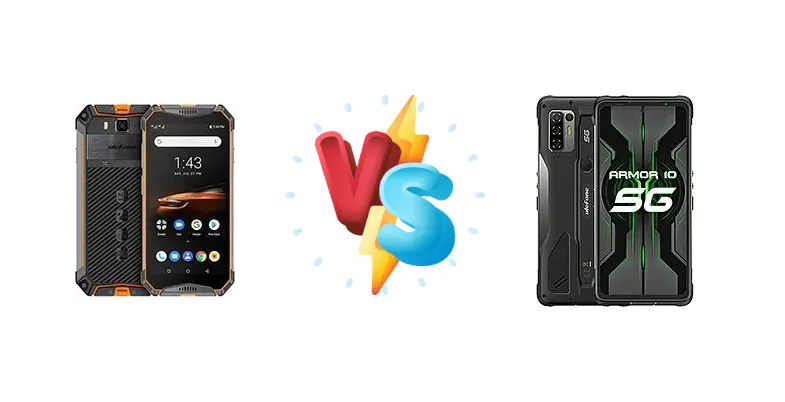
|
🏆 Quick Verdict
For most users, the Ulefone Armor 10 5G is the superior choice. Its Dimensity 800 chipset delivers significantly improved performance and future-proofs the device with 5G support. While the 3W offers a lower price, the performance gap is substantial enough to justify the extra investment for those who demand responsiveness.
| PHONES | ||
|---|---|---|
| Phone Names | Ulefone Armor 3W | Ulefone Armor 10 5G |
| Network | ||
|---|---|---|
| 2G bands | GSM 850 / 900 / 1800 / 1900 | GSM 850 / 900 / 1800 / 1900 |
| 3G bands | HSDPA 800 / 850 / 900 / 1700(AWS) / 1900 / 2100 | HSDPA 850 / 900 / 1700(AWS) / 1900 / 2100 |
| 4G bands | 1, 2, 3, 4, 5, 7, 8, 12, 13, 17, 18, 19, 20, 25, 26, 28, 34, 38, 39, 40, 41 | 1, 2, 3, 4, 5, 7, 8, 12, 13, 17, 18, 19, 20, 25, 26, 28, 34, 38, 39, 40, 41, 66 |
| 5G bands | - | 1, 3, 41, 77, 78, 79 SA/NSA |
| Speed | HSPA 42.2/11.5 Mbps, LTE (2CA) Cat7 300/150 Mbps | HSPA, LTE, 5G |
| Technology | GSM / CDMA / HSPA / EVDO / LTE | GSM / CDMA / HSPA / EVDO / LTE / 5G |
| CDMA2000 1xEV-DO | CDMA2000 1xEV-DO | |
| Launch | ||
|---|---|---|
| Announced | 2019, September. Released 2019, September | 2020, November 17. Released 2020, December 07 |
| Status | Discontinued | Discontinued |
| Body | ||
|---|---|---|
| Build | - | Front glass, aluminum back with rubber, aluminum frame |
| Dimensions | 164.8 x 79.2 x 18.2 mm (6.49 x 3.12 x 0.72 in) | 176.5 x 82.8 x 14.6 mm (6.95 x 3.26 x 0.57 in) |
| SIM | Nano-SIM + Nano-SIM | Nano-SIM + Nano-SIM |
| Weight | 365 g (12.87 oz) | 328 g (11.57 oz) |
| IP68 dust/water resistant (up to 1.5m for 30 min) Drop-to-concrete resistance from up to 1.2m MIL-STD-810G compliant | IP68 dust/water resistant (up to 1.5m for 30 min) Drop-to-concrete resistance from up to 1.2m MIL-STD-810G compliant | |
| Display | ||
|---|---|---|
| Protection | - | Scratch-resistant glass, oleophobic coating |
| Resolution | 1080 x 2160 pixels, 18:9 ratio (~424 ppi density) | 1080 x 2400 pixels, 20:9 ratio (~395 ppi density) |
| Size | 5.7 inches, 83.8 cm2 (~64.2% screen-to-body ratio) | 6.67 inches, 107.4 cm2 (~73.5% screen-to-body ratio) |
| Type | IPS LCD | IPS LCD |
| Platform | ||
|---|---|---|
| CPU | Octa-core (4x2.1 GHz Cortex-A73 & 4x2.1 GHz Cortex-A53) | Octa-core (4x2.0 GHz Cortex-A76 & 4x2.0 GHz Cortex-A55) |
| Chipset | Mediatek MT6771 Helio P70 (12 nm) | Mediatek Dimensity 800 (7 nm) |
| GPU | Mali-G72 MP3 | Mali-G57 MP4 |
| OS | Android 9.0 (Pie) | Android 10, planned upgrade to Android 11 |
| Memory | ||
|---|---|---|
| Card slot | microSDXC (dedicated slot) | microSDXC (uses shared SIM slot) |
| Internal | 64GB 6GB RAM | 128GB 8GB RAM |
| eMMC 5.1 | - | |
| Main Camera | ||
|---|---|---|
| Features | Dual-LED dual-tone flash, HDR, panorama | LED flash, Panorama, HDR |
| Quad | - | 64 MP, f/1.9, 26mm (wide), 1/1.72", 0.8µm, PDAF 8 MP, f/2.2, 119˚ (ultrawide) 5 MP (macro) Auxiliary lens |
| Single | 21 MP, f/1.8, (wide), 1/2.4", 1.12µm, PDAF | - |
| Video | 1080p@30fps | 4K@30fps, 1080p@30fps |
| Selfie camera | ||
|---|---|---|
| Single | 8 MP | 16 MP, f/2.2 |
| Video | 1080p@30fps | 1080p@30fps |
| Sound | ||
|---|---|---|
| 3.5mm jack | No | Yes |
| 35mm jack | No | Yes |
| Loudspeaker | Yes | Yes |
| Comms | ||
|---|---|---|
| Bluetooth | 4.1, A2DP | 5.2, A2DP, LE |
| NFC | Yes | Yes |
| Positioning | GPS, GLONASS, BDS | GPS, GLONASS, GALILEO, BDS |
| Radio | Stereo FM radio, RDS, recording | FM radio, RDS, recording |
| USB | USB Type-C 2.0, OTG | USB Type-C 2.0, OTG |
| WLAN | Wi-Fi 802.11 a/b/g/n/ac, dual-band, Wi-Fi Direct | Wi-Fi 802.11 a/b/g/n/ac, Wi-Fi Direct |
| Features | ||
|---|---|---|
| Sensors | Fingerprint (side-mounted), accelerometer, gyro, proximity, compass, barometer, coulombmeter | Fingerprint (side-mounted), accelerometer, gyro, proximity, compass, baroceptor, coulombmeter |
| Battery | ||
|---|---|---|
| Charging | 18W wired | 15W wired 15W wireless |
| Type | Li-Po 10300 mAh | Li-Po 5800 mAh |
| Misc | ||
|---|---|---|
| Colors | Black/Orange | Black |
| Price | - | About 420 EUR |
Ulefone Armor 3W
- More affordable price point
- Slightly faster wired charging (18W)
- Rugged design for durability
- Significantly weaker processor (Helio P70)
- Lacks 5G connectivity
- Less efficient chipset
Ulefone Armor 10 5G
- Much faster processor (Dimensity 800)
- 5G connectivity for faster data speeds
- Wireless charging support
- Slightly slower wired charging (15W)
- Higher price tag
- Potentially higher power consumption (though offset by 7nm process)
Display Comparison
Neither Ulefone provides display specifications beyond size, so a detailed comparison is limited. However, the Armor 10 5G’s more modern chipset suggests a potentially higher-quality panel with better color accuracy and viewing angles. The Armor 3W, relying on the older Helio P70, likely utilizes a more basic LCD panel. Bezels are expected to be similar on both, given their rugged design focus.
Camera Comparison
Without detailed camera specs, a direct comparison is difficult. However, the Armor 10 5G’s more powerful ISP (Image Signal Processor) within the Dimensity 800 chipset will likely result in better image processing, particularly in low-light conditions. Both phones likely feature similar sensor configurations, potentially including a primary sensor, an ultra-wide, and macro lenses. The Armor 3W’s older chipset may limit its ability to take advantage of advanced camera features.
Performance
The performance difference is the most significant factor. The Armor 10 5G’s MediaTek Dimensity 800 (7nm) is a substantial upgrade over the Armor 3W’s Helio P70 (12nm). The Dimensity 800 utilizes Cortex-A76 cores, offering a noticeable improvement in single-core performance, while the 7nm process provides better power efficiency and thermal management. This translates to smoother multitasking, faster app loading times, and a more responsive user experience on the Armor 10 5G. The Armor 3W’s Cortex-A73 cores are adequate for basic tasks, but will struggle with demanding applications.
Battery Life
While the Armor 10 5G has slightly slower wired charging at 15W compared to the Armor 3W’s 18W, it compensates with the addition of 15W wireless charging – a convenience feature absent on the 3W. The Dimensity 800’s improved power efficiency also contributes to potentially longer battery life despite similar battery capacities (not specified in the provided data). The 18W charging on the 3W will offer a slightly faster 0-100% charge time, but the Armor 10 5G’s wireless charging provides added flexibility.
Buying Guide
Buy the Ulefone Armor 3W if you prioritize affordability and only need basic smartphone functionality for tasks like calls, texts, and light app usage in a rugged package. Buy the Ulefone Armor 10 5G if you require faster processing speeds for multitasking, gaming, or demanding applications, and if 5G connectivity is a necessity for your location and data plan.