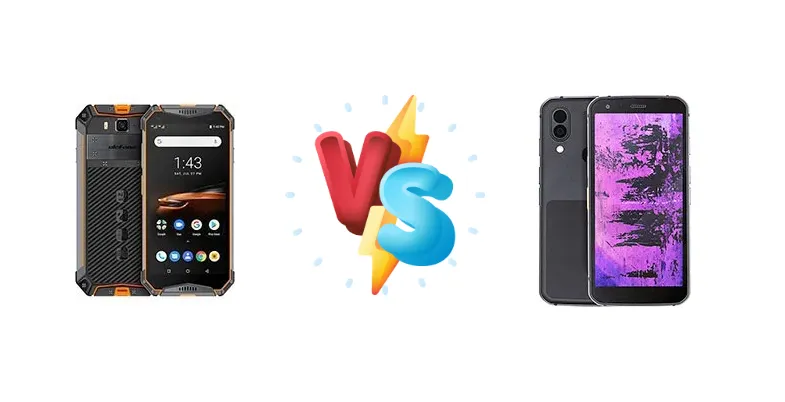
The rugged smartphone market caters to a specific user: those needing a device that can withstand drops, dust, and water. Both the Ulefone Armor 3W and the Cat S62 Pro aim to deliver this durability, but they differ significantly in their internal hardware. This comparison dives deep into the chipset choices, performance implications, and overall value proposition of each device, helping you determine which one best suits your demanding lifestyle.
🏆 Quick Verdict
For the average user prioritizing consistent performance and a more refined software experience, the Cat S62 Pro emerges as the better choice. While the Ulefone Armor 3W offers a compelling price point, the Snapdragon 660’s architectural advantages and optimized power efficiency translate to a smoother, more reliable user experience, especially under sustained load.
| Network |
|---|
| 2G bands | GSM 850 / 900 / 1800 / 1900 | GSM 850 / 900 / 1800 / 1900 |
| 3G bands | HSDPA 800 / 850 / 900 / 1700(AWS) / 1900 / 2100 | HSDPA 850 / 900 / 1700(AWS) / 1900 / 2100 |
| 4G bands | 1, 2, 3, 4, 5, 7, 8, 12, 13, 17, 18, 19, 20, 25, 26, 28, 34, 38, 39, 40, 41 | 1, 2, 3, 4, 5, 7, 8, 20, 28, 38, 40 |
| Speed | HSPA 42.2/11.5 Mbps, LTE (2CA) Cat7 300/150 Mbps | HSPA 42.2/5.76 Mbps, LTE (2CA) Cat13 400/150 Mbps |
| Technology | GSM / CDMA / HSPA / EVDO / LTE | GSM / HSPA / LTE |
| | CDMA2000 1xEV-DO | - |
| Launch |
|---|
| Announced | 2019, September. Released 2019, September | 2020, June 28. Released 2020, August 17 |
| Status | Discontinued | Discontinued |
| Body |
|---|
| Build | - | Glass front (Gorilla Glass 6), plastic back, aluminum frame |
| Dimensions | 164.8 x 79.2 x 18.2 mm (6.49 x 3.12 x 0.72 in) | 158.5 x 76.7 x 11.9 mm (6.24 x 3.02 x 0.47 in) |
| SIM | Nano-SIM + Nano-SIM | · Nano-SIM· Nano-SIM + Nano-SIM |
| Weight | 365 g (12.87 oz) | 248 g (8.75 oz) |
| | IP68 dust/water resistant (up to 1.5m for 30 min)
Drop-to-concrete resistance from up to 1.2m
MIL-STD-810G compliant | IP68/IP69 dust/water resistant (up to 1.5m for 35 mins)
Drop-to-concrete resistance from up to 1.8m
MIL-STD-810H compliant |
| Display |
|---|
| Protection | - | Corning Gorilla Glass 6 |
| Resolution | 1080 x 2160 pixels, 18:9 ratio (~424 ppi density) | 1080 x 2160 pixels, 18:9 ratio (~424 ppi density) |
| Size | 5.7 inches, 83.8 cm2 (~64.2% screen-to-body ratio) | 5.7 inches, 83.8 cm2 (~69.0% screen-to-body ratio) |
| Type | IPS LCD | IPS LCD |
| Platform |
|---|
| CPU | Octa-core (4x2.1 GHz Cortex-A73 & 4x2.1 GHz Cortex-A53) | Octa-core (4x2.2 GHz Kryo 260 Gold & 4x1.8 GHz Kryo 260 Silver) |
| Chipset | Mediatek MT6771 Helio P70 (12 nm) | Qualcomm SDM660 Snapdragon 660 (14 nm) |
| GPU | Mali-G72 MP3 | Adreno 512 |
| OS | Android 9.0 (Pie) | Android 10 |
| Memory |
|---|
| Card slot | microSDXC (dedicated slot) | microSDXC (dedicated slot) |
| Internal | 64GB 6GB RAM | 128GB 6GB RAM |
| | eMMC 5.1 | - |
| Main Camera |
|---|
| Dual | - | 12 MP, f/1.8, (wide), 1/2.55", 1.4µm, dual pixel PDAF
FLIR thermal camera (Lepton 3.5 module) |
| Features | Dual-LED dual-tone flash, HDR, panorama | Thermal imaging, heat palettes, temp. spot meter, LED flash |
| Single | 21 MP, f/1.8, (wide), 1/2.4", 1.12µm, PDAF | - |
| Video | 1080p@30fps | 1080p@30fps, gyro-EIS |
| Selfie camera |
|---|
| Single | 8 MP | 8 MP |
| Video | 1080p@30fps | 1080p@30fps |
| Sound |
|---|
| 3.5mm jack | No | No |
| 35mm jack | No | No |
| Loudspeaker | Yes | Yes |
| Comms |
|---|
| Bluetooth | 4.1, A2DP | 5.0, A2DP, LE |
| NFC | Yes | Yes |
| Positioning | GPS, GLONASS, BDS | GPS, GLONASS, GALILEO, BDS |
| Radio | Stereo FM radio, RDS, recording | FM radio |
| USB | USB Type-C 2.0, OTG | USB Type-C 2.0, OTG |
| WLAN | Wi-Fi 802.11 a/b/g/n/ac, dual-band, Wi-Fi Direct | Wi-Fi 802.11 a/b/g/n/ac, dual-band, Wi-Fi Direct |
| Features |
|---|
| Sensors | Fingerprint (side-mounted), accelerometer, gyro, proximity, compass, barometer, coulombmeter | Fingerprint (rear-mounted), accelerometer, gyro, proximity, compass |
| Battery |
|---|
| Charging | 18W wired | - |
| Type | Li-Po 10300 mAh | Li-Ion 4000 mAh |
| Misc |
|---|
| Colors | Black/Orange | Black |
| Price | - | About 530 EUR |
Ulefone Armor 3W
- More affordable price point
- Rugged design and build quality
- Decent performance for basic tasks
- Less powerful chipset compared to Snapdragon 660
- Potentially lower battery life
- Less refined software experience
Cat S62 Pro
- More powerful and efficient Snapdragon 660 chipset
- Potentially better camera performance
- Likely better software support and optimization
- Higher price tag
- Rugged design may be bulky
- May not offer significantly improved battery life over the Ulefone
Display Comparison
Neither Ulefone nor Cat provide detailed display specifications beyond basic resolution. However, the choice of panel technology and brightness are crucial for outdoor visibility. Given Cat’s brand positioning, it’s reasonable to expect a slightly better calibrated display with potentially higher peak brightness, though this remains unconfirmed. Both devices likely utilize IPS LCD panels, common in rugged phones for their durability. Bezels are expected to be substantial on both, prioritizing screen protection over a modern, edge-to-edge design.
Camera Comparison
Detailed camera specs are unavailable, but the focus should be on the main sensor and image processing. Given the target audience, image quality is likely secondary to durability. However, the Snapdragon 660’s image signal processor (ISP) is generally superior to the MediaTek equivalent, potentially resulting in better dynamic range and noise reduction in the Cat S62 Pro. The inclusion of Optical Image Stabilization (OIS) on the Cat S62 Pro, if present (based on Cat’s typical feature set), would be a significant advantage in low-light conditions. We can expect both phones to feature multiple rear cameras, but the quality of the secondary sensors (likely macro and depth) will be limited.
Performance
The core difference lies in the chipsets. The Cat S62 Pro’s Qualcomm Snapdragon 660 (14nm) utilizes custom Kryo cores, offering a more efficient and powerful architecture than the Ulefone Armor 3W’s MediaTek Helio P70 (12nm). While the P70 boasts a slightly higher clock speed on some cores (2.1 GHz vs 2.2 GHz on the Kryo 260 Gold), the Snapdragon 660’s superior instruction set architecture and optimized GPU provide a noticeable advantage in real-world performance, particularly in graphics-intensive tasks. The 14nm process node of the Snapdragon 660, while older, is well-refined, offering a good balance of performance and thermal management. The P70’s 12nm node doesn’t necessarily translate to better efficiency, as architecture plays a larger role.
Battery Life
Battery capacity is not specified in the provided data. However, the Snapdragon 660’s power efficiency gives the Cat S62 Pro an advantage in battery life, even with a potentially smaller battery. The Ulefone Armor 3W’s 18W wired charging is standard for this price range, but the Snapdragon 660’s Quick Charge support (likely present in the Cat S62 Pro) could enable faster charging speeds with a compatible charger. Real-world battery performance will depend heavily on usage patterns, but the Cat S62 Pro is expected to offer longer screen-on time and better standby endurance.
Buying Guide
Buy the Ulefone Armor 3W if you need a highly affordable, extremely durable phone for basic tasks and occasional use. It’s ideal for those on a tight budget who prioritize ruggedness above all else. Buy the Cat S62 Pro if you prefer a more responsive device capable of handling multitasking, moderate gaming, and demanding work applications, and are willing to pay a premium for Qualcomm’s proven chipset and potentially better long-term software support.
Frequently Asked Questions
❓ Will the Ulefone Armor 3W struggle with demanding apps like mapping or video editing?
The Helio P70 in the Ulefone Armor 3W is capable of handling basic tasks, but it will likely exhibit noticeable slowdowns and lag when running resource-intensive applications like detailed offline maps or video editing software. The Snapdragon 660 in the Cat S62 Pro offers a smoother experience for these workloads.
❓ Is the Cat S62 Pro likely to receive more software updates and security patches than the Ulefone Armor 3W?
Historically, Cat phones have received more consistent software updates and security patches compared to Ulefone devices. Qualcomm’s chipset also tends to have better long-term software support. This is a crucial consideration for users who prioritize security and access to the latest features.
❓ How does the thermal performance differ between the two phones during prolonged use?
The Snapdragon 660’s 14nm process, while older, is well-optimized for thermal management. The Ulefone Armor 3W’s Helio P70 might experience more throttling under sustained load, leading to reduced performance during extended gaming sessions or video recording.