
Ulefone Armor 34 vs. Power Armor 13: A Deep Dive into Rugged Smartphone Performance
| Phones Images | |||||
|---|---|---|---|---|---|
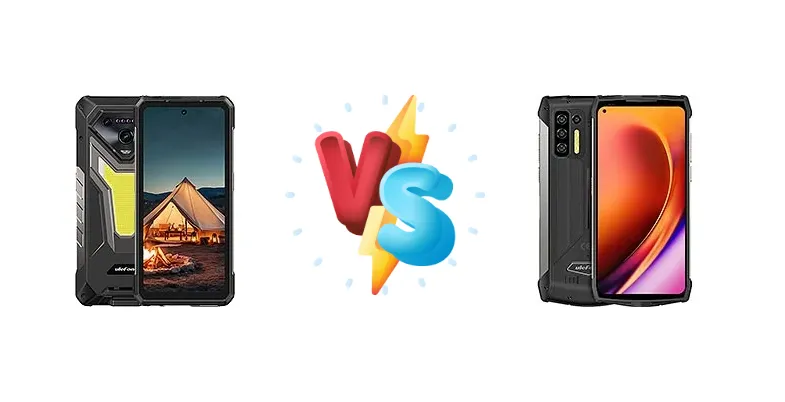
|
🏆 Quick Verdict
For most users, the Ulefone Armor 34 is the superior choice. Its Dimensity 7300 chipset offers a substantial performance boost over the Power Armor 13’s Helio G95, coupled with significantly improved battery endurance (384:54h vs 296h). While the Power Armor 13 offers wireless charging, the Armor 34’s faster wired charging and overall efficiency make it the winner.
| PHONES | ||
|---|---|---|
| Phone Names | Ulefone Armor 34 | Ulefone Power Armor 13 |
| Network | ||
|---|---|---|
| 2G bands | GSM 850 / 900 / 1800 / 1900 | GSM 850 / 900 / 1800 / 1900 |
| 3G bands | HSDPA 800 / 850 / 900 / 1700(AWS) / 1900 / 2100 | HSDPA 850 / 900 / 1700(AWS) / 1900 / 2100 |
| 4G bands | 1, 2, 3, 4, 5, 7, 8, 12, 13, 17, 18, 19, 20, 25, 26, 28, 32, 34, 38, 39, 40, 41, 66, 71 | 1, 2, 3, 4, 5, 7, 8, 12, 13, 17, 18, 19, 20, 25, 26, 28, 38, 40, 66 |
| 5G bands | 1, 2, 3, 5, 7, 8, 20, 25, 28, 38, 40, 41, 66, 71, 77, 78, 79 SA/NSA/Sub6 | - |
| Speed | HSPA, LTE, 5G | HSPA 42.2/11.5 Mbps, LTE Cat12 600/150 Mbps |
| Technology | GSM / HSPA / LTE / 5G | GSM / HSPA / LTE |
| Launch | ||
|---|---|---|
| Announced | 2025, August | 2021, July 22 |
| Status | Available. Released 2025, August 18 | Available. Released 2021, July 26 |
| Body | ||
|---|---|---|
| Dimensions | 183.1 x 86.6 x 32.7 mm (7.21 x 3.41 x 1.29 in) | 183.7 x 85.4 x 20.8 mm (7.23 x 3.36 x 0.82 in) |
| SIM | Nano-SIM + Nano-SIM | Nano-SIM + Nano-SIM |
| Weight | 763 g (1.68 lb) | 492 g (1.08 lb) |
| - | IP68 dust/water resistant (up to 1.5m for 30 min) Drop-to-concrete resistance from up to 1.2m MIL-STD-810G compliant | |
| Display | ||
|---|---|---|
| Protection | Corning Gorilla Glass 5, Mohs level 4 | Corning Gorilla Glass 3 |
| Resolution | 1080 x 2460 pixels (~387 ppi density) | 1080 x 2400 pixels, 20:9 ratio (~386 ppi density) |
| Size | 6.95 inches, 114.7 cm2 (~72.3% screen-to-body ratio) | 6.81 inches, 112.0 cm2 (~71.4% screen-to-body ratio) |
| Type | IPS LCD, 120Hz, 600 nits (peak) | IPS LCD |
| Platform | ||
|---|---|---|
| CPU | Octa-core (4x2.5 GHz Cortex-A78 & 4x2.0 GHz Cortex-A55) | Octa-core (2x2.05 GHz Cortex-A76 & 6x2.0 GHz Cortex-A55) |
| Chipset | Mediatek Dimensity 7300 (4 nm) | Mediatek MT6785V/CD Helio G95 (12 nm) |
| GPU | Mali-G615 MC2 | Mali-G76 MC4 |
| OS | Android 15 | Android 11 |
| Memory | ||
|---|---|---|
| Card slot | microSDXC (dedicated slot) | microSDXC (uses shared SIM slot) |
| Internal | 512GB 16GB RAM | 256GB 8GB RAM |
| Main Camera | ||
|---|---|---|
| Features | Dual-LED flash, HDR, panorama | Quad-LED flash, HDR, panorama |
| Penta | - | 48 MP, f/1.8, 26mm (wide), 1/2.0", 0.8µm, PDAF 8 MP, f/2.2, (ultrawide) 2 MP (macro) Auxiliary lens |
| Triple | 50 MP, f/2.0, 23mm (wide), 1/1.3", 1.2µm, multi-directional PDAF 64 MP, f/1.8, (night vision), 1/2.0", 0.7µm, 4 infrared lights 50 MP, f/2.2, 16mm, 117˚ (ultrawide), 1/2.76", 0.64µm | - |
| Video | 4K@30fps, 1080p@30fps, gyro-EIS | 4K@30fps, 1080p@30fps |
| Selfie camera | ||
|---|---|---|
| Features | - | HDR, panorama |
| Single | 32 MP, f/2.5, 25mm (wide), 1/2.8", 0.8µm | 16 MP, f/2.2 |
| Video | 1080p@30fps | 1080p@30fps |
| Sound | ||
|---|---|---|
| 3.5mm jack | - | Yes |
| 35mm jack | Yes | Yes |
| Loudspeaker | Yes | Yes |
| Comms | ||
|---|---|---|
| Bluetooth | 5.4, A2DP, LE | 5.0, A2DP, LE |
| Infrared port | Yes | - |
| NFC | Yes | Yes |
| Positioning | GPS, GALILEO, GLONASS, QZSS, BDS, NavIC | GPS, GLONASS, GALILEO, BDS |
| Radio | Wireless FM radio, RDS, recording | FM radio, RDS, recording |
| USB | USB Type-C 2.0, OTG, accessory connector pins | - |
| WLAN | Wi-Fi 802.11 a/b/g/n/ac/6, dual-band | Wi-Fi 802.11 a/b/g/n/ac, dual-band |
| Features | ||
|---|---|---|
| Sensors | Fingerprint (side-mounted), accelerometer, gyro, proximity, compass, barometer | Fingerprint (side-mounted), accelerometer, gyro, proximity, compass, baroceptor, coulombmeter |
| - | Infrared distance measure (error range: 1~20m, ±10mm; 20~40m, ±25mm) | |
| Battery | ||
|---|---|---|
| Charging | 66W wired 10W reverse wired | 33W wired 15W wireless 5W reverse wireless |
| Type | Li-Ion 25500 mAh | Li-Po 13200 mAh |
| Misc | ||
|---|---|---|
| Colors | Black | Black |
| Price | € 459.99 / $ 413.32 / £ 369.99 | About 300 EUR |
| Tests | ||
|---|---|---|
| Battery life | - | Endurance rating 296h |
| Camera | - | Photo / Video |
| Display | - | Contrast ratio: 1306:1 (nominal) |
| Loudspeaker | - | -28.3 LUFS (Average) |
| Performance | - | AnTuTu: 294194 (v8), 351678 (v9) GeekBench: 1610 (v5.1) GFXBench: 18fps (ES 3.1 onscreen) |
| EU LABEL | ||
|---|---|---|
| Battery | 384:54h endurance, 1000 cycles | - |
| Energy | Class A | - |
| Free fall | Class D (88 falls) | - |
| Repairability | Class C | - |
Ulefone Armor 34
- Significantly faster processor (Dimensity 7300)
- Much longer battery life (384:54h endurance)
- Faster wired charging (66W)
- No wireless charging
- Camera specifications are unknown
Ulefone Power Armor 13
- Wireless charging support
- Potentially lower price point
- Established platform (Helio G95)
- Significantly slower processor (Helio G95)
- Shorter battery life (296h endurance)
- Slower wired charging (33W)
Display Comparison
Both devices share a contrast ratio of 1306:1, suggesting similar visual depth. However, the Power Armor 13’s measured peak brightness of 401 nits is the only display specification provided. Without comparable data for the Armor 34, it’s difficult to definitively state which offers a better viewing experience in direct sunlight. The lack of refresh rate information for both devices suggests they likely operate at the standard 60Hz, which is adequate but doesn’t offer the smoother scrolling experience found on higher refresh rate panels.
Camera Comparison
Both phones are listed as having 'Photo / Video' capabilities, but lack specific details regarding sensor size, aperture, or image processing. This makes a direct comparison impossible. The absence of any mention of OIS (Optical Image Stabilization) suggests neither device features this technology. Without further information, it’s reasonable to assume the camera performance will be similar, focusing on basic photography needs rather than high-end image quality. The lack of detail suggests neither phone is a standout in the camera department.
Performance
The Ulefone Armor 34’s Mediatek Dimensity 7300 (4nm) represents a major architectural upgrade over the Power Armor 13’s Helio G95 (12nm). The Dimensity 7300’s Cortex-A78 cores, clocked at 2.5 GHz, are significantly faster than the G95’s Cortex-A76 cores at 2.05 GHz. The 4nm process node also contributes to improved power efficiency and reduced thermal throttling. This translates to a noticeably smoother experience in demanding applications and games. The Armor 34 is likely to handle multitasking and resource-intensive tasks with greater ease.
Battery Life
The Ulefone Armor 34 boasts a significantly longer endurance rating of 384:54 hours compared to the Power Armor 13’s 296 hours. This substantial difference is likely due to the more efficient Dimensity 7300 chipset and potentially a more optimized software experience. The Armor 34 also features faster 66W wired charging, allowing for quicker top-ups, while the Power Armor 13 offers 33W wired, 15W wireless, and 5W reverse wireless charging. While wireless charging is convenient, the Armor 34’s faster wired charging and superior battery life make it the more practical choice for users who prioritize minimizing downtime.
Buying Guide
Buy the Ulefone Armor 34 if you need a phone capable of handling demanding tasks like gaming or video editing, and require exceptional battery life for extended field work. Buy the Ulefone Power Armor 13 if you prioritize wireless charging, are on a tighter budget, and your usage primarily revolves around basic communication and light app usage.