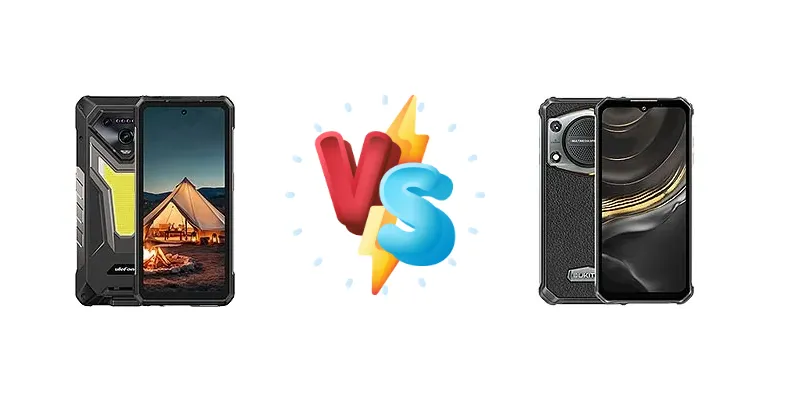
The rugged smartphone market caters to a specific need: durability. Both the Ulefone Armor 34 and Oukitel WP22 aim to deliver that, but they diverge significantly in their internal hardware. The Armor 34 represents a leap forward with its modern Mediatek Dimensity 7300 chipset, while the WP22 utilizes the older Helio P90. This comparison will dissect these differences to determine which device offers the best blend of performance, battery life, and rugged reliability.
🏆 Quick Verdict
For most users, the Ulefone Armor 34 is the clear winner. Its Dimensity 7300 chipset provides a substantial performance advantage over the Oukitel WP22’s Helio P90, translating to smoother multitasking and gaming. While the WP22 may offer a lower price point, the Armor 34’s superior processing power and charging capabilities justify the investment.
| Network |
|---|
| 2G bands | GSM 850 / 900 / 1800 / 1900 | GSM 850 / 900 / 1800 / 1900 |
| 3G bands | HSDPA 800 / 850 / 900 / 1700(AWS) / 1900 / 2100 | HSDPA 850 / 900 / 1700(AWS) / 1900 / 2100 |
| 4G bands | 1, 2, 3, 4, 5, 7, 8, 12, 13, 17, 18, 19, 20, 25, 26, 28, 32, 34, 38, 39, 40, 41, 66, 71 | LTE |
| 5G bands | 1, 2, 3, 5, 7, 8, 20, 25, 28, 38, 40, 41, 66, 71, 77, 78, 79 SA/NSA/Sub6 | - |
| Speed | HSPA, LTE, 5G | HSPA, LTE |
| Technology | GSM / HSPA / LTE / 5G | GSM / HSPA / LTE |
| Launch |
|---|
| Announced | 2025, August | 2023, March |
| Status | Available. Released 2025, August 18 | Available. Released 2023, March |
| Body |
|---|
| Dimensions | 183.1 x 86.6 x 32.7 mm (7.21 x 3.41 x 1.29 in) | - |
| SIM | Nano-SIM + Nano-SIM | Nano-SIM + Nano-SIM |
| Weight | 763 g (1.68 lb) | - |
| Display |
|---|
| Protection | Corning Gorilla Glass 5, Mohs level 4 | - |
| Resolution | 1080 x 2460 pixels (~387 ppi density) | 1080 x 2408 pixels, 20:9 ratio (~401 ppi density) |
| Size | 6.95 inches, 114.7 cm2 (~72.3% screen-to-body ratio) | 6.58 inches, 104.3 cm2 |
| Type | IPS LCD, 120Hz, 600 nits (peak) | IPS LCD, 480 nits |
| Platform |
|---|
| CPU | Octa-core (4x2.5 GHz Cortex-A78 & 4x2.0 GHz Cortex-A55) | Octa-core (2x2.2 GHz Cortex-A75 & 6x2.0 GHz Cortex-A55) |
| Chipset | Mediatek Dimensity 7300 (4 nm) | Mediatek MT6779 Helio P90 (12 nm) |
| GPU | Mali-G615 MC2 | PowerVR GM9446 |
| OS | Android 15 | Android 13 |
| Memory |
|---|
| Card slot | microSDXC (dedicated slot) | microSDXC (uses shared SIM slot) |
| Internal | 512GB 16GB RAM | 256GB 8GB RAM |
| Main Camera |
|---|
| Features | Dual-LED flash, HDR, panorama | Dual-LED flash |
| Triple | 50 MP, f/2.0, 23mm (wide), 1/1.3", 1.2µm, multi-directional PDAF
64 MP, f/1.8, (night vision), 1/2.0", 0.7µm, 4 infrared lights
50 MP, f/2.2, 16mm, 117˚ (ultrawide), 1/2.76", 0.64µm | 48 MP, f/1.8, (wide), PDAF
20 MP, (night vision), infrared night vision lights
2 MP (macro) |
| Video | 4K@30fps, 1080p@30fps, gyro-EIS | 4K@30fps, 1080p@30fps |
| Selfie camera |
|---|
| Single | 32 MP, f/2.5, 25mm (wide), 1/2.8", 0.8µm | 16 MP |
| Video | 1080p@30fps | Yes |
| Sound |
|---|
| 35mm jack | Yes | Unspecified |
| Loudspeaker | Yes | Yes (125 dB, 4W peak, 36mm speaker) |
| Comms |
|---|
| Bluetooth | 5.4, A2DP, LE | 5.0, A2DP, LE |
| Infrared port | Yes | - |
| NFC | Yes | Yes |
| Positioning | GPS, GALILEO, GLONASS, QZSS, BDS, NavIC | GPS, GLONASS, GALILEO, BDS |
| Radio | Wireless FM radio, RDS, recording | Wireless FM radio |
| USB | USB Type-C 2.0, OTG, accessory connector pins | USB Type-C 2.0, OTG |
| WLAN | Wi-Fi 802.11 a/b/g/n/ac/6, dual-band | Yes |
| Features |
|---|
| Sensors | Fingerprint (side-mounted), accelerometer, gyro, proximity, compass, barometer | Fingerprint (side-mounted), accelerometer, proximity |
| Battery |
|---|
| Charging | 66W wired
10W reverse wired | Reverse wired |
| Type | Li-Ion 25500 mAh | Li-Po 10000 mAh |
| Misc |
|---|
| Colors | Black | Black |
| Price | € 459.99 / $ 413.32 / £ 369.99 | About 240 EUR |
| EU LABEL |
|---|
| Battery | 384:54h endurance, 1000 cycles | - |
| Energy | Class A | - |
| Free fall | Class D (88 falls) | - |
| Repairability | Class C | - |
Ulefone Armor 34
- Significantly faster processor (Dimensity 7300)
- 66W fast charging for quick power-ups
- Longer battery life (384:54h endurance)
- Likely higher price point
- May be slightly larger/heavier due to advanced components
Oukitel WP22
- Potentially lower price
- Reverse wired charging for accessories
- Rugged design for durability
- Outdated processor (Helio P90) limits performance
- Slower charging speeds
- Lower overall battery endurance
Display Comparison
Display specifications are absent from the provided data, but given the target market, both devices likely feature durable, potentially lower-resolution displays. The Armor 34’s chipset suggests potential support for higher refresh rates, which the WP22’s older processor likely lacks. Bezels are likely substantial on both to contribute to drop protection. Color accuracy is likely secondary to durability in both cases.
Camera Comparison
Camera details are missing, but the chipset difference hints at a significant disparity in image processing capabilities. The Dimensity 7300 includes a more advanced ISP (Image Signal Processor) allowing for better noise reduction, dynamic range, and overall image quality. While both phones likely feature multiple cameras, the Armor 34 will likely produce superior photos and videos. Without sensor size information, it's difficult to make definitive claims, but the processing power advantage favors the Ulefone.
Performance
The core difference lies in the chipsets. The Ulefone Armor 34’s Mediatek Dimensity 7300 (4nm) is a significant upgrade over the Oukitel WP22’s Helio P90 (12nm). The Dimensity 7300’s newer architecture – featuring 4x2.5 GHz Cortex-A78 and 4x2.0 GHz Cortex-A55 cores – delivers substantially higher CPU and GPU performance. The 4nm process node also translates to improved thermal efficiency, meaning the Armor 34 is less likely to throttle under sustained load. The WP22’s Helio P90, with its 2x2.2 GHz Cortex-A75 and 6x2.0 GHz Cortex-A55 cores, is adequate for basic tasks but will struggle with demanding applications. The Armor 34 will provide a far smoother experience for gaming and multitasking.
Battery Life
The Ulefone Armor 34 boasts a remarkable 384:54h endurance rating, suggesting excellent battery optimization. Coupled with its 66W wired charging, it offers a fast and efficient charging experience. The WP22’s battery capacity is unknown, but it only offers reverse wired charging, indicating a slower charging speed. The Armor 34’s 1000 cycle battery life claim suggests a longer lifespan, making it a more durable long-term investment. The faster charging of the Armor 34 is a significant advantage for users who need to quickly replenish their battery.
Buying Guide
Buy the Ulefone Armor 34 if you prioritize performance for demanding tasks like gaming, video editing, or running multiple apps simultaneously. Its 66W charging is also a significant benefit for those who need to quickly top up their battery. Buy the Oukitel WP22 if your primary needs are basic communication, light usage, and a lower upfront cost, and you aren't concerned with the latest processing speeds.
Frequently Asked Questions
❓ Will the Ulefone Armor 34 handle demanding games like Genshin Impact or Call of Duty Mobile smoothly?
The Dimensity 7300 chipset in the Ulefone Armor 34 is capable of running demanding games, though settings may need to be adjusted for optimal performance. The improved GPU and CPU architecture compared to the Helio P90 in the WP22 will result in significantly higher frame rates and a smoother gaming experience.
❓ Is the reverse charging feature on the Oukitel WP22 useful for more than just emergencies?
While convenient, the Oukitel WP22’s reverse charging is limited by its likely lower output wattage and unknown battery capacity. It’s best suited for topping up small accessories like wireless earbuds or a smartwatch in a pinch, rather than fully charging another phone.
❓ How does the 4nm process node of the Dimensity 7300 benefit the Ulefone Armor 34 in real-world usage?
The 4nm process node means the Dimensity 7300 is more power-efficient than the 12nm Helio P90. This translates to less heat generation under load, reducing the likelihood of performance throttling during extended gaming sessions or demanding tasks. It also contributes to the Armor 34’s impressive battery endurance.