
Ulefone Armor 34 Pro vs. Oukitel WP210: A Deep Dive into Rugged Performance and Battery Life
| Phones Images | |||||
|---|---|---|---|---|---|
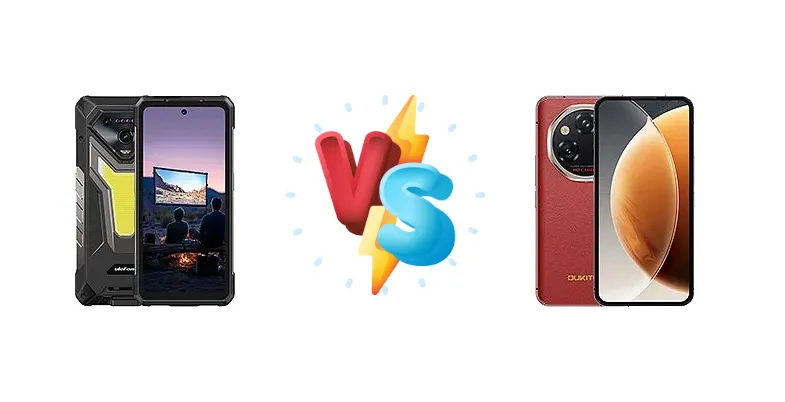
|
🏆 Quick Verdict
For the average user prioritizing all-day (and multi-day) battery life and consistent performance, the Ulefone Armor 34 Pro emerges as the winner. Its 384:54h endurance significantly outpaces the WP210, making it ideal for travelers and field workers. However, the Oukitel WP210’s Dimensity 8200 offers a noticeable performance edge for gamers and power users.
| PHONES | ||
|---|---|---|
| Phone Names | Ulefone Armor 34 Pro | Oukitel WP210 |
| Network | ||
|---|---|---|
| 2G bands | GSM 850 / 900 / 1800 / 1900 | GSM 850 / 900 / 1800 / 1900 |
| 3G bands | HSDPA 800 / 850 / 900 / 1700(AWS) / 1900 / 2100 | HSDPA 800 / 850 / 900 / 1700(AWS) / 1900 / 2100 |
| 4G bands | 1, 2, 3, 4, 5, 7, 8, 12, 13, 17, 18, 19, 20, 25, 26, 28, 32, 34, 38, 39, 40, 41, 66, 71 | 1, 2, 3, 4, 5, 7, 8, 12, 13, 17, 18, 19, 20, 25, 26, 28, 34, 38, 39, 40, 41, 66, 71 |
| 5G bands | 1, 2, 3, 5, 7, 8, 20, 25, 28, 38, 40, 41, 66, 71, 77, 78, 79 SA/NSA/Sub6 | 1, 2, 3, 5, 7, 8, 12, 20, 25, 28, 34, 38, 39, 40, 41, 48, 66, 71, 77, 78 SA/NSA |
| Speed | HSPA, LTE, 5G | HSPA, LTE, 5G |
| Technology | GSM / CDMA / HSPA / CDMA2000 / LTE / 5G | GSM / HSPA / LTE / 5G |
| Launch | ||
|---|---|---|
| Announced | 2025, March 03 | 2025, July |
| Status | Available. Released 2025, June | Available. Released 2025, July 15 |
| Body | ||
|---|---|---|
| Dimensions | 183.1 x 86.6 x 32.7 mm (7.21 x 3.41 x 1.29 in) | 163.6 x 77.9 x 13.7 mm (6.44 x 3.07 x 0.54 in) |
| SIM | Nano-SIM + Nano-SIM | Nano-SIM + Nano-SIM |
| Weight | 825 g (1.82 lb) | 311 g (10.97 oz) |
| Display | ||
|---|---|---|
| Protection | Corning Gorilla Glass 5, Mohs level 4 | Corning Gorilla Glass 5, Mohs level 5 |
| Resolution | 1080 x 2460 pixels (~387 ppi density) | 1080 x 2408 pixels, 20:9 ratio (~394 ppi density) |
| Size | 6.95 inches, 114.7 cm2 (~72.3% screen-to-body ratio) | 6.7 inches, 108.1 cm2 (~84.9% screen-to-body ratio) |
| Type | IPS LCD, 120Hz, 600 nits (peak) | IPS LCD, 120Hz, 500 nits |
| Platform | ||
|---|---|---|
| CPU | Octa-core (4x2.5 GHz Cortex-A78 & 4x2.0 GHz Cortex-A55) | Octa-core (1x3.1 GHz Cortex-A78 & 3x3.0 GHz Cortex-A78 & 4x2.0 GHz Cortex-A55) |
| Chipset | Mediatek Dimensity 7300 (4 nm) | Mediatek Dimensity 8200 (4 nm) |
| GPU | Mali-G615 MC2 | Mali-G610 MC6 |
| OS | Android 15 | Android 15 |
| Memory | ||
|---|---|---|
| Card slot | microSDXC (dedicated slot) | microSDXC (uses shared SIM slot) |
| Internal | 512GB 16GB RAM | 512GB 12GB RAM |
| Main Camera | ||
|---|---|---|
| Features | Dual-LED flash, HDR, panorama | LED flash, HDR, panorama |
| Triple | 50 MP, f/2.0, (wide), 1/1.3", 1.2µm, PDAF 64 MP, f/1.8, (night vision), 1/2.0", 0.7µm, 4 infrared lights 50 MP, f/2.2, 117˚ (ultrawide), 1/2.76", 0.64µm, AF | 108 MP, f/1.9, (wide), 1/1.8", PDAF 2 MP (macro) Auxiliary lens |
| Video | 4K@30fps, 1080p@30/60fps, gyro-EIS | 4K@30fps |
| Selfie camera | ||
|---|---|---|
| Single | 32 MP, f/2.5, (wide), 1/2.8", 0.8µm | 32 MP, f/2.2, (wide), 1/2.74" |
| Video | 1080p@30fps | 1080p@30fps |
| Sound | ||
|---|---|---|
| 35mm jack | Yes | No |
| Loudspeaker | Yes | Yes |
| Comms | ||
|---|---|---|
| Bluetooth | 5.4, A2DP, LE | 5.3, A2DP, LE |
| Infrared port | Yes | - |
| NFC | Yes | Yes |
| Positioning | GPS, GALILEO, GLONASS, QZSS, BDS, NavIC | GPS (L1+L5), GLONASS, GALILEO, BDS |
| Radio | Wireless FM radio, RDS, recording | FM radio |
| USB | USB Type-C 2.0, OTG, accessory connector pins | USB Type-C 2.0 |
| WLAN | Wi-Fi 802.11 a/b/g/n/ac/6e, tri-band | Wi-Fi 802.11 a/b/g/n/ac/6, dual-band |
| Features | ||
|---|---|---|
| Sensors | Fingerprint (side-mounted), accelerometer, gyro, proximity, compass, barometer | Fingerprint (side-mounted), accelerometer, gyro, proximity, compass |
| Battery | ||
|---|---|---|
| Charging | 66W wired 10W reverse wired | 45W wired |
| Type | Li-Po 25500 mAh | Li-Po 8800 mAh |
| Misc | ||
|---|---|---|
| Colors | Black | Gray, Black, Red |
| Price | € 637.49 / $ 516.41 / £ 479.99 / ₹ 81,500 | - |
| EU LABEL | ||
|---|---|---|
| Battery | 384:54h endurance, 1000 cycles | 86:17h endurance, 1000 cycles |
| Energy | Class A | Class B |
| Free fall | Class D (88 falls) | Class A (270 falls) |
| Repairability | Class C | Class C |
Ulefone Armor 34 Pro
- Exceptional battery life (384:54h endurance)
- Efficient Dimensity 7300 chipset
- 66W wired charging with 10W reverse charging
- Less powerful CPU compared to the WP210
- Potentially lower peak display brightness
Oukitel WP210
- Powerful Dimensity 8200 chipset for demanding tasks
- Faster CPU clock speeds
- Potentially brighter display
- Significantly shorter battery life (86:17h endurance)
- 45W charging is slower than the Armor 34 Pro
Display Comparison
While display specifications aren't provided, both phones likely utilize IPS LCD panels given their rugged focus. The key difference will be brightness and potentially refresh rate. The Armor 34 Pro’s endurance suggests a more conservative display power draw, potentially sacrificing peak brightness for longevity. The WP210, with its more powerful chipset, *could* support a higher peak brightness and refresh rate, but this comes at the cost of battery life. Bezels are likely similar on both, prioritizing durability over minimal design.
Camera Comparison
Without detailed camera specs, it’s difficult to make a definitive judgment. However, the chipset plays a role. The Dimensity 8200 in the WP210 has a more powerful ISP (Image Signal Processor) capable of handling more complex image processing tasks, potentially resulting in better dynamic range and low-light performance. The Armor 34 Pro’s ISP is still capable, but likely less sophisticated. We anticipate both phones will feature a primary sensor, but the WP210’s processing power could allow for more advanced features like better HDR and faster image capture.
Performance
The Oukitel WP210 boasts the more powerful Mediatek Dimensity 8200, featuring a 3.1 GHz Cortex-A78 prime core and three additional Cortex-A78 cores clocked at 3.0 GHz, alongside four Cortex-A55 efficiency cores. This contrasts with the Ulefone Armor 34 Pro’s Dimensity 7300, which uses four 2.5 GHz Cortex-A78 cores and four 2.0 GHz Cortex-A55 cores. The 8200’s higher clock speeds and core configuration translate to a significant advantage in CPU-intensive tasks and gaming. However, the 7300’s 4nm process node is more efficient, contributing to the Armor 34 Pro’s superior battery life. Both phones utilize an octa-core configuration, but the WP210’s architecture is geared towards peak performance, while the 34 Pro prioritizes sustained efficiency.
Battery Life
The Ulefone Armor 34 Pro’s 384:54h endurance is a standout feature, dwarfing the Oukitel WP210’s 86:17h. This difference is primarily attributable to the Dimensity 7300’s efficiency and likely a more conservative software implementation. While the WP210’s 45W charging is faster than the 34 Pro’s 66W, the sheer difference in endurance means the 34 Pro will spend significantly less time plugged into the wall. The 10W reverse wired charging on the 34 Pro is a useful addition for topping up accessories, a feature absent on the WP210.
Buying Guide
Buy the Ulefone Armor 34 Pro if you need a phone that can reliably last for days on a single charge, and you value consistent performance for everyday tasks and moderate gaming. Buy the Oukitel WP210 if you prioritize maximum processing power for demanding applications, gaming, and are willing to compromise on battery life and potentially carry a power bank.