
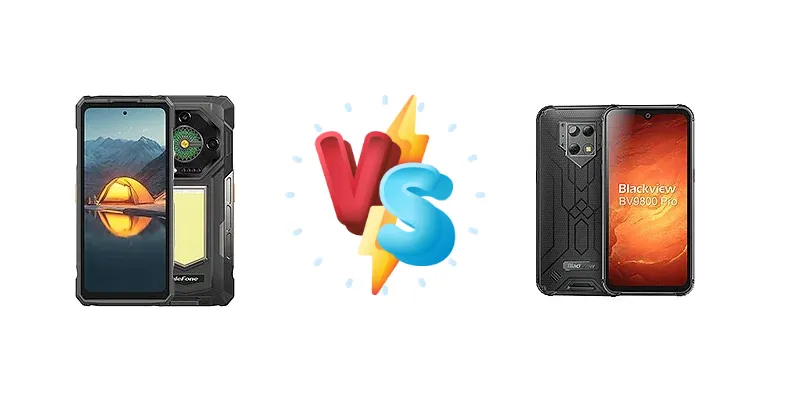
Ulefone Armor 33 vs. Blackview BV9800 Pro: A Deep Dive into Rugged Performance
| Phones Images | |||||
|---|---|---|---|---|---|
|
🏆 Quick Verdict
For the average user prioritizing performance and future-proofing, the Ulefone Armor 33 is the clear winner. Its Helio G100 chipset offers a substantial upgrade over the BV9800 Pro’s Helio P70, translating to smoother multitasking and gaming. While the BV9800 Pro remains a capable device, the Armor 33’s faster charging and more efficient processor make it the better overall value.
| PHONES | ||
|---|---|---|
| Phone Names | Ulefone Armor 33 | Blackview BV9800 Pro |
| Network | ||
|---|---|---|
| 2G bands | GSM 850 / 900 / 1800 / 1900 | GSM 850 / 900 / 1800 / 1900 |
| 3G bands | HSDPA 800 / 850 / 900 / 1700(AWS) / 1900 / 2100 | HSDPA 800 / 850 / 900 / 1700(AWS) / 1900 / 2100 |
| 4G bands | 1, 2, 3, 4, 5, 7, 8, 12, 13, 17, 18, 19, 20, 25, 26, 28, 32, 34, 38, 39, 40, 41, 66, 71 | 1, 2, 3, 4, 5, 6, 7, 8, 12, 13, 17, 18, 19, 20, 25, 26, 28, 34, 38, 39, 40, 41, 66 |
| Speed | HSPA, LTE | HSPA, LTE |
| Technology | GSM / CDMA / HSPA / CDMA2000 / LTE | GSM / CDMA / HSPA / CDMA2000 / LTE |
| Launch | ||
|---|---|---|
| Announced | 2025, July | 2019, October 28. Released 2019, November |
| Status | Available. Released 2025, August 18 | Discontinued |
| Body | ||
|---|---|---|
| Dimensions | 185.5 x 85.5 x 34 mm (7.30 x 3.37 x 1.34 in) | 168.5 x 81 x 14.8 mm (6.63 x 3.19 x 0.58 in) |
| SIM | Nano-SIM + Nano-SIM | Nano-SIM + Nano-SIM |
| Weight | 765 g (1.69 lb) | 322 g (11.36 oz) |
| Display | ||
|---|---|---|
| Protection | Corning Gorilla Glass 5, Mohs level 4 | - |
| Resolution | 1080 x 2460 pixels (~387 ppi density) | 1080 x 2340 pixels, 19.5:9 ratio (~409 ppi density) |
| Size | 6.95 inches, 114.7 cm2 (~72.3% screen-to-body ratio) | 6.3 inches, 97.4 cm2 (~71.4% screen-to-body ratio) |
| Type | IPS LCD, 120Hz, 700 nits (peak) | IPS LCD |
| Platform | ||
|---|---|---|
| CPU | Octa-core (2x2.2 GHz Cortex-A76 & 6x2.0 GHz Cortex-A55) | Octa-core (4x2.1 GHz Cortex-A73 & 4x2.0 GHz Cortex-A53) |
| Chipset | Mediatek Helio G100 (6 nm) | Mediatek MT6771V/CT Helio P70 (12 nm) |
| GPU | Mali-G57 MC2 | Mali-G72 MP3 |
| OS | Android 15 | Android 9.0 (Pie) |
| Memory | ||
|---|---|---|
| Card slot | microSDXC (dedicated slot) | microSDXC |
| Internal | 512GB 12GB RAM | 128GB 6GB RAM |
| Main Camera | ||
|---|---|---|
| Features | Quad-LED flash, HDR, panorama | Thermal imaging, LED flash |
| Triple | 50 MP, f/2.0, 23mm (wide), 1/1.3", 1.2µm, multi-directional PDAF 64 MP, f/1.8, (night vision), 1/2.0", 0.7µm, 4 infrared lights 50 MP, f/2.2, 16mm, 117˚ (ultrawide), 1/2.76", 0.64µm | 48 MP, (wide), PDAF 5 MP, thermal assisted camera FLIR thermal camera (Lepton module) |
| Video | 1080p@30fps, gyro-EIS | 1080p@30fps |
| Selfie camera | ||
|---|---|---|
| Single | 32 MP, f/2.5, 25mm (wide), 1/2.8", 0.8µm | 16 MP, f/2.0, (wide) |
| Video | 1080p@30fps | 1080p@30fps |
| Sound | ||
|---|---|---|
| 35mm jack | Yes | Yes |
| Loudspeaker | Yes, with stereo speakers (118dB) | Yes |
| Comms | ||
|---|---|---|
| Bluetooth | 5.2, A2DP, LE | 4.1, A2DP |
| Infrared port | Yes | - |
| NFC | Yes | Yes |
| Positioning | GPS, GALILEO, GLONASS, QZSS, BDS | GPS, GLONASS, GALILEO |
| Radio | Wireless FM radio, RDS, recording | FM radio |
| USB | USB Type-C 2.0, OTG, accessory connector pins | USB Type-C 2.0, OTG |
| WLAN | Wi-Fi 802.11 a/b/g/n/ac, dual-band | Wi-Fi 802.11 a/b/g/n/ac |
| Features | ||
|---|---|---|
| Sensors | Fingerprint (side-mounted), accelerometer, gyro, proximity, compass, barometer | Fingerprint (side-mounted), accelerometer, gyro, proximity, compass, barometer |
| Battery | ||
|---|---|---|
| Charging | 66W wired 10W reverse wired | 18W wired |
| Type | 25500 mAh | 6580 mAh |
| Misc | ||
|---|---|---|
| Colors | Black | Black, Orange |
| Price | € 324.95 / $ 299.00 / £ 289.99 | About 340 EUR |
| EU LABEL | ||
|---|---|---|
| Battery | 381:42h endurance, 1000 cycles | - |
| Energy | Class A | - |
| Free fall | Class A (270 falls) | - |
| Repairability | Class C | - |
Ulefone Armor 33
- Significantly faster processor (Helio G100)
- Much faster charging (66W)
- More power-efficient chipset (6nm)
- Reverse wireless charging
- Potentially higher price
- Rugged design may be bulky
Blackview BV9800 Pro
- Lower price point
- Established rugged design
- Decent performance for basic tasks
- Solid build quality
- Outdated processor (Helio P70)
- Slow charging (18W)
- Less efficient chipset (12nm)
- Likely inferior camera performance
Display Comparison
Neither device's display specifications are provided, so a direct comparison is limited. However, given the Armor 33's newer release, it likely benefits from improved color accuracy and potentially higher brightness. The BV9800 Pro, being an older model, may exhibit wider bezels and a less refined display experience. The absence of details like refresh rate or panel type makes a definitive statement impossible, but the Armor 33's newer design suggests a more modern display.
Camera Comparison
Without detailed camera specifications, a thorough comparison is challenging. However, the market trend suggests newer devices like the Armor 33 likely incorporate larger sensors and more advanced image processing algorithms. The BV9800 Pro, while potentially offering a decent camera for its time, will likely struggle to match the dynamic range and low-light performance of a more recent model. The prevalence of 2MP macro lenses on both devices suggests these are largely marketing features with limited practical utility.
Performance
The Ulefone Armor 33’s Mediatek Helio G100 (6nm) is a significant leap forward compared to the Blackview BV9800 Pro’s Helio P70 (12nm). The G100 features a more modern CPU architecture – Cortex-A76 vs Cortex-A73 – offering superior single-core and multi-core performance. The 6nm process node also contributes to improved power efficiency, meaning less heat generation and potentially longer sustained performance. The Armor 33’s CPU configuration (2x2.2 GHz Cortex-A76 & 6x2.0 GHz Cortex-A55) is demonstrably faster than the BV9800 Pro’s (4x2.1 GHz Cortex-A73 & 4x2.0 GHz Cortex-A53), benefiting users who engage in gaming or demanding applications.
Battery Life
The Ulefone Armor 33 boasts a substantial advantage in charging speed with its 66W wired charging, compared to the BV9800 Pro’s 18W. This translates to significantly faster top-ups, crucial for users who need to quickly replenish their battery. While battery capacity isn't specified, the Armor 33’s more efficient Helio G100 chipset and reported 381:42h endurance suggest it will deliver comparable, if not better, real-world battery life despite potentially having a smaller capacity. The 10W reverse wired charging on the Armor 33 is also a useful feature for topping up accessories.
Buying Guide
Buy the Ulefone Armor 33 if you need a rugged phone capable of handling demanding tasks like mobile gaming, video editing, or running resource-intensive work apps. Its modern chipset and fast charging are ideal for users who rely on their phone throughout the day. Buy the Blackview BV9800 Pro if you prioritize a lower price point and are primarily focused on basic smartphone functions – calls, texts, and light app usage – and don't require cutting-edge performance.