
Ulefone Armor 33 Pro vs Power Armor 14 Pro: Which Rugged Phone Reigns Supreme?
| Phones Images | |||||
|---|---|---|---|---|---|
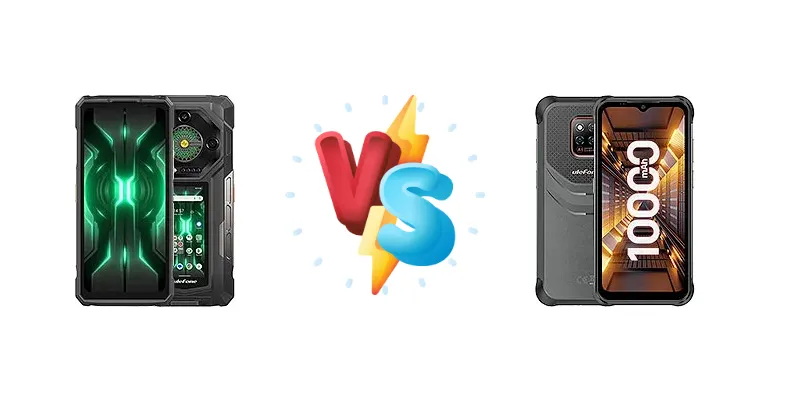
|
🏆 Quick Verdict
For users demanding peak performance in a rugged package, the Ulefone Armor 33 Pro is the clear winner. Its Dimensity 7300X chipset offers a substantial leap in processing capability over the Power Armor 14 Pro’s Helio G85. However, if wireless charging and a lower price are paramount, the Power Armor 14 Pro remains a viable option.
| PHONES | ||
|---|---|---|
| Phone Names | Ulefone Armor 33 Pro | Ulefone Power Armor 14 Pro |
| Network | ||
|---|---|---|
| 2G bands | GSM 850 / 900 / 1800 / 1900 | GSM 850 / 900 / 1800 / 1900 |
| 3G bands | HSDPA 800 / 850 / 900 / 1700(AWS) / 1900 / 2100 | HSDPA 850 / 900 / 1700(AWS) / 1900 / 2100 |
| 4G bands | 1, 2, 3, 4, 5, 7, 8, 12, 13, 17, 18, 19, 20, 25, 26, 28, 32, 34, 38, 39, 40, 41, 66, 71 | 1, 2, 3, 4, 5, 7, 8, 12, 13, 17, 18, 19, 20, 25, 26, 28, 38, 40 |
| 5G bands | 1, 2, 3, 5, 7, 8, 20, 25, 28, 38, 40, 41, 66, 71, 77, 78, 79 SA/NSA/Sub6 | - |
| Speed | HSPA, LTE, 5G | HSPA, LTE |
| Technology | GSM / CDMA / HSPA / CDMA2000 / LTE / 5G | GSM / HSPA / LTE |
| Launch | ||
|---|---|---|
| Announced | 2025, March 03 | 2022, March 09 |
| Status | Available. Released 2025, August 18 | Available. Released 2022, March 09 |
| Body | ||
|---|---|---|
| Dimensions | 185.5 x 85.5 x 34 mm (7.30 x 3.37 x 1.34 in) | 175.6 x 82.5 x 17.2 mm (6.91 x 3.25 x 0.68 in) |
| SIM | Nano-SIM + Nano-SIM | Nano-SIM + Nano-SIM |
| Weight | 776.5 g (1.71 lb) | 358.2 g (12.63 oz) |
| - | IP68 dust/water resistant (up to 1.5m for 30 min) Drop-to-concrete resistance from up to 1.5m MIL-STD-810G compliant | |
| Display | ||
|---|---|---|
| Protection | Corning Gorilla Glass 5, Mohs level 4 | Corning Gorilla Glass 3 |
| Resolution | 1080 x 2460 pixels (~387 ppi density) | 720 x 1600 pixels, 20:9 ratio (~269 ppi density) |
| Size | 6.95 inches, 114.7 cm2 (~72.3% screen-to-body ratio) | 6.52 inches, 102.6 cm2 (~70.8% screen-to-body ratio) |
| Type | IPS LCD, 120Hz, 700 nits (peak) | IPS LCD |
| Platform | ||
|---|---|---|
| CPU | Octa-core (4x2.5 GHz Cortex-A78 & 4x2.0 GHz Cortex-A55) | Octa-core (2x2.0 GHz Cortex-A75 & 6x1.8 GHz Cortex-A55) |
| Chipset | Mediatek Dimensity 7300X (4 nm) | Mediatek MT6769Z Helio G85 (12 nm) |
| GPU | Mali-G615 MC2 | Mali-G52 MC2 |
| OS | Android 14 | Android 12 |
| Memory | ||
|---|---|---|
| Card slot | microSDXC (dedicated slot) | microSDXC (uses shared SIM slot) |
| Internal | 512GB 16GB RAM | 128GB 6GB RAM, 128GB 8GB RAM |
| - | eMMC 5.1 | |
| Main Camera | ||
|---|---|---|
| Features | Quad-LED flash, HDR, panorama | LED flash, HDR, panorama |
| Single | - | 16 MP, f/2.2 |
| Triple | 50 MP, f/2.0, 23mm (wide), 1/1.3", 1.2µm, multi-directional PDAF 64 MP, f/1.8, (night vision), 1/2.0", 0.7µm, 4 infrared lights 50 MP, f/2.2, 16mm, 117˚ (ultrawide), 1/2.76", 0.64µm | 20 MP, f/1.8, 26mm (wide), 1/2.78", 1.0µm, PDAF 2 MP (macro) Auxiliary lens |
| Video | 4K@30fps, 1080p@30fps, gyro-EIS | 1080p@30fps |
| Selfie camera | ||
|---|---|---|
| Features | - | HDR, panorama |
| Single | 32 MP, f/2.5, 25mm (wide), 1/2.8", 0.8µm | 16 MP, f/2.2 |
| Video | 4K@30fps, 1080p@30fps | 1080p@30fps |
| Sound | ||
|---|---|---|
| 3.5mm jack | - | Yes |
| 35mm jack | Yes | Yes |
| Loudspeaker | Yes, with stereo speakers (118dB) | Yes |
| Comms | ||
|---|---|---|
| Bluetooth | 5.4, A2DP, LE | 5.0, A2DP, LE |
| Infrared port | Yes | - |
| NFC | Yes | Yes |
| Positioning | GPS, GALILEO, GLONASS, QZSS, BDS, NavIC | GPS, GLONASS, GALILEO, BDS |
| Radio | Wireless FM radio, RDS, recording | FM radio, RDS, recording |
| USB | USB Type-C 2.0, OTG, accessory connector pins | USB Type-C 2.0, OTG |
| WLAN | Wi-Fi 802.11 a/b/g/n/ac/6e, tri-band | Wi-Fi 802.11 a/b/g/n/ac, dual-band |
| Features | ||
|---|---|---|
| Sensors | Fingerprint (side-mounted), accelerometer, gyro, proximity, compass, barometer | Fingerprint (side-mounted), accelerometer, proximity, compass |
| Battery | ||
|---|---|---|
| Charging | 66W wired 10W reverse wired | 18W wired 15W wireless |
| Type | 25500 mAh | Li-Po 10000 mAh |
| Misc | ||
|---|---|---|
| Colors | Black | Black |
| Price | € 455.99 / $ 395.57 / £ 359.99 | About 260 EUR |
| EU LABEL | ||
|---|---|---|
| Battery | 383:36h endurance, 1000 cycles | - |
| Energy | Class A | - |
| Free fall | Class A (270 falls) | - |
| Repairability | Class C | - |
Ulefone Armor 33 Pro
- Significantly faster processor (Dimensity 7300X)
- Faster 66W wired charging
- Longer battery endurance (383h)
- 10W reverse wired charging
- Likely higher price point
- May generate more heat under sustained load (though 4nm helps)
Ulefone Power Armor 14 Pro
- More affordable price
- Wireless charging support (15W)
- Decent performance for basic tasks
- Rugged build quality
- Slower processor (Helio G85)
- Slower 18W wired charging
- Lower overall performance
Display Comparison
While both phones likely feature durable displays befitting their rugged nature, the provided data focuses on internal components. We can infer that the Armor 33 Pro, targeting a higher performance bracket, may benefit from a higher resolution or refresh rate panel, though this isn't confirmed. The absence of display specs necessitates focusing on the core performance differences.
Camera Comparison
The provided data doesn't detail camera specifications beyond the chipsets. Given the Armor 33 Pro’s focus on higher-end components, it’s reasonable to expect a more sophisticated camera system with a larger sensor and improved image processing capabilities. However, without specific sensor size or aperture information, a definitive comparison is impossible. Users should expect better low-light performance and overall image quality from the Armor 33 Pro, assuming Ulefone leverages its chipset advantage.
Performance
The performance gap between these two devices is substantial. The Ulefone Armor 33 Pro’s Mediatek Dimensity 7300X (4nm) is a modern, high-performance chipset featuring an octa-core configuration with 4x2.5 GHz Cortex-A78 and 4x2.0 GHz Cortex-A55 cores. This contrasts sharply with the Power Armor 14 Pro’s older Mediatek MT6769Z Helio G85 (12nm) with its 2x2.0 GHz Cortex-A75 and 6x1.8 GHz Cortex-A55 cores. The 4nm process node of the Dimensity 7300X translates to significantly improved power efficiency and thermal management, allowing for sustained peak performance. The Armor 33 Pro will excel in demanding applications and multitasking, while the Power Armor 14 Pro is geared towards everyday use.
Battery Life
The Ulefone Armor 33 Pro boasts impressive endurance, rated at 383 hours and 1000 charge cycles. While the Power Armor 14 Pro’s battery capacity isn’t specified, its 18W wired and 15W wireless charging options offer convenience. The Armor 33 Pro’s 66W wired charging is significantly faster, allowing for quicker top-ups. The 10W reverse wired charging on the Armor 33 Pro is also a useful feature for charging accessories in the field. The longer endurance and faster charging of the Armor 33 Pro are key advantages for users who rely heavily on their phone throughout the day.
Buying Guide
Buy the Ulefone Armor 33 Pro if you need a rugged phone capable of handling demanding tasks like mobile gaming, video editing, or running complex applications in the field. Its superior chipset and faster charging will significantly improve your workflow. Buy the Ulefone Power Armor 14 Pro if you prioritize a lower upfront cost, value wireless charging convenience, and primarily use your phone for basic communication, navigation, and light media consumption.