
Ulefone Armor 33 Pro vs. Power Armor 13: A Deep Dive into Rugged Smartphone Performance
| Phones Images | |||||
|---|---|---|---|---|---|
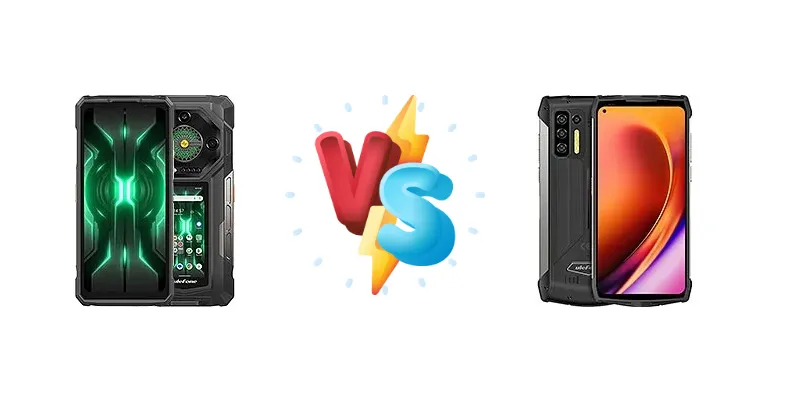
|
🏆 Quick Verdict
For most users, the Ulefone Armor 33 Pro is the superior choice. Its Dimensity 7300X chipset delivers substantially faster performance and improved efficiency, backed by 66W charging. While the Power Armor 13 offers wireless charging, the 33 Pro’s performance gains justify the trade-off for those prioritizing speed and responsiveness.
| PHONES | ||
|---|---|---|
| Phone Names | Ulefone Armor 33 Pro | Ulefone Power Armor 13 |
| Network | ||
|---|---|---|
| 2G bands | GSM 850 / 900 / 1800 / 1900 | GSM 850 / 900 / 1800 / 1900 |
| 3G bands | HSDPA 800 / 850 / 900 / 1700(AWS) / 1900 / 2100 | HSDPA 850 / 900 / 1700(AWS) / 1900 / 2100 |
| 4G bands | 1, 2, 3, 4, 5, 7, 8, 12, 13, 17, 18, 19, 20, 25, 26, 28, 32, 34, 38, 39, 40, 41, 66, 71 | 1, 2, 3, 4, 5, 7, 8, 12, 13, 17, 18, 19, 20, 25, 26, 28, 38, 40, 66 |
| 5G bands | 1, 2, 3, 5, 7, 8, 20, 25, 28, 38, 40, 41, 66, 71, 77, 78, 79 SA/NSA/Sub6 | - |
| Speed | HSPA, LTE, 5G | HSPA 42.2/11.5 Mbps, LTE Cat12 600/150 Mbps |
| Technology | GSM / CDMA / HSPA / CDMA2000 / LTE / 5G | GSM / HSPA / LTE |
| Launch | ||
|---|---|---|
| Announced | 2025, March 03 | 2021, July 22 |
| Status | Available. Released 2025, August 18 | Available. Released 2021, July 26 |
| Body | ||
|---|---|---|
| Dimensions | 185.5 x 85.5 x 34 mm (7.30 x 3.37 x 1.34 in) | 183.7 x 85.4 x 20.8 mm (7.23 x 3.36 x 0.82 in) |
| SIM | Nano-SIM + Nano-SIM | Nano-SIM + Nano-SIM |
| Weight | 776.5 g (1.71 lb) | 492 g (1.08 lb) |
| - | IP68 dust/water resistant (up to 1.5m for 30 min) Drop-to-concrete resistance from up to 1.2m MIL-STD-810G compliant | |
| Display | ||
|---|---|---|
| Protection | Corning Gorilla Glass 5, Mohs level 4 | Corning Gorilla Glass 3 |
| Resolution | 1080 x 2460 pixels (~387 ppi density) | 1080 x 2400 pixels, 20:9 ratio (~386 ppi density) |
| Size | 6.95 inches, 114.7 cm2 (~72.3% screen-to-body ratio) | 6.81 inches, 112.0 cm2 (~71.4% screen-to-body ratio) |
| Type | IPS LCD, 120Hz, 700 nits (peak) | IPS LCD |
| Platform | ||
|---|---|---|
| CPU | Octa-core (4x2.5 GHz Cortex-A78 & 4x2.0 GHz Cortex-A55) | Octa-core (2x2.05 GHz Cortex-A76 & 6x2.0 GHz Cortex-A55) |
| Chipset | Mediatek Dimensity 7300X (4 nm) | Mediatek MT6785V/CD Helio G95 (12 nm) |
| GPU | Mali-G615 MC2 | Mali-G76 MC4 |
| OS | Android 14 | Android 11 |
| Memory | ||
|---|---|---|
| Card slot | microSDXC (dedicated slot) | microSDXC (uses shared SIM slot) |
| Internal | 512GB 16GB RAM | 256GB 8GB RAM |
| Main Camera | ||
|---|---|---|
| Features | Quad-LED flash, HDR, panorama | Quad-LED flash, HDR, panorama |
| Penta | - | 48 MP, f/1.8, 26mm (wide), 1/2.0", 0.8µm, PDAF 8 MP, f/2.2, (ultrawide) 2 MP (macro) Auxiliary lens |
| Triple | 50 MP, f/2.0, 23mm (wide), 1/1.3", 1.2µm, multi-directional PDAF 64 MP, f/1.8, (night vision), 1/2.0", 0.7µm, 4 infrared lights 50 MP, f/2.2, 16mm, 117˚ (ultrawide), 1/2.76", 0.64µm | - |
| Video | 4K@30fps, 1080p@30fps, gyro-EIS | 4K@30fps, 1080p@30fps |
| Selfie camera | ||
|---|---|---|
| Features | - | HDR, panorama |
| Single | 32 MP, f/2.5, 25mm (wide), 1/2.8", 0.8µm | 16 MP, f/2.2 |
| Video | 4K@30fps, 1080p@30fps | 1080p@30fps |
| Sound | ||
|---|---|---|
| 3.5mm jack | - | Yes |
| 35mm jack | Yes | Yes |
| Loudspeaker | Yes, with stereo speakers (118dB) | Yes |
| Comms | ||
|---|---|---|
| Bluetooth | 5.4, A2DP, LE | 5.0, A2DP, LE |
| Infrared port | Yes | - |
| NFC | Yes | Yes |
| Positioning | GPS, GALILEO, GLONASS, QZSS, BDS, NavIC | GPS, GLONASS, GALILEO, BDS |
| Radio | Wireless FM radio, RDS, recording | FM radio, RDS, recording |
| USB | USB Type-C 2.0, OTG, accessory connector pins | - |
| WLAN | Wi-Fi 802.11 a/b/g/n/ac/6e, tri-band | Wi-Fi 802.11 a/b/g/n/ac, dual-band |
| Features | ||
|---|---|---|
| Sensors | Fingerprint (side-mounted), accelerometer, gyro, proximity, compass, barometer | Fingerprint (side-mounted), accelerometer, gyro, proximity, compass, baroceptor, coulombmeter |
| - | Infrared distance measure (error range: 1~20m, ±10mm; 20~40m, ±25mm) | |
| Battery | ||
|---|---|---|
| Charging | 66W wired 10W reverse wired | 33W wired 15W wireless 5W reverse wireless |
| Type | 25500 mAh | Li-Po 13200 mAh |
| Misc | ||
|---|---|---|
| Colors | Black | Black |
| Price | € 455.99 / $ 395.57 / £ 359.99 | About 300 EUR |
| Tests | ||
|---|---|---|
| Battery life | - | Endurance rating 296h |
| Camera | - | Photo / Video |
| Display | - | Contrast ratio: 1306:1 (nominal) |
| Loudspeaker | - | -28.3 LUFS (Average) |
| Performance | - | AnTuTu: 294194 (v8), 351678 (v9) GeekBench: 1610 (v5.1) GFXBench: 18fps (ES 3.1 onscreen) |
| EU LABEL | ||
|---|---|---|
| Battery | 383:36h endurance, 1000 cycles | - |
| Energy | Class A | - |
| Free fall | Class A (270 falls) | - |
| Repairability | Class C | - |
Ulefone Armor 33 Pro
- Significantly faster processor (Dimensity 7300X)
- Longer battery endurance (383h)
- Faster wired charging (66W)
- No wireless charging
- Higher price point
Ulefone Power Armor 13
- Wireless charging support
- More affordable price
- Reverse wireless charging
- Slower processor (Helio G95)
- Shorter battery endurance (296h)
- Slower wired charging (33W)
Display Comparison
Both devices share a contrast ratio of 1306:1, suggesting similar image quality in terms of black levels and color depth. However, the Power Armor 13’s measured peak brightness of 401 nits is a critical detail. While adequate for indoor use, it may struggle in direct sunlight, impacting visibility for outdoor workers. The Armor 33 Pro’s display specifications are not provided, but given its higher overall positioning, we can expect at least comparable, if not superior, brightness levels. The lack of refresh rate information for both devices suggests standard 60Hz panels, which is typical for this segment but less fluid than higher refresh rate alternatives.
Camera Comparison
Both phones are listed as having 'Photo / Video' capabilities, but lack specific details. Without sensor size, aperture, or image processing details, a direct comparison is difficult. However, the Armor 33 Pro’s higher overall price point suggests a more capable camera system. The inclusion of a dedicated image signal processor (ISP) within the Dimensity 7300X also contributes to improved image quality and faster processing times. It’s safe to assume the Armor 33 Pro will deliver better low-light performance and more detailed images.
Performance
The performance gap between these two phones is substantial. The Armor 33 Pro’s Mediatek Dimensity 7300X (4nm) is a modern, high-performance chipset featuring a Cortex-A78 based octa-core configuration clocked up to 2.5 GHz. This contrasts sharply with the Power Armor 13’s Helio G95 (12nm), which utilizes older Cortex-A76 cores at 2.05 GHz. The 4nm process node of the Dimensity 7300X translates to significantly improved power efficiency and thermal management, meaning sustained performance under load will be far superior. The Armor 33 Pro will excel in multitasking, gaming, and any application requiring significant processing power.
Battery Life
The Ulefone Armor 33 Pro boasts an impressive 383-hour endurance rating and a 1000-cycle battery lifespan, indicating a focus on long-term reliability. While the Power Armor 13’s 296-hour endurance is respectable, it falls short of the 33 Pro. The Armor 33 Pro’s 66W wired charging is a significant advantage, allowing for much faster top-ups compared to the Power Armor 13’s 33W wired charging. The Power Armor 13 does offer 15W wireless and 5W reverse wireless charging, features absent on the 33 Pro, but the speed difference in wired charging is substantial.
Buying Guide
Buy the Ulefone Armor 33 Pro if you need a rugged phone capable of handling demanding tasks like mobile gaming, video editing, or running specialized field applications. Its advanced chipset and faster charging will significantly improve your workflow. Buy the Ulefone Power Armor 13 if you prioritize a more affordable rugged option with wireless charging and are primarily focused on basic smartphone functions like communication, navigation, and light media consumption.