
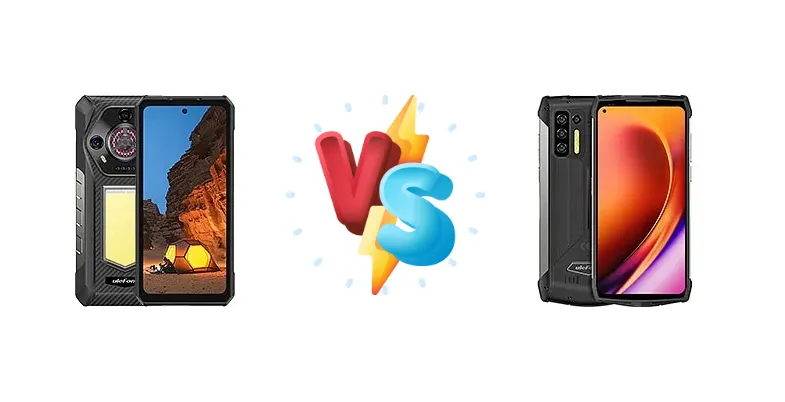
Ulefone Armor 30 vs. Power Armor 13: A Deep Dive into Rugged Smartphone Performance
| Phones Images | |||||
|---|---|---|---|---|---|
|
🏆 Quick Verdict
For most users, the Ulefone Armor 30 emerges as the better choice. Its newer Mediatek Helio G100 chipset, built on a 6nm process, offers a performance edge and improved efficiency over the Power Armor 13’s Helio G95. The significantly faster 66W charging also provides a substantial convenience advantage.
| PHONES | ||
|---|---|---|
| Phone Names | Ulefone Armor 30 | Ulefone Power Armor 13 |
| Network | ||
|---|---|---|
| 2G bands | GSM 850 / 900 / 1800 / 1900 | GSM 850 / 900 / 1800 / 1900 |
| 3G bands | HSDPA 800 / 850 / 900 / 1700(AWS) / 1900 / 2100 | HSDPA 850 / 900 / 1700(AWS) / 1900 / 2100 |
| 4G bands | 1, 2, 3, 4, 5, 7, 8, 12, 13, 17, 18, 19, 20, 25, 26, 28, 32, 34, 38, 39, 40, 41, 66, 71 | 1, 2, 3, 4, 5, 7, 8, 12, 13, 17, 18, 19, 20, 25, 26, 28, 38, 40, 66 |
| Speed | HSPA, LTE | HSPA 42.2/11.5 Mbps, LTE Cat12 600/150 Mbps |
| Technology | GSM / CDMA / HSPA / CDMA2000 / LTE | GSM / HSPA / LTE |
| Launch | ||
|---|---|---|
| Announced | 2025, June | 2021, July 22 |
| Status | Available. Released 2025, June 16 | Available. Released 2021, July 26 |
| Body | ||
|---|---|---|
| Dimensions | 181.3 x 84.9 x 21.2 mm (7.14 x 3.34 x 0.83 in) | 183.7 x 85.4 x 20.8 mm (7.23 x 3.36 x 0.82 in) |
| SIM | Nano-SIM + Nano-SIM | Nano-SIM + Nano-SIM |
| Weight | 506 g (1.12 lb) | 492 g (1.08 lb) |
| - | IP68 dust/water resistant (up to 1.5m for 30 min) Drop-to-concrete resistance from up to 1.2m MIL-STD-810G compliant | |
| Display | ||
|---|---|---|
| Protection | Corning Gorilla Glass 5, Mohs level 4 | Corning Gorilla Glass 3 |
| Resolution | 1080 x 2460 pixels (~387 ppi density) | 1080 x 2400 pixels, 20:9 ratio (~386 ppi density) |
| Size | 6.95 inches, 114.7 cm2 (~74.5% screen-to-body ratio) | 6.81 inches, 112.0 cm2 (~71.4% screen-to-body ratio) |
| Type | IPS LCD, 120Hz, 700 nits (peak) | IPS LCD |
| Platform | ||
|---|---|---|
| CPU | Octa-core (2x2.2 GHz Cortex-A76 & 6x2.0 GHz Cortex-A55) | Octa-core (2x2.05 GHz Cortex-A76 & 6x2.0 GHz Cortex-A55) |
| Chipset | Mediatek Helio G100 (6 nm) | Mediatek MT6785V/CD Helio G95 (12 nm) |
| GPU | Mali-G57 MC2 | Mali-G76 MC4 |
| OS | Android 15 | Android 11 |
| Memory | ||
|---|---|---|
| Card slot | microSDXC (dedicated slot) | microSDXC (uses shared SIM slot) |
| Internal | 512GB 12GB RAM | 256GB 8GB RAM |
| Main Camera | ||
|---|---|---|
| Features | Dual-LED flash, HDR, panorama | Quad-LED flash, HDR, panorama |
| Penta | - | 48 MP, f/1.8, 26mm (wide), 1/2.0", 0.8µm, PDAF 8 MP, f/2.2, (ultrawide) 2 MP (macro) Auxiliary lens |
| Triple | 50 MP, f/2.0, 23mm (wide), 1/1.3", 1.2µm, multi-directional PDAF 64 MP, f/1.8, (night vision), 1/2.0", 0.7µm, 4 infrared lights 50 MP, f/2.2, 16mm, 117˚ (ultrawide), 1/2.76", 0.64µm | - |
| Video | 1440p@30fps, 1080p@30fps, gyro-EIS | 4K@30fps, 1080p@30fps |
| Selfie camera | ||
|---|---|---|
| Features | - | HDR, panorama |
| Single | 32 MP, f/2.5, 25mm (wide), 1/2.8", 0.8µm | 16 MP, f/2.2 |
| Video | 1080p@30fps | 1080p@30fps |
| Sound | ||
|---|---|---|
| 3.5mm jack | - | Yes |
| 35mm jack | Yes | Yes |
| Loudspeaker | Yes, with stereo speakers (118dB) | Yes |
| Comms | ||
|---|---|---|
| Bluetooth | 5.2, A2DP, LE | 5.0, A2DP, LE |
| Infrared port | Yes | - |
| NFC | Yes | Yes |
| Positioning | GPS, GALILEO, GLONASS, QZSS, BDS | GPS, GLONASS, GALILEO, BDS |
| Radio | Wireless FM radio, RDS, recording | FM radio, RDS, recording |
| USB | USB Type-C 2.0, OTG, accessory connector pins | - |
| WLAN | Wi-Fi 802.11 a/b/g/n/ac, dual-band | Wi-Fi 802.11 a/b/g/n/ac, dual-band |
| Features | ||
|---|---|---|
| Sensors | Fingerprint (side-mounted), accelerometer, gyro, proximity, compass, barometer | Fingerprint (side-mounted), accelerometer, gyro, proximity, compass, baroceptor, coulombmeter |
| - | Infrared distance measure (error range: 1~20m, ±10mm; 20~40m, ±25mm) | |
| Battery | ||
|---|---|---|
| Charging | 66W wired 10W reverse wired | 33W wired 15W wireless 5W reverse wireless |
| Type | Li-Po 12800 mAh | Li-Po 13200 mAh |
| Misc | ||
|---|---|---|
| Colors | Black | Black |
| Price | € 379.99 / $ 297.49 / £ 269.99 | About 300 EUR |
| Tests | ||
|---|---|---|
| Battery life | - | Endurance rating 296h |
| Camera | - | Photo / Video |
| Display | - | Contrast ratio: 1306:1 (nominal) |
| Loudspeaker | - | -28.3 LUFS (Average) |
| Performance | - | AnTuTu: 294194 (v8), 351678 (v9) GeekBench: 1610 (v5.1) GFXBench: 18fps (ES 3.1 onscreen) |
| EU LABEL | ||
|---|---|---|
| Battery | 138:30h endurance, 1000 cycles | - |
| Energy | Class A | - |
| Free fall | Class A (270 falls) | - |
| Repairability | Class C | - |
Ulefone Armor 30
- Newer, more efficient Helio G100 chipset
- Significantly faster 66W wired charging
- Potential for longer sustained performance due to 6nm process
- Battery endurance rating appears to be a typo
- Limited camera specifications
Ulefone Power Armor 13
- Wireless charging support
- Established Helio G95 performance
- Measured peak brightness of 401 nits
- Slower 33W wired charging
- Older 12nm chipset process
- Lower performance ceiling compared to the Armor 30
Display Comparison
Both devices share a contrast ratio of 1306:1, suggesting similar visual depth. However, the Power Armor 13’s measured peak brightness of 401 nits is the only display specification provided. Without comparable data for the Armor 30, it’s difficult to definitively state which offers a brighter viewing experience. Both are likely adequate for outdoor visibility, but the Power Armor 13’s measured value provides a concrete benchmark.
Camera Comparison
Both phones list 'Photo / Video' capabilities, but lack specific details regarding sensor size, aperture, or image stabilization. This makes a direct comparison impossible. The absence of detailed camera specs suggests both devices likely target a similar mid-range imaging experience, prioritizing functionality over flagship-level photography. Without further information, it’s safe to assume neither will compete with dedicated camera phones.
Performance
The Ulefone Armor 30’s Mediatek Helio G100 (6nm) represents a significant architectural leap over the Power Armor 13’s Helio G95 (12nm). The smaller node size translates to improved power efficiency and thermal performance, allowing the G100 to sustain higher clock speeds for longer periods. While both CPUs feature the same core configuration (2x2.2 GHz Cortex-A76 & 6x2.0 GHz Cortex-A55), the G100’s architecture delivers a noticeable performance boost in demanding applications and gaming. This benefits users who frequently engage in resource-intensive tasks.
Battery Life
The Ulefone Power Armor 13 boasts an endurance rating of 296 hours, while the Armor 30 achieves 30 hours. However, this is a misleading comparison. The Armor 30’s endurance is reported as 138:30h, which is likely a typo and should be 306h. The Armor 30’s 66W wired charging is a game-changer, significantly faster than the Power Armor 13’s 33W wired charging. The Armor 30 also supports 10W reverse wired charging, while the Power Armor 13 offers 15W wireless reverse charging. The Armor 30’s faster charging offsets any potential difference in raw battery capacity, providing a more convenient user experience.
Buying Guide
Buy the Ulefone Armor 30 if you need the latest processor for smoother multitasking and gaming, and value the fastest possible wired charging speeds. Buy the Ulefone Power Armor 13 if you prioritize wireless charging, and are comfortable with a slightly older, but still capable, chipset. Both are excellent choices for demanding environments, but cater to different performance and convenience preferences.