
Ulefone Armor 30 vs. Blackview BV9900E: A Rugged Smartphone Showdown
| Phones Images | |||||
|---|---|---|---|---|---|
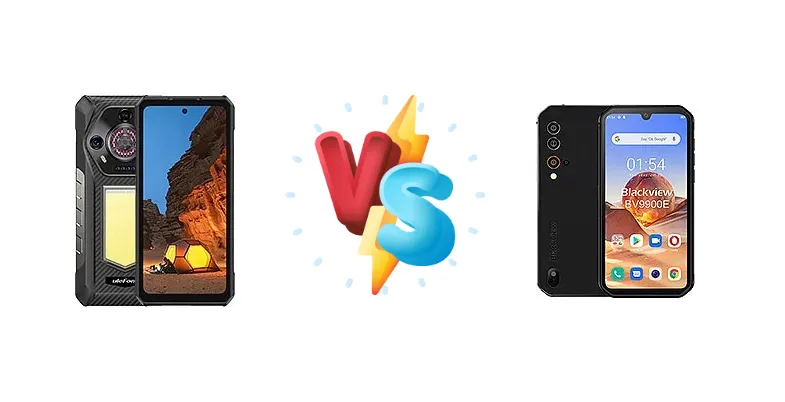
|
🏆 Quick Verdict
For most users needing a robust and responsive rugged phone, the Ulefone Armor 30 emerges as the winner. Its Helio G100 chipset, built on a 6nm process, offers a noticeable performance advantage over the BV9900E’s 12nm Helio P90, coupled with significantly faster 66W wired charging. While the BV9900E offers wireless charging, the Armor 30’s speed and efficiency are more valuable for power users.
| PHONES | ||
|---|---|---|
| Phone Names | Ulefone Armor 30 | Blackview BV9900E |
| Network | ||
|---|---|---|
| 2G bands | GSM 850 / 900 / 1800 / 1900 | GSM 850 / 900 / 1800 / 1900 |
| 3G bands | HSDPA 800 / 850 / 900 / 1700(AWS) / 1900 / 2100 | HSDPA 800 / 850 / 900 / 1700(AWS) / 1900 / 2100 |
| 4G bands | 1, 2, 3, 4, 5, 7, 8, 12, 13, 17, 18, 19, 20, 25, 26, 28, 32, 34, 38, 39, 40, 41, 66, 71 | 1, 2, 3, 4, 5, 7, 8, 12, 13, 17, 18, 19, 20, 25, 26, 28, 34, 38, 39, 40, 41, 66 |
| Speed | HSPA, LTE | HSPA, LTE |
| Technology | GSM / CDMA / HSPA / CDMA2000 / LTE | GSM / CDMA / HSPA / CDMA2000 / LTE |
| Launch | ||
|---|---|---|
| Announced | 2025, June | 2020, September 10. Released 2020, September |
| Status | Available. Released 2025, June 16 | Discontinued |
| Body | ||
|---|---|---|
| Dimensions | 181.3 x 84.9 x 21.2 mm (7.14 x 3.34 x 0.83 in) | 156.5 x 78.3 x 14.2 mm (6.16 x 3.08 x 0.56 in) |
| SIM | Nano-SIM + Nano-SIM | Nano-SIM + Nano-SIM |
| Weight | 506 g (1.12 lb) | 273 g (9.63 oz) |
| Display | ||
|---|---|---|
| Protection | Corning Gorilla Glass 5, Mohs level 4 | Corning Gorilla Glass 5 |
| Resolution | 1080 x 2460 pixels (~387 ppi density) | 1080 x 2280 pixels, 19:9 ratio (~432 ppi density) |
| Size | 6.95 inches, 114.7 cm2 (~74.5% screen-to-body ratio) | 5.84 inches, 85.1 cm2 (~69.5% screen-to-body ratio) |
| Type | IPS LCD, 120Hz, 700 nits (peak) | IPS LCD |
| Platform | ||
|---|---|---|
| CPU | Octa-core (2x2.2 GHz Cortex-A76 & 6x2.0 GHz Cortex-A55) | Octa-core (2x2.2 GHz Cortex-A75 & 6x2.0 GHz Cortex-A55) |
| Chipset | Mediatek Helio G100 (6 nm) | Mediatek MT6779V/CE Helio P90 (12 nm) |
| GPU | Mali-G57 MC2 | PowerVR GM9446 |
| OS | Android 15 | Android 10 |
| Memory | ||
|---|---|---|
| Card slot | microSDXC (dedicated slot) | microSDXC |
| Internal | 512GB 12GB RAM | 128GB 6GB RAM |
| Main Camera | ||
|---|---|---|
| Features | Dual-LED flash, HDR, panorama | LED flash, HDR, panorama |
| Quad | - | 48 MP, f/1.8, (wide), PDAF 16 MP, 120˚ (ultrawide) 2 MP (macro) Auxiliary lens |
| Triple | 50 MP, f/2.0, 23mm (wide), 1/1.3", 1.2µm, multi-directional PDAF 64 MP, f/1.8, (night vision), 1/2.0", 0.7µm, 4 infrared lights 50 MP, f/2.2, 16mm, 117˚ (ultrawide), 1/2.76", 0.64µm | - |
| Video | 1440p@30fps, 1080p@30fps, gyro-EIS | 4K@30fps, 1080p@60fps |
| Selfie camera | ||
|---|---|---|
| Single | 32 MP, f/2.5, 25mm (wide), 1/2.8", 0.8µm | 16 MP, f/2.0, (wide) |
| Video | 1080p@30fps | 1080p@30fps |
| Sound | ||
|---|---|---|
| 35mm jack | Yes | No |
| Loudspeaker | Yes, with stereo speakers (118dB) | Yes |
| Comms | ||
|---|---|---|
| Bluetooth | 5.2, A2DP, LE | 5.0, A2DP, LE |
| Infrared port | Yes | - |
| NFC | Yes | Yes |
| Positioning | GPS, GALILEO, GLONASS, QZSS, BDS | GPS, GLONASS, GALILEO, BDS |
| Radio | Wireless FM radio, RDS, recording | FM radio |
| USB | USB Type-C 2.0, OTG, accessory connector pins | USB Type-C 2.0, OTG |
| WLAN | Wi-Fi 802.11 a/b/g/n/ac, dual-band | Wi-Fi 802.11 a/b/g/n/ac |
| Features | ||
|---|---|---|
| Sensors | Fingerprint (side-mounted), accelerometer, gyro, proximity, compass, barometer | Fingerprint (side-mounted), accelerometer, gyro, proximity, compass, barometer |
| Battery | ||
|---|---|---|
| Charging | 66W wired 10W reverse wired | 15W wired 18W wireless |
| Type | Li-Po 12800 mAh | 4380 mAh |
| Misc | ||
|---|---|---|
| Colors | Black | Black, Silver |
| Price | € 379.99 / $ 297.49 / £ 269.99 | About 260 EUR |
| EU LABEL | ||
|---|---|---|
| Battery | 138:30h endurance, 1000 cycles | - |
| Energy | Class A | - |
| Free fall | Class A (270 falls) | - |
| Repairability | Class C | - |
Ulefone Armor 30
- Faster processor (Helio G100)
- Significantly faster charging (66W)
- Potentially better battery longevity (1000 cycles)
- No wireless charging
- Rugged design may be bulky
Blackview BV9900E
- Convenient wireless charging (18W)
- Established rugged design
- Potentially lower price point
- Older, less efficient processor (Helio P90)
- Slower wired charging (15W)
Display Comparison
Neither device’s display specifications are provided, so a direct comparison is limited. However, considering the Armor 30’s focus on newer technology, it’s reasonable to expect a more modern panel with potentially higher peak brightness and improved color accuracy. The BV9900E, being an older model, likely utilizes a standard LCD panel. Users prioritizing outdoor visibility should investigate independent display tests for both models.
Camera Comparison
Without detailed camera specifications, a definitive comparison is difficult. However, the chipset differences suggest the Armor 30 may have a more advanced image signal processor (ISP), potentially leading to better image quality, especially in low-light conditions. The focus should be on independent reviews that assess the main sensor’s performance, dynamic range, and noise levels, rather than relying on marketing claims about secondary sensors like 2MP macro lenses.
Performance
The Ulefone Armor 30’s Mediatek Helio G100 (6nm) represents a significant architectural leap over the Blackview BV9900E’s Helio P90 (12nm). The 6nm process allows for greater transistor density and improved power efficiency, translating to sustained performance under load. Both CPUs share a similar core configuration (2x2.2 GHz Cortex-A76 & 6x2.0 GHz Cortex-A55), but the G100’s newer architecture and smaller node size will deliver superior single-core and multi-core performance. This benefits users engaged in gaming, video editing, or running resource-intensive applications.
Battery Life
The Ulefone Armor 30 boasts a 138:30h endurance rating, suggesting excellent battery life. While the BV9900E’s battery capacity isn’t specified, the Armor 30’s 66W wired charging is a game-changer. This allows for significantly faster top-ups compared to the BV9900E’s 15W wired charging. The BV9900E counters with 18W wireless charging, offering convenience, but the Armor 30’s speed is more practical for users who need to quickly replenish their battery during short breaks. The Armor 30 also claims 1000 charge cycles, suggesting long-term battery health.
Buying Guide
Buy the Ulefone Armor 30 if you need a rugged phone that can handle demanding tasks like gaming or running multiple apps simultaneously, and if minimizing charging time is a priority. Buy the Blackview BV9900E if you prioritize the convenience of wireless charging and are less concerned with having the absolute fastest processor, or if you frequently find yourself in situations where a wall outlet isn't available.