
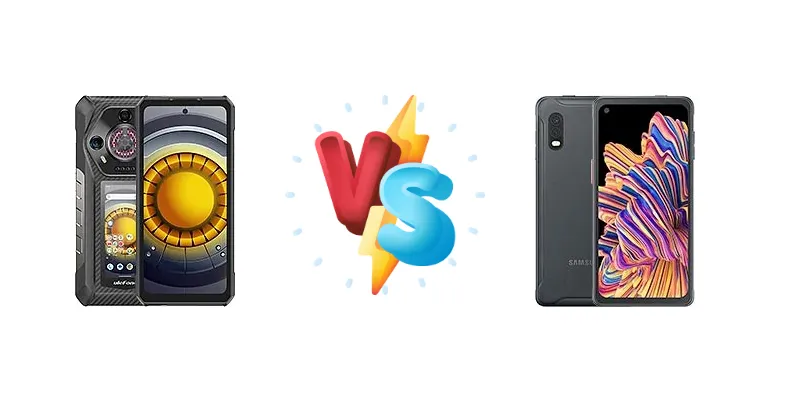
Ulefone Armor 30 Pro vs. Samsung Galaxy XCover Pro: A Deep Dive for Professionals
| Phones Images | |||||
|---|---|---|---|---|---|
|
🏆 Quick Verdict
For the average user prioritizing raw performance and battery endurance, the Ulefone Armor 30 Pro is the clear winner. Its Dimensity 7300X chipset offers a significant leap in processing power and efficiency over the Samsung’s Exynos 9611, coupled with substantially faster 66W charging. However, Samsung’s established software support and enterprise features may appeal to specific business needs.
| PHONES | ||
|---|---|---|
| Phone Names | Ulefone Armor 30 Pro | Samsung Galaxy XCover Pro |
| Network | ||
|---|---|---|
| 2G bands | GSM 850 / 900 / 1800 / 1900 | GSM 850 / 900 / 1800 / 1900 |
| 3G bands | HSDPA 800 / 850 / 900 / 1700(AWS) / 1900 / 2100 | HSDPA 850 / 900 / 1900 / 2100 - International |
| 4G bands | 1, 2, 3, 4, 5, 7, 8, 12, 13, 17, 18, 19, 20, 25, 26, 28, 32, 34, 38, 39, 40, 41, 66, 71 | 1, 2, 3, 5, 7, 8, 20, 28, 38, 40, 41 - International |
| 5G bands | 1, 2, 3, 5, 7, 8, 20, 25, 28, 38, 40, 41, 66, 71, 77, 78, 79 SA/NSA/Sub6 | - |
| Speed | HSPA, LTE, 5G | HSPA 42.2/5.76 Mbps, LTE (3CA) Cat11 600/50 Mbps |
| Technology | GSM / CDMA / HSPA / CDMA2000 / LTE / 5G | GSM / HSPA / LTE |
| - | 1, 2, 3, 4, 5, 7, 12, 13, 14, 20, 29, 38, 40, 41, 66 - Canada | |
| Launch | ||
|---|---|---|
| Announced | 2025, April 03 | 2020, January |
| Status | Available. Released 2025, April 03 | Available. Released 2020, January |
| Body | ||
|---|---|---|
| Dimensions | 181.3 x 84.9 x 21.2 mm (7.14 x 3.34 x 0.83 in) | 159.9 x 76.7 x 10 mm (6.30 x 3.02 x 0.39 in) |
| SIM | Nano-SIM + Nano-SIM | · Nano-SIM· Nano-SIM + Nano-SIM |
| Weight | 509 g (1.12 lb) | 218 g (7.69 oz) |
| - | IP68 dust/water resistant (up to 1.5m for 35 min) Drop-to-concrete resistance from up to 1.5m MIL-STD-810G compliant* *does not guarantee ruggedness or use in extreme conditions | |
| Display | ||
|---|---|---|
| Protection | Corning Gorilla Glass 5, Mohs level 4 | Corning Gorilla Glass 5 |
| Resolution | 1080 x 2460 pixels (~387 ppi density) | 1080 x 2340 pixels, 19.5:9 ratio (~409 ppi density) |
| Size | 6.95 inches, 114.7 cm2 (~74.5% screen-to-body ratio) | 6.3 inches, 97.4 cm2 (~79.4% screen-to-body ratio) |
| Type | IPS LCD, 120Hz, 700 nits (peak) | IPS LCD |
| Platform | ||
|---|---|---|
| CPU | Octa-core (4x2.5 GHz Cortex-A78 & 4x2.0 GHz Cortex-A55) | Octa-core (4x2.3 GHz Cortex-A73 & 4x1.7 GHz Cortex-A53) |
| Chipset | Mediatek Dimensity 7300X (4 nm) | Exynos 9611 (10 nm) |
| GPU | Mali-G615 MC2 | Mali-G72 MP3 |
| OS | Android 14, planned upgrade to Android 15 | Android 10, upgradable to Android 13, One UI 5 |
| Memory | ||
|---|---|---|
| Card slot | microSDXC (dedicated slot) | microSDXC (dedicated slot) |
| Internal | 512GB 16GB RAM | 64GB 4GB RAM |
| Main Camera | ||
|---|---|---|
| Dual | - | 25 MP, f/1.7, 26mm (wide), PDAF 8 MP, f/2.2, 123˚ (ultrawide), 1/4.0", 1.12µm |
| Features | Dual-LED flash, HDR, panorama | Dual-LED flash, HDR, panorama |
| Triple | 50 MP, f/2.0, 23mm (wide), 1/1.3", 1.2µm, multi-directional PDAF 64 MP, f/1.8, (night vision), 1/2.0", 0.7µm, 4 infrared lights 50 MP, f/2.2, 16mm, 117˚ (ultrawide), 1/2.76", 0.64µm | - |
| Video | 4K@30fps, 1080p@30fps, gyro-EIS | 1080p@30fps |
| Selfie camera | ||
|---|---|---|
| Features | - | HDR |
| Single | 32 MP, f/2.5, 25mm (wide), 1/2.8", 0.8µm | 13 MP, f/2.0, (wide), 1/3.1", 1.12µm |
| Video | 1080p@30fps | 1080p@30fps |
| Sound | ||
|---|---|---|
| 3.5mm jack | - | Yes |
| 35mm jack | Yes | Yes |
| Loudspeaker | Yes, with stereo speakers (118dB) | Yes |
| Comms | ||
|---|---|---|
| Bluetooth | 5.4, A2DP, LE | 5.0, A2DP, LE |
| Infrared port | Yes | - |
| NFC | Yes | Yes |
| Positioning | GPS, GALILEO, GLONASS, QZSS, BDS, NavIC | GPS, GLONASS, GALILEO, BDS |
| Radio | Wireless FM radio, RDS, recording | FM radio (market/region dependent) |
| USB | USB Type-C 2.0, OTG, accessory connector pins | USB Type-C 2.0 |
| WLAN | Wi-Fi 802.11 a/b/g/n/ac/6e, dual-band | Wi-Fi 802.11 a/b/g/n/ac/k/v/r, dual-band, Wi-Fi Direct |
| Features | ||
|---|---|---|
| Sensors | Fingerprint (side-mounted), accelerometer, gyro, proximity, compass, barometer | Fingerprint (side-mounted), accelerometer, gyro, proximity, compass |
| - | ANT+ | |
| Battery | ||
|---|---|---|
| Charging | 66W wired 10W reverse wired | 15W wired |
| Type | Li-Po 12800 mAh | Li-Po 4050 mAh, removable |
| Misc | ||
|---|---|---|
| Colors | Black | Black |
| Models | - | SM-G715FN/DS, SM-G715FN, SM-G715F, SM-G715W, SM-G715U, SM-G715U1 |
| Price | € 459.99 / $ 354.49 / £ 319.99 | About 120 EUR |
| SAR EU | - | 0.47 W/kg (head) 1.23 W/kg (body) |
| EU LABEL | ||
|---|---|---|
| Battery | 142:00h endurance, 1000 cycles | - |
| Energy | Class A | - |
| Free fall | Class A (270 falls) | - |
| Repairability | Class C | - |
Ulefone Armor 30 Pro
- Significantly faster processor (Dimensity 7300X)
- Much faster charging (66W)
- Potentially longer battery life (142h endurance)
- Brand recognition is lower than Samsung
- Software update support may be less consistent
Samsung Galaxy XCover Pro
- Established Samsung ecosystem and software support
- Compatibility with enterprise mobile management (EMM) solutions
- Rugged design with reliable build quality
- Outdated processor (Exynos 9611)
- Slow charging (15W)
- Lower overall performance
Display Comparison
Neither device boasts a cutting-edge display. While specific details like peak brightness and color accuracy are absent, the focus is on ruggedness, not visual fidelity. Both likely employ durable glass or plastic coverings. The XCover Pro’s display is likely optimized for outdoor visibility, a common Samsung trait, but the Armor 30 Pro’s panel technology remains unknown. The absence of high refresh rates on either device suggests a focus on power conservation.
Camera Comparison
Detailed camera specs are limited, but the focus here isn’t likely on photography prowess. Both phones likely feature serviceable cameras for documentation and basic image capture. The Armor 30 Pro’s camera system is unknown, but the XCover Pro’s camera is likely geared towards practical use cases rather than high-resolution detail. The presence of a 2MP macro camera on the XCover Pro is largely a marketing feature with limited real-world utility. Image processing will likely differ, with Samsung favoring its signature vibrant color profiles.
Performance
The performance gap is substantial. The Ulefone Armor 30 Pro’s Mediatek Dimensity 7300X (4nm) is a modern chipset featuring a Cortex-A78 based octa-core CPU clocked up to 2.5 GHz. This architecture, built on a smaller 4nm process, delivers significantly improved performance and power efficiency compared to the Samsung Galaxy XCover Pro’s Exynos 9611 (10nm). The Exynos 9611, with its Cortex-A73 cores peaking at 2.3 GHz, is a generation behind and operates on a less efficient 10nm node. This translates to slower application loading times, less responsive multitasking, and potentially more thermal throttling under sustained load on the Samsung device. The Armor 30 Pro will excel in demanding applications and multitasking scenarios.
Battery Life
The Ulefone Armor 30 Pro claims an impressive 142-hour endurance, suggesting a large battery capacity (specific mAh is missing). More importantly, its 66W wired charging is a game-changer, allowing for significantly faster top-ups compared to the XCover Pro’s slow 15W charging. While the XCover Pro may offer decent battery life for moderate use, the Armor 30 Pro’s combination of endurance and rapid charging provides a substantial advantage for users who rely heavily on their device throughout the day. The Armor 30 Pro also boasts 10W reverse wired charging, a feature absent on the XCover Pro.
Buying Guide
Buy the Ulefone Armor 30 Pro if you need a rugged phone that can handle demanding tasks like mobile gaming, data-intensive applications, or extended field work requiring long battery life and quick recharging. Buy the Samsung Galaxy XCover Pro if you prioritize a familiar Samsung ecosystem, reliable software updates, and compatibility with existing enterprise mobile management (EMM) solutions, even if it means sacrificing some processing power and charging speed.