
Ulefone Armor 30 Pro vs. Oukitel WP100 Titan: A Deep Dive into Rugged Smartphone Endurance
| Phones Images | |||||
|---|---|---|---|---|---|
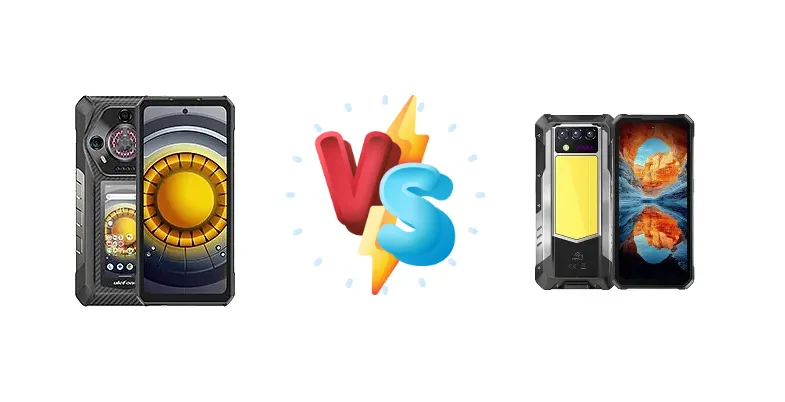
|
🏆 Quick Verdict
For the average user prioritizing battery life and long-term reliability, the Oukitel WP100 Titan emerges as the winner. Its significantly higher battery endurance (166:39h vs 142:00h) and 1400 charge cycles outweigh the Armor 30 Pro’s marginally faster processor.
| PHONES | ||
|---|---|---|
| Phone Names | Ulefone Armor 30 Pro | Oukitel WP100 Titan |
| Network | ||
|---|---|---|
| 2G bands | GSM 850 / 900 / 1800 / 1900 | GSM 850 / 900 / 1800 / 1900 |
| 3G bands | HSDPA 800 / 850 / 900 / 1700(AWS) / 1900 / 2100 | HSDPA 800 / 850 / 900 / 1700(AWS) / 1900 / 2100 |
| 4G bands | 1, 2, 3, 4, 5, 7, 8, 12, 13, 17, 18, 19, 20, 25, 26, 28, 32, 34, 38, 39, 40, 41, 66, 71 | 1, 2, 3, 4, 5, 7, 8, 12, 13, 17, 18, 19, 20, 25, 26, 28, 34, 38, 40, 41, 66 LTE |
| 5G bands | 1, 2, 3, 5, 7, 8, 20, 25, 28, 38, 40, 41, 66, 71, 77, 78, 79 SA/NSA/Sub6 | 1, 2, 3, 5, 7, 8, 12, 20, 28, 38, 40, 41, 66, 71, 77, 78, 79 |
| Speed | HSPA, LTE, 5G | HSPA, LTE |
| Technology | GSM / CDMA / HSPA / CDMA2000 / LTE / 5G | GSM / HSPA / EVDO / LTE / 5G |
| Launch | ||
|---|---|---|
| Announced | 2025, April 03 | 2025, February 18 |
| Status | Available. Released 2025, April 03 | Available. Released 2025, February 18 |
| Body | ||
|---|---|---|
| Build | - | Glass front, aluminum with plastic frame and back |
| Dimensions | 181.3 x 84.9 x 21.2 mm (7.14 x 3.34 x 0.83 in) | 178.3 x 84.3 x 35.6 mm (7.02 x 3.32 x 1.40 in) |
| SIM | Nano-SIM + Nano-SIM | Nano-SIM + Nano-SIM |
| Weight | 509 g (1.12 lb) | 876.6 g (1.93 lb) |
| Display | ||
|---|---|---|
| Protection | Corning Gorilla Glass 5, Mohs level 4 | Corning Gorilla Glass 5, Mohs level 5 |
| Resolution | 1080 x 2460 pixels (~387 ppi density) | 1080 x 2460 pixels (~395 ppi density) |
| Size | 6.95 inches, 114.7 cm2 (~74.5% screen-to-body ratio) | 6.8 inches, 109.8 cm2 (~73.1% screen-to-body ratio) |
| Type | IPS LCD, 120Hz, 700 nits (peak) | IPS LCD, 120Hz, 450 nits |
| Platform | ||
|---|---|---|
| CPU | Octa-core (4x2.5 GHz Cortex-A78 & 4x2.0 GHz Cortex-A55) | Octa-core (4x2.5 GHz Cortex-A78 & 4x2.0 GHz Cortex-A55) |
| Chipset | Mediatek Dimensity 7300X (4 nm) | Mediatek Dimensity 7300 (4 nm) |
| GPU | Mali-G615 MC2 | Mali-G615 MP2 |
| OS | Android 14, planned upgrade to Android 15 | Android 14 |
| Memory | ||
|---|---|---|
| Card slot | microSDXC (dedicated slot) | microSDXC (uses shared SIM slot) |
| Internal | 512GB 16GB RAM | 512GB 16GB RAM |
| Main Camera | ||
|---|---|---|
| Features | Dual-LED flash, HDR, panorama | LED flash, HDR, portrait, panorama |
| Triple | 50 MP, f/2.0, 23mm (wide), 1/1.3", 1.2µm, multi-directional PDAF 64 MP, f/1.8, (night vision), 1/2.0", 0.7µm, 4 infrared lights 50 MP, f/2.2, 16mm, 117˚ (ultrawide), 1/2.76", 0.64µm | 200 MP (wide), 1/1.4", PDAF, LED 20 MP (Night Vision), 1/2.78", AF 2 MP (macro) |
| Video | 4K@30fps, 1080p@30fps, gyro-EIS | 4K@30fps |
| Selfie camera | ||
|---|---|---|
| Single | 32 MP, f/2.5, 25mm (wide), 1/2.8", 0.8µm | 32MP, 1/2.74" |
| Video | 1080p@30fps | 1080p@30fps |
| Sound | ||
|---|---|---|
| 35mm jack | Yes | No |
| Loudspeaker | Yes, with stereo speakers (118dB) | Yes |
| Comms | ||
|---|---|---|
| Bluetooth | 5.4, A2DP, LE | 5.4, A2DP, LE |
| Infrared port | Yes | - |
| NFC | Yes | Yes |
| Positioning | GPS, GALILEO, GLONASS, QZSS, BDS, NavIC | GPS, GLONASS, GALILEO, BDS |
| Radio | Wireless FM radio, RDS, recording | FM radio, FM recording |
| USB | USB Type-C 2.0, OTG, accessory connector pins | USB Type-C 2.0, OTG |
| WLAN | Wi-Fi 802.11 a/b/g/n/ac/6e, dual-band | Wi-Fi 802.11 a/b/g/n/ac/6e, dual-band |
| Features | ||
|---|---|---|
| Sensors | Fingerprint (side-mounted), accelerometer, gyro, proximity, compass, barometer | Fingerprint (side-mounted), accelerometer, gyro, proximity, compass |
| Battery | ||
|---|---|---|
| Charging | 66W wired 10W reverse wired | 66W wired 18W reverse wired |
| Type | Li-Po 12800 mAh | Li-Po 33000 mAh |
| Misc | ||
|---|---|---|
| Colors | Black | Black |
| Price | € 459.99 / $ 354.49 / £ 319.99 | About 780 EUR |
| EU LABEL | ||
|---|---|---|
| Battery | 142:00h endurance, 1000 cycles | 166:39h endurance, 1400 cycles |
| Energy | Class A | Class B |
| Free fall | Class A (270 falls) | Class A (270 falls) |
| Repairability | Class C | Class C |
Ulefone Armor 30 Pro
- Potentially slightly faster processor (Dimensity 7300X)
- 66W fast charging
- Rugged design for durability
- Lower battery endurance (142:00h)
- Fewer battery charge cycles (1000)
Oukitel WP100 Titan
- Superior battery endurance (166:39h)
- Higher battery charge cycle count (1400)
- 18W reverse wired charging
- Standard Dimensity 7300 (potentially slightly slower)
- May take longer to fully charge due to larger battery
Display Comparison
Both devices are expected to feature robust displays suitable for outdoor use, though specific details like peak brightness and panel type are not provided. The focus here is on durability, and both manufacturers likely prioritize scratch resistance and visibility in direct sunlight. Without further data, it's difficult to differentiate display quality beyond the inherent ruggedization.
Camera Comparison
Without detailed camera specifications, a direct comparison is limited. Both phones likely feature multi-camera setups geared towards versatility rather than photographic excellence. The absence of sensor size or aperture information suggests a focus on practicality over high-end imaging. Users should expect competent daylight photography but potentially struggle in low-light conditions. The inclusion of a 2MP macro lens on either device is likely a marketing feature with limited real-world utility.
Performance
Both the Ulefone Armor 30 Pro and Oukitel WP100 Titan utilize the Mediatek Dimensity 7300 series, an octa-core processor built on a 4nm process. The Armor 30 Pro features the Dimensity 7300X, which *may* offer a slight edge in CPU and GPU clock speeds, translating to marginally faster performance in benchmarks and demanding applications. However, the difference is likely to be imperceptible in most real-world scenarios. Both chips share the same core configuration (4x2.5 GHz Cortex-A78 & 4x2.0 GHz Cortex-A55), meaning the architectural foundation is identical. Thermal management will be key; the 4nm process should help mitigate throttling, but rugged designs often prioritize heat dissipation less than sleek flagships.
Battery Life
The Oukitel WP100 Titan clearly wins in battery endurance, boasting 166:39 hours compared to the Ulefone Armor 30 Pro’s 142:00 hours. This translates to nearly two full days of extra usage for the Titan. Crucially, the WP100 Titan also supports 1400 battery charge cycles, significantly exceeding the Armor 30 Pro’s 1000 cycles. This indicates the Titan’s battery will maintain its capacity for a longer period, delaying the need for replacement. Both devices support 66W wired charging, offering reasonably fast top-ups, but the Titan’s larger capacity will take longer to fully charge. The WP100 Titan also offers 18W reverse wired charging, exceeding the Armor 30 Pro’s 10W, making it more useful for topping up accessories.
Buying Guide
Buy the Ulefone Armor 30 Pro if you need a slightly more responsive experience for demanding tasks and appreciate the potential for marginally faster app loading times. Buy the Oukitel WP100 Titan if you prioritize maximum uptime between charges, require a phone that will hold its charge capacity for longer, and value the peace of mind that comes with a larger battery cycle count.