
Ulefone Armor 29 Ultra vs. Blackview BV8800: A Rugged Smartphone Face-Off
| Phones Images | |||||
|---|---|---|---|---|---|
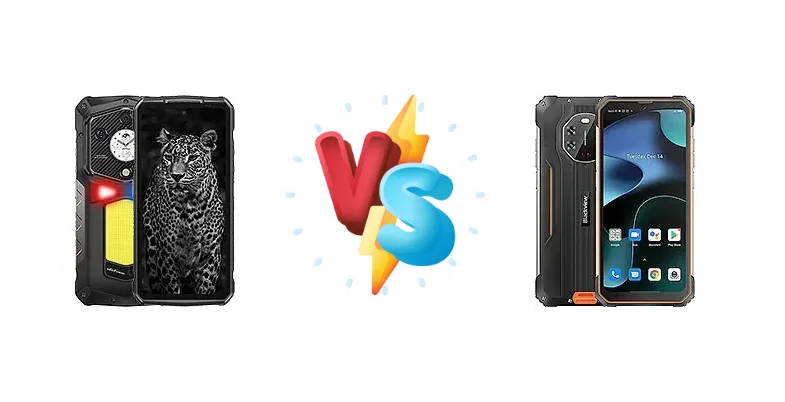
|
🏆 Quick Verdict
For users prioritizing raw performance and future-proofing, the Ulefone Armor 29 Ultra is the clear winner. Its Dimensity 9300+ chipset delivers a generational leap in processing power. However, the Blackview BV8800 remains a compelling choice for those seeking a capable rugged phone at a significantly lower price point.
| PHONES | ||
|---|---|---|
| Phone Names | Ulefone Armor 29 Ultra | Blackview BV8800 |
| Network | ||
|---|---|---|
| 2G bands | GSM 850 / 900 / 1800 / 1900 | GSM 850 / 900 / 1800 / 1900 |
| 3G bands | HSDPA 800 / 850 / 900 / 1700(AWS) / 1900 / 2100 | HSDPA 800 / 850 / 900 / 1700(AWS) / 1900 / 2100 |
| 4G bands | 1, 2, 3, 4, 5, 7, 8, 12, 13, 17, 18, 19, 20, 25, 26, 28, 32, 34, 38, 39, 40, 41, 66, 71 | 1, 2, 3, 4, 5, 7, 8, 12, 13, 17, 18, 19, 20, 25, 26, 28, 30, 34, 38, 39, 40, 41, 66 |
| 5G bands | 1, 2, 3, 5, 7, 8, 20, 25, 28, 38, 40, 41, 66, 71, 77, 78, 79 SA/NSA/Sub6 | - |
| Speed | HSPA, LTE, 5G | HSPA, LTE |
| Technology | GSM / CDMA / HSPA / CDMA2000 / LTE / 5G | GSM / CDMA / HSPA / CDMA2000 / LTE |
| - | CDMA2000 1x | |
| Launch | ||
|---|---|---|
| Announced | 2025, August | 2021, December 24 |
| Status | Available. Released 2025, August 18 | Available. Released 2022, January 10 |
| Body | ||
|---|---|---|
| Dimensions | 177.3 x 85.6 x 33.8 mm (6.98 x 3.37 x 1.33 in) | 176.2 x 83.5 x 17.7 mm (6.94 x 3.29 x 0.70 in) |
| SIM | Nano-SIM + Nano-SIM | Nano-SIM + Nano-SIM |
| Weight | 688 g (1.52 lb) | 367 g (12.95 oz) |
| - | IP68/IP69K dust/water resistant (up to 1.5m for 30 min) Drop-to-concrete resistance from up to 1.5m MIL-STD-810H compliant | |
| Display | ||
|---|---|---|
| Protection | Corning Gorilla Glass 5, Mohs level 4 | - |
| Resolution | 1080 x 2400 pixels, 20:9 ratio (~395 ppi density) | 1080 x 2408 pixels, 20:9 ratio (~401 ppi density) |
| Size | 6.67 inches, 107.4 cm2 (~70.8% screen-to-body ratio) | 6.58 inches, 104.3 cm2 (~70.9% screen-to-body ratio) |
| Type | AMOLED, 1B colors, 120Hz, 900 nits (HBM), 2200 nits (peak) | IPS LCD, 90Hz, 480 nits |
| Platform | ||
|---|---|---|
| CPU | Octa-core (1x3.4 GHz Cortex-X4 & 3x2.85 GHz Cortex-X4 & 4x2.0 GHz Cortex-A720) | Octa-core (2x2.05 GHz Cortex-A76 & 6x2.0 GHz Cortex-A55) |
| Chipset | Mediatek Dimensity 9300+ (4 nm) | Mediatek MT6781 Helio G96 (12 nm) |
| GPU | Immortalis-G720 MC12 | Mali-G57 MC2 |
| OS | Android 15 | Android 11, Doke-OS 3.0 |
| Memory | ||
|---|---|---|
| Card slot | microSDXC (dedicated slot) | No |
| Internal | 1TB 16GB RAM | 128GB 8GB RAM |
| - | UFS 2.1 | |
| Main Camera | ||
|---|---|---|
| Features | LED flash, HDR, panorama | Dual-LED flash, HDR, panorama |
| Quad | - | 50 MP, f/1.8, (wide), PDAF 8 MP, f/2.2, 117˚ (ultrawide) 20 MP, f/1.8, (IR camera), 2 IR emitters Auxiliary lens |
| Single | - | 16 MP, f/2.0, (wide) |
| Triple | 50 MP, f/1.9, 23mm (wide), 1.0"-type, 1.6µm, dual pixel PDAF 64 MP, f/1.8, 26mm (night vision), 1/2.0", 0.7µm, 4 infrared lights 50 MP, f/2.2, 16mm, 117˚ (ultrawide), 1/2.76", 0.64µm | - |
| Video | 8K@30fps, 4K@30fps, 1080p@30/60fps, gyro-EIS | 1440p@30fps |
| Selfie camera | ||
|---|---|---|
| Single | 50 MP, f/2.5, 25mm (wide), 1/2.76", 0.64µm | 16 MP, f/2.0, (wide) |
| Video | 1080p@30fps | 1080p@30fps |
| Sound | ||
|---|---|---|
| 3.5mm jack | - | No |
| 35mm jack | Yes | No |
| Loudspeaker | Yes | Yes |
| Comms | ||
|---|---|---|
| Bluetooth | 5.4, A2DP, LE | 5.2, A2DP, LE |
| Infrared port | Yes | - |
| NFC | Yes | Yes |
| Positioning | GPS, GALILEO, GLONASS, QZSS, BDS, NavIC | GPS, GLONASS, GALILEO, BDS |
| Radio | Wireless FM radio, RDS, recording | FM radio |
| USB | USB Type-C 3.2 Gen2, Display Port 1.4, OTG, accessory connector pins | USB Type-C 2.0, OTG |
| WLAN | Wi-Fi 802.11 a/b/g/n/ac/6/7, tri-band | Wi-Fi 802.11 a/b/g/n/ac |
| Features | ||
|---|---|---|
| Sensors | Fingerprint (side-mounted), accelerometer, gyro, proximity, compass, barometer | Fingerprint (side-mounted), accelerometer, gyro, proximity, compass, barometer |
| Battery | ||
|---|---|---|
| Charging | 120W wired, PPS, 20% in 10 min 10W reverse wired | 33W wired, 31% in 30 min, 100% in 90 min Reverse wired |
| Type | Li-Po 21200 mAh | 8380 mAh |
| Misc | ||
|---|---|---|
| Colors | Black | Black, Orange, Green |
| Price | $ 877.91 / £ 639.99 / € 799.99 | About 350 EUR |
| Tests | ||
|---|---|---|
| Battery life | - | Endurance rating 199h |
| Camera | - | Photo / Video |
| Display | - | Contrast ratio: 1348:1 (nominal) |
| Loudspeaker | - | -29.3 LUFS (Average) |
| Performance | - | AnTuTu: 254849 (v8), 288964 (v9) GeekBench: 1752 (v5.1) GFXBench: 10fps (ES 3.1 onscreen) |
| EU LABEL | ||
|---|---|---|
| Battery | 112:30h endurance, 1000 cycles | - |
| Energy | Class A | - |
| Free fall | Class A (270 falls) | - |
| Repairability | Class B | - |
Ulefone Armor 29 Ultra
- Unmatched performance with Dimensity 9300+
- Ultra-fast 120W charging
- Exceptional battery endurance (112:30h)
- Higher price point
- Detailed camera specs currently unavailable
Blackview BV8800
- Affordable price
- Rugged and durable build
- Decent battery life for basic use
- Outdated Helio G96 chipset
- Slow charging speed (33W)
- Limited performance for demanding tasks
Display Comparison
The Blackview BV8800 features a display with a 1348:1 contrast ratio and a measured peak brightness of 501 nits. While adequate for outdoor visibility, it lacks the advanced features expected in this price range. The Ulefone Armor 29 Ultra’s display specifications are currently unavailable, but given its flagship positioning, we anticipate a higher peak brightness and potentially a higher refresh rate for smoother visuals. The BV8800’s contrast ratio, while respectable, suggests a standard LCD panel, whereas the Armor 29 Ultra may incorporate more advanced panel technology.
Camera Comparison
Both devices offer photo and video capabilities, but detailed camera specifications are limited for the Ulefone Armor 29 Ultra. The Blackview BV8800’s camera system is not detailed enough to provide a meaningful comparison beyond its basic functionality. The absence of specific sensor details for the Ulefone suggests a focus on overall image processing capabilities leveraging the Dimensity 9300+'s ISP. Users seeking advanced photographic features should await further details on the Armor 29 Ultra’s camera setup.
Performance
This is where the chasm between these two devices becomes apparent. The Ulefone Armor 29 Ultra’s Mediatek Dimensity 9300+ (4nm) chipset, with its octa-core configuration (1x3.4 GHz Cortex-X4, 3x2.85 GHz Cortex-X4, and 4x2.0 GHz Cortex-A720), represents a significant leap in processing power compared to the Blackview BV8800’s Mediatek MT6781 Helio G96 (12nm). The Dimensity 9300+’s 4nm process node translates to superior thermal efficiency and reduced power consumption, minimizing throttling during sustained workloads. The G96’s octa-core setup (2x2.05 GHz Cortex-A76 & 6x2.0 GHz Cortex-A55) is geared towards mid-range performance, suitable for everyday tasks but struggling with graphically intensive applications. The Armor 29 Ultra will deliver a far smoother and more responsive experience, particularly in gaming and multitasking.
Battery Life
The Ulefone Armor 29 Ultra boasts an impressive 112:30h endurance rating and supports 120W wired charging, achieving 20% charge in just 10 minutes. This rapid charging capability is a significant advantage for users who need to quickly top up their battery. The Blackview BV8800, with a 199h endurance rating, offers considerably less battery life. Its 33W charging takes 30 minutes for 31% and 90 minutes for a full charge. While the BV8800’s endurance is respectable, the Armor 29 Ultra’s combination of longer endurance and significantly faster charging provides a superior user experience. The Armor 29 Ultra also claims 1000 charge cycles, suggesting a longer lifespan for the battery itself.
Buying Guide
Buy the Ulefone Armor 29 Ultra if you need uncompromising performance for demanding tasks like mobile gaming, video editing, or running complex applications in the field. Its 120W charging and advanced chipset will keep you productive. Buy the Blackview BV8800 if you prioritize affordability and a reliable, durable device for basic communication, navigation, and photography – a solid workhorse without breaking the bank.