
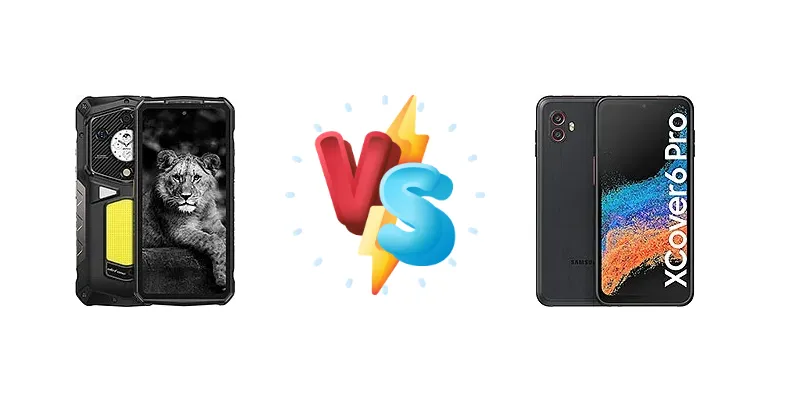
Ulefone Armor 29 Pro vs. Samsung Galaxy XCover6 Pro: A Rugged Showdown
| Phones Images | |||||
|---|---|---|---|---|---|
|
🏆 Quick Verdict
For users prioritizing raw speed and rapid charging, the Ulefone Armor 29 Pro is the clear winner. Its Dimensity 7400 and 120W charging offer a significant advantage. However, the Samsung Galaxy XCover6 Pro appeals to those valuing software support, a more polished experience, and Samsung's ecosystem.
| PHONES | ||
|---|---|---|
| Phone Names | Ulefone Armor 29 Pro | Samsung Galaxy XCover6 Pro |
| Network | ||
|---|---|---|
| 2G bands | GSM 850 / 900 / 1800 / 1900 | GSM 850 / 900 / 1800 / 1900 |
| 3G bands | HSDPA 800 / 850 / 900 / 1700(AWS) / 1900 / 2100 | HSDPA 850 / 900 / 1700(AWS) / 1900 / 2100 |
| 4G bands | 1, 2, 3, 4, 5, 7, 8, 12, 13, 17, 18, 19, 20, 25, 26, 28, 32, 34, 38, 39, 40, 41, 66, 71 | 1, 2, 3, 4, 5, 7, 8, 12, 17, 20, 26, 28, 32, 38, 39, 40, 41, 66 - International |
| 5G bands | 1, 2, 3, 5, 7, 8, 20, 25, 28, 38, 40, 41, 66, 71, 77, 78, 79 SA/NSA/Sub6 | 1, 3, 5, 7, 8, 20, 28, 38, 40, 41, 78 SA/NSA |
| Speed | HSPA, LTE, 5G | HSPA, LTE, 5G |
| Technology | GSM / CDMA / HSPA / CDMA2000 / LTE / 5G | GSM / HSPA / LTE / 5G |
| Launch | ||
|---|---|---|
| Announced | 2025, August 14 | 2022, June 29 |
| Status | Available. Released 2025, September 15 | Available. Released 2022, July 13 |
| Body | ||
|---|---|---|
| Dimensions | 177.4 x 85.6 x 33.8 mm (6.98 x 3.37 x 1.33 in) | 168.8 x 79.9 x 9.9 mm (6.65 x 3.15 x 0.39 in) |
| SIM | Nano-SIM + Nano-SIM | · Nano-SIM· Nano-SIM + Nano-SIM |
| Weight | 688 g (1.52 lb) | 235 g (8.29 oz) |
| - | IP68 dust/water resistant (up to 1.5m for 35 min) Drop-to-concrete resistance from up to 1.5m MIL-STD-810H compliant* *does not guarantee ruggedness or use in extreme conditions | |
| Display | ||
|---|---|---|
| Protection | Corning Gorilla Glass 3 | Corning Gorilla Glass Victus+ |
| Resolution | 1080 x 2400 pixels, 20:9 ratio (~395 ppi density) | 1080 x 2408 pixels, 20:9 ratio (~400 ppi density) |
| Size | 6.67 inches, 107.4 cm2 (~70.7% screen-to-body ratio) | 6.6 inches, 104.9 cm2 (~77.8% screen-to-body ratio) |
| Type | AMOLED, 1B colors, 120Hz, 2200 nits (peak) | PLS LCD, 120Hz |
| Platform | ||
|---|---|---|
| CPU | Octa-core (4x2.6 GHz Cortex-A78 & 4x2.0 GHz Cortex-A55) | Octa-core (1x2.4 GHz Cortex-A78 & 3x2.2 GHz Cortex-A78 & 4x1.9 GHz Cortex-A55) |
| Chipset | Mediatek Dimensity 7400 (4 nm) | Qualcomm SM7325 Snapdragon 778G 5G (6 nm) |
| GPU | Mali-G615 MC2 | Adreno 642L |
| OS | Android 15 | Android 12, upgradable to Android 15, One UI 7 |
| Memory | ||
|---|---|---|
| Card slot | microSDXC (dedicated slot) | microSDXC (dedicated slot) |
| Internal | 512GB 16GB RAM | 128GB 6GB RAM |
| Main Camera | ||
|---|---|---|
| Dual | - | 50 MP, f/1.8, (wide), 1/2.76", 0.64µm, PDAF 8 MP, f/2.2, 123˚ (ultrawide), 1/4.0", 1.12µm |
| Features | Quad-LED flash, HDR, panorama | Dual-LED flash, HDR, panorama |
| Single | - | 50 MP, f/1.8, (wide), 1/2.76", 0.64µm, PDAF 8 MP, f/2.2, 123˚ (ultrawide), 1/4.0", 1.12µm |
| Triple | 50 MP, f/2.0, 23mm (wide), 1/1.31", 1.2µm, PDAF 64 MP, f/1.8, 26mm (night vision), 1/2.0", 0.7µm, 4 infrared lights 50 MP, f/2.2, 16mm, 117˚ (ultrawide), 1/2.76", 0.64µm | - |
| Video | 4K@30fps, 1080p@30/60fps, gyro-EIS | 4K@30fps, 1080p@30fps |
| Selfie camera | ||
|---|---|---|
| Features | - | HDR |
| Single | 50 MP, f/2.5, 25mm (wide), 1/2.76", 0.64µm | 13 MP, f/2.2, (wide), 1/3.1", 1.12µm |
| Video | 1080p@30fps | 1080p@30fps |
| Sound | ||
|---|---|---|
| 3.5mm jack | - | Yes |
| 35mm jack | Yes | Yes |
| Loudspeaker | Yes | Yes |
| Comms | ||
|---|---|---|
| Bluetooth | 5.4, A2DP, LE | 5.2, A2DP, LE |
| Infrared port | Yes | - |
| NFC | Yes | Yes |
| Positioning | GPS, GALILEO, GLONASS, QZSS, BDS, NavIC | GPS, GLONASS, BDS, GALILEO, QZSS |
| Radio | Wireless FM radio, RDS, recording | No |
| USB | USB Type-C 2.0, OTG, accessory connector pins | USB Type-C 3.2, charging connector pins |
| WLAN | Wi-Fi 802.11 a/b/g/n/ac/6e, tri-band | Wi-Fi 802.11 a/b/g/n/ac/mc/6e, tri-band, Wi-Fi Direct |
| Features | ||
|---|---|---|
| Sensors | Fingerprint (side-mounted), accelerometer, gyro, proximity, compass, barometer | Fingerprint (side-mounted), accelerometer, gyro, proximity, compass, barometer |
| - | Samsung DeX support | |
| Battery | ||
|---|---|---|
| Charging | 120W wired, PPS, 20% in 10 min 10W reverse wired | 25W wired (USA) 15W wired (International) |
| Type | Li-Ion 21200 mAh | Li-Po 4050 mAh, removable |
| Misc | ||
|---|---|---|
| Colors | Black | Black |
| Models | - | SM-G736U, SM-G736U1, SM-G736B, SM-G736B/DS |
| Price | € 479.99 / $ 459.99 / £ 369.99 | $ 155.92 / C$ 329.97 / £ 249.00 / € 199.99 |
| SAR | - | 1.03 W/kg (head) 1.08 W/kg (body) |
| SAR EU | - | 1.48 W/kg (head) 1.23 W/kg (body) |
Ulefone Armor 29 Pro
- Significantly faster 120W charging
- More powerful and efficient Dimensity 7400 chipset
- Potentially better value for money
- Reverse wireless charging
- Less established brand reputation
- Software updates may be less frequent
Samsung Galaxy XCover6 Pro
- Samsung’s reliable software and update policy
- Stronger brand recognition and ecosystem integration
- Potentially better display quality
- More refined user experience
- Slower 25W/15W charging
- Less powerful Snapdragon 778G chipset
- Higher price point
Display Comparison
Neither device boasts a cutting-edge display, focusing instead on durability. While specific display specs (resolution, brightness) are missing for both, the XCover6 Pro likely benefits from Samsung’s display expertise, potentially offering better color accuracy and viewing angles. The Armor 29 Pro’s display is likely tuned for outdoor visibility, a common trait in rugged phones. The lack of LTPO on either device suggests standard refresh rates, prioritizing battery life over fluid scrolling.
Camera Comparison
Without detailed camera specs, a direct comparison is difficult. However, the focus should be on real-world image quality and processing. Samsung’s image processing is generally well-regarded, prioritizing vibrant colors and detail. Ulefone often focuses on sensor size, but software optimization is crucial. The absence of information regarding OIS (Optical Image Stabilization) on either device suggests a reliance on digital stabilization, which can introduce artifacts in low-light conditions. We can assume both phones will feature a standard wide and ultrawide setup, but the Armor 29 Pro may lean towards higher megapixel counts for marketing appeal.
Performance
The core difference lies in the chipsets. The Ulefone Armor 29 Pro’s Mediatek Dimensity 7400 (4nm) is architecturally more modern than the Samsung Galaxy XCover6 Pro’s Snapdragon 778G (6nm). The Dimensity 7400’s Cortex-A78 cores run at a higher clock speed (2.6 GHz vs 2.4 GHz), suggesting superior single-core performance. The 4nm process node of the Dimensity 7400 also translates to improved power efficiency and potentially less thermal throttling under sustained load. However, Qualcomm’s Snapdragon is known for its optimized software integration and consistent performance. The XCover6 Pro’s CPU configuration (1x2.4 GHz Cortex-A78 & 3x2.2 GHz Cortex-A78 & 4x1.9 GHz Cortex-A55) is unusual, with three high-performance cores, potentially impacting multi-core efficiency.
Battery Life
The Ulefone Armor 29 Pro’s 120W wired charging is a game-changer, promising a 20% charge in just 10 minutes. This is significantly faster than the Samsung Galaxy XCover6 Pro’s 25W (USA) / 15W (International) charging. While battery capacity isn’t specified, the faster charging of the Ulefone mitigates the impact of a potentially smaller battery. The 10W reverse wired charging on the Ulefone is a useful addition for topping up accessories, a feature absent on the XCover6 Pro.
Buying Guide
Buy the Ulefone Armor 29 Pro if you need a phone for demanding tasks in the field, require the fastest possible charging speeds, and aren't heavily invested in the Samsung ecosystem. Buy the Samsung Galaxy XCover6 Pro if you prefer a more refined software experience, value long-term software updates, and need compatibility with Samsung accessories and services, even if it means sacrificing some raw processing power.