
Ulefone Armor 29 Pro Thermal vs. Infinix Hot 30i: A Deep Dive into Performance and Value
| Phones Images | |||||
|---|---|---|---|---|---|
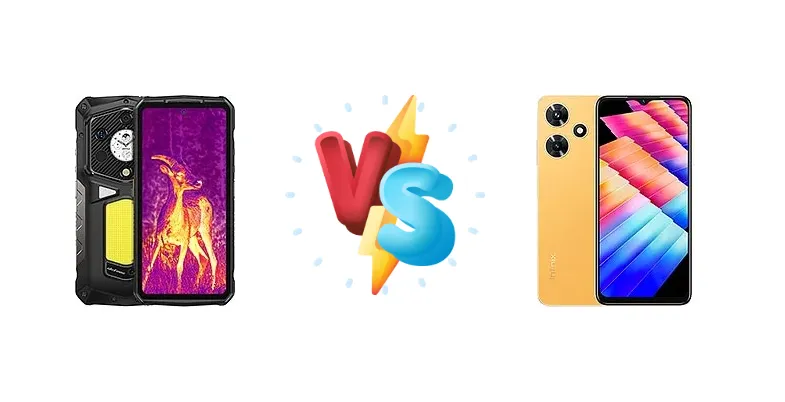
|
🏆 Quick Verdict
For users prioritizing performance, fast charging, and ruggedness, the Ulefone Armor 29 Pro Thermal is the clear winner. Its Dimensity 7400 chipset and 120W charging significantly outperform the Infinix Hot 30i's Unisoc T606 and 18W charging, justifying the price difference for demanding users.
| PHONES | ||
|---|---|---|
| Phone Names | Ulefone Armor 29 Pro Thermal | Infinix Hot 30i |
| Network | ||
|---|---|---|
| 2G bands | GSM 850 / 900 / 1800 / 1900 | GSM 850 / 900 / 1800 / 1900 |
| 3G bands | HSDPA 800 / 850 / 900 / 1700(AWS) / 1900 / 2100 | HSDPA 850 / 900 / 1700(AWS) / 1900 / 2100 |
| 4G bands | 1, 2, 3, 4, 5, 7, 8, 12, 13, 17, 18, 19, 20, 25, 26, 28, 32, 34, 38, 39, 40, 41, 66, 71 | 1, 2, 3, 4, 5, 7, 8, 20, 28, 38, 40, 41 |
| 5G bands | 1, 2, 3, 5, 7, 8, 20, 25, 28, 38, 40, 41, 66, 71, 77, 78, 79 SA/NSA/Sub6 | - |
| Speed | HSPA, LTE, 5G | HSPA, LTE |
| Technology | GSM / CDMA / HSPA / CDMA2000 / LTE / 5G | GSM / HSPA / LTE |
| Launch | ||
|---|---|---|
| Announced | 2025, August 14 | 2023, March 31 |
| Status | Available. Released 2025, September 15 | Available. Released 2023, March 31 |
| Body | ||
|---|---|---|
| Build | - | Glass front, plastic frame, plastic back |
| Dimensions | 177.4 x 85.6 x 33.8 mm (6.98 x 3.37 x 1.33 in) | 164 x 75.8 x 8.4 mm (6.46 x 2.98 x 0.33 in) |
| SIM | Nano-SIM + Nano-SIM | Nano-SIM + Nano-SIM |
| Weight | 688 g (1.52 lb) | 191 g (6.74 oz) |
| Display | ||
|---|---|---|
| Protection | Corning Gorilla Glass 3 | - |
| Resolution | 1080 x 2400 pixels, 20:9 ratio (~395 ppi density) | 720 x 1612 pixels, 20:9 ratio (~269 ppi density) |
| Size | 6.67 inches, 107.4 cm2 (~70.7% screen-to-body ratio) | 6.56 inches, 103.4 cm2 (~83.2% screen-to-body ratio) |
| Type | AMOLED, 1B colors, 120Hz, 2200 nits (peak) | IPS LCD, 90Hz, 500 nits (peak) |
| Platform | ||
|---|---|---|
| CPU | Octa-core (4x2.6 GHz Cortex-A78 & 4x2.0 GHz Cortex-A55) | Octa-core (2x1.6 GHz Cortex-A75 & 6x1.6 GHz Cortex-A55) |
| Chipset | Mediatek Dimensity 7400 (4 nm) | Unisoc T606 (12 nm) |
| GPU | Mali-G615 MC2 | Mali-G57 MP1 |
| OS | Android 15 | Android 12, XOS 10.6 |
| Memory | ||
|---|---|---|
| Card slot | microSDXC (dedicated slot) | microSDXC (dedicated slot) |
| Internal | 512GB 16GB RAM | 64GB 4GB RAM, 128GB 4GB RAM, 128GB 8GB RAM |
| - | UFS 2.2 | |
| Main Camera | ||
|---|---|---|
| Dual | - | 13 MP, f/1.9, (wide), AF 0.08 MP, (depth) |
| Features | Quad-LED flash, HDR, panorama | Dual-LED flash, HDR, panorama |
| Quad | 50 MP, f/2.0, 23mm (wide), 1/1.31", 1.2µm, PDAF 64 MP, f/1.8, 26mm (night vision), 1/2.0", 0.7µm, 4 infrared lights 50 MP, f/2.2, 16mm, 117˚ (ultrawide), 1/2.76", 0.64µm Thermal camera by ThermoVue T2, 640x512 px | - |
| Single | - | 13 MP, f/1.9, (wide), 1/3.07", AF Auxiliary lens |
| Video | 4K@30fps, 1080p@30/60fps, gyro-EIS | 1080p@30fps |
| Selfie camera | ||
|---|---|---|
| Features | - | Dual-LED flash |
| Single | 50 MP, f/2.5, 25mm (wide), 1/2.76", 0.64µm | 8 MP, f/2.0, (wide), 1/3.94" |
| Video | 1080p@30fps | 1080p@30fps |
| Sound | ||
|---|---|---|
| 3.5mm jack | - | Yes |
| 35mm jack | Yes | Yes |
| Loudspeaker | Yes | Yes |
| Comms | ||
|---|---|---|
| Bluetooth | 5.4, A2DP, LE | Yes |
| Infrared port | Yes | - |
| NFC | Yes | Yes (Hot 30i NFC only) |
| Positioning | GPS, GALILEO, GLONASS, QZSS, BDS, NavIC | GPS |
| Radio | Wireless FM radio, RDS, recording | FM radio |
| USB | USB Type-C 2.0, OTG, accessory connector pins | USB Type-C 2.0, OTG |
| WLAN | Wi-Fi 802.11 a/b/g/n/ac/6e, tri-band | Wi-Fi 802.11 a/b/g/n/ac, dual-band |
| Features | ||
|---|---|---|
| Sensors | Fingerprint (side-mounted), accelerometer, gyro, proximity, compass, barometer | Fingerprint (side-mounted), accelerometer, proximity, compass |
| Battery | ||
|---|---|---|
| Charging | 120W wired, PPS, 20% in 10 min 10W reverse wired | 18W wired |
| Type | Li-Ion 21200 mAh | 5000 mAh |
| Misc | ||
|---|---|---|
| Colors | Black | Mirror Black, Glacier Blue, Diamond White, Marigold |
| Models | - | X669, X669D |
| Price | € 789.99 / $ 583.19 | - |
Ulefone Armor 29 Pro Thermal
- Significantly faster 120W charging
- More powerful Dimensity 7400 chipset
- Ruggedized design for durability
- Likely higher price point
- Potentially bulkier design due to ruggedization
Infinix Hot 30i
- More affordable price
- Potentially larger display
- Lightweight and slim design
- Slower 18W charging
- Less powerful Unisoc T606 chipset
- Less durable build quality
Display Comparison
While both devices likely feature LCD panels (data unavailable for the Infinix), the focus here isn't display quality, but practicality. The Ulefone, being a rugged phone, likely prioritizes screen durability over peak brightness or color accuracy. The Infinix Hot 30i, targeting budget consumers, will likely have a larger display, but potentially lower brightness levels. Neither device is expected to feature high refresh rates or advanced panel technologies like LTPO.
Camera Comparison
Without detailed camera specs, a direct comparison is difficult. However, the Ulefone, positioned as a premium rugged device, likely incorporates a more capable main sensor and potentially optical image stabilization (OIS). The Infinix Hot 30i will likely rely on software processing to enhance image quality. The presence of a 2MP macro camera on the Infinix is a common budget feature, offering limited practical benefit due to its low resolution and fixed focus. The Ulefone's camera system is expected to prioritize image clarity and dynamic range, while the Infinix will focus on providing acceptable results in good lighting conditions.
Performance
The performance gap is substantial. The Ulefone Armor 29 Pro Thermal’s Mediatek Dimensity 7400 (4nm) is a significant leap ahead of the Infinix Hot 30i’s Unisoc T606 (12nm). The Dimensity 7400’s Cortex-A78 cores, clocked at 2.6 GHz, offer considerably more processing power than the T606’s Cortex-A75 cores at 1.6 GHz. The 4nm process node of the Dimensity 7400 also translates to superior thermal efficiency, reducing throttling during sustained workloads. This benefits gamers and users running demanding applications. The T606 is adequate for basic tasks, but will struggle with graphically intensive games or multitasking.
Battery Life
The Ulefone Armor 29 Pro Thermal’s 120W wired charging is a game-changer, capable of adding 20% charge in just 10 minutes. This is a massive advantage over the Infinix Hot 30i’s 18W charging. While battery capacity isn't specified for either device, the faster charging of the Ulefone effectively mitigates any potential capacity difference. The Ulefone also includes 10W reverse wired charging, a feature absent on the Infinix, allowing it to charge other devices.
Buying Guide
Buy the Ulefone Armor 29 Pro Thermal if you need a phone that can withstand harsh environments, demands high performance for gaming or productivity, and values incredibly fast charging. Buy the Infinix Hot 30i if you prioritize affordability, a large display for media consumption, and are comfortable with a more basic feature set and slower charging speeds.