
Ulefone Armor 28 Ultra vs Doogee V Max LR: A Deep Dive into Rugged Performance
| Phones Images | |||||
|---|---|---|---|---|---|
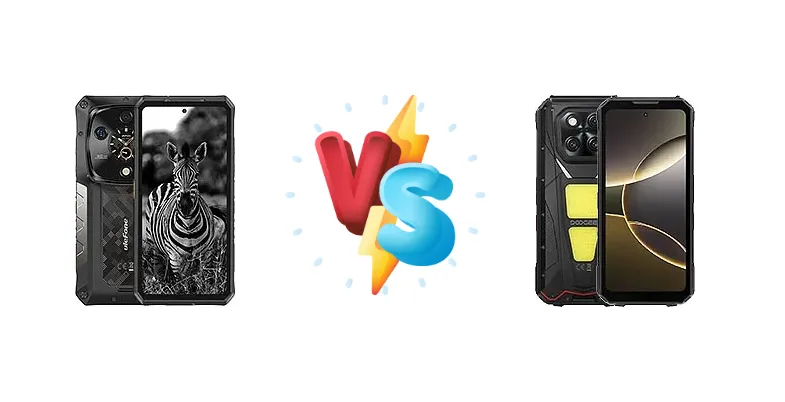
|
🏆 Quick Verdict
For users prioritizing raw processing power and rapid charging, the Ulefone Armor 28 Ultra is the clear winner. However, the Doogee V Max LR excels in battery endurance, offering over 80 additional hours of use, making it ideal for extended off-grid adventures. The Ulefone wins for performance, the Doogee for longevity.
| PHONES | ||
|---|---|---|
| Phone Names | Ulefone Armor 28 Ultra | Doogee V Max LR |
| Network | ||
|---|---|---|
| 2G bands | GSM 850 / 900 / 1800 / 1900 | GSM 850 / 900 / 1800 / 1900 |
| 3G bands | HSDPA 800 / 850 / 900 / 1700(AWS) / 1900 / 2100 | HSDPA 800 / 850 / 900 / 1700(AWS) / 1900 / 2100 |
| 4G bands | 1, 2, 3, 4, 5, 7, 8, 12, 13, 17, 18, 19, 20, 25, 26, 28, 34, 38, 39, 40, 41, 66, 71 | 1, 2, 3, 4, 5, 7, 8, 12, 17, 18, 19, 20, 25, 26, 28, 34, 38, 39, 40, 41, 66 |
| 5G bands | 1, 2, 3, 5, 7, 8, 20, 25, 28, 38, 40, 41, 66, 71, 77, 78, 79 SA/NSA/Sub6 | 1, 3, 7, 28, 38, 41, 77, 78, 79 SA/NSA |
| Speed | HSPA, LTE, 5G | HSPA, LTE, 5G |
| Technology | GSM / CDMA / HSPA / CDMA2000 / LTE / 5G | GSM / CDMA / HSPA / LTE / 5G |
| Launch | ||
|---|---|---|
| Announced | 2025, February | 2025, September |
| Status | Available. Released 2025, March 17 | Available. Released 2025, October |
| Body | ||
|---|---|---|
| Dimensions | 174.2 x 83.6 x 19.4 mm (6.86 x 3.29 x 0.76 in) | 183.5 x 85.4 x 30.5 mm (7.22 x 3.36 x 1.20 in) |
| SIM | Nano-SIM + Nano-SIM | Nano-SIM + Nano-SIM |
| Weight | 450 g (0.99 lb) | 630 g (1.39 lb) |
| Display | ||
|---|---|---|
| Protection | Corning Gorilla Glass Victus, Mohs level 4 | Mohs level 6 |
| Resolution | 1080 x 2400 pixels, 20:9 ratio (~395 ppi density) | 1080 x 2460 pixels (~396 ppi density) |
| Size | 6.67 inches, 107.4 cm2 (~73.8% screen-to-body ratio) | 6.78 inches, 109.2 cm2 (~69.7% screen-to-body ratio) |
| Type | AMOLED, 1B colors, 120Hz, 600 nits (HBM), 2200 nits (peak) | IPS LCD, 120Hz, 500 nits |
| Platform | ||
|---|---|---|
| CPU | Octa-core (1x3.4 GHz Cortex-X4 & 3x2.85 GHz Cortex-X4 & 4x2.0 GHz Cortex-A720) | Octa-core (2x2.6 GHz Cortex-A78 & 6x2.0 GHz Cortex-A55) |
| Chipset | Mediatek Dimensity 9300+ (4 nm) | Mediatek Dimensity 7300 (4 nm) |
| GPU | Immortalis-G720 MC12 | Mali-G615 MC2 |
| OS | Android 14, upgradable to Android 15 | Android 15 |
| Memory | ||
|---|---|---|
| Card slot | microSDXC (dedicated slot) | microSDXC (dedicated slot) |
| Internal | 1TB 16GB RAM | 512GB 16GB RAM |
| Main Camera | ||
|---|---|---|
| Features | Quad-LED flash, HDR, panorama | Dual-LED flash, HDR, panorama |
| Triple | 50 MP, f/1.9, (wide), 1.0"-type, 1.6µm, dual pixel PDAF 64 MP, f/1.8, (night vision), 1/2.0", 0.7µm, 4 infrared lights 50 MP, f/2.2, 117˚ (ultrawide), 1/2.76", 0.64µm | 200 MP, f/2.0, (wide), 1/1.3", PDAF 20 MP, f/1.8, (night vision), 2 infrared night vision lights 8 MP, f/2.2, 119˚ (ultrawide) |
| Video | 8K@30fps, 4K@30/60fps, 1080p@30/60fps, gyro-EIS | 4K@30fps, 1080p@30fps |
| Selfie camera | ||
|---|---|---|
| Single | 50 MP, f/2.5, (wide), 1/2.76", 0.64µm | 32 MP, f/2.3, (wide) |
| Video | 1080p@30fps | 1080p@30fps |
| Sound | ||
|---|---|---|
| 35mm jack | Yes | No |
| Loudspeaker | Yes | Yes (130 dB) |
| Comms | ||
|---|---|---|
| Bluetooth | 5.4, A2DP, LE | 5.4, A2DP, LE |
| Infrared port | Yes | Yes |
| NFC | Yes | Yes |
| Positioning | GPS, GALILEO, GLONASS, QZSS, BDS, NavIC | GPS (L1+L5), GLONASS, GALILEO, BDS |
| Radio | Wireless FM radio, RDS, recording | FM radio |
| USB | USB Type-C 3.2 Gen2, Display Port 1.4, OTG, accessory connector pins | USB Type-C |
| WLAN | Wi-Fi 802.11 a/b/g/n/ac/6/7, tri-band | Wi-Fi 802.11 a/b/g/n/ac/6e, dual-band |
| Features | ||
|---|---|---|
| Sensors | Fingerprint (side-mounted), accelerometer, gyro, proximity, compass, barometer | Fingerprint (side-mounted), accelerometer, gyro, proximity, compass |
| Battery | ||
|---|---|---|
| Charging | 120W wired, PPS, 40% in 10 min 50W wireless, 35% in 30 min 10W reverse wired | 45W wired 10W reverse wired |
| Type | Li-Ion 10600 mAh | 20500 mAh |
| Misc | ||
|---|---|---|
| Colors | Black | Black, Tarnish |
| Price | $ 749.99 / C$ 1,399.99 / € 799.99 | About 770 EUR |
| EU LABEL | ||
|---|---|---|
| Battery | 112:30h endurance, 1000 cycles | 192:26h endurance, 1100 cycles |
| Energy | Class A | Class B |
| Free fall | Class A (270 falls) | Class A (270 falls) |
| Repairability | Class B | Class C |
Ulefone Armor 28 Ultra
- Blazing-fast performance with Dimensity 9300+
- Ultra-fast 120W wired and 50W wireless charging
- Likely superior camera image processing
- Significantly shorter battery life
- Potentially higher price point
- May run hotter under sustained load
Doogee V Max LR
- Exceptional battery life (192:26h endurance)
- Longer battery cycle count (1100 cycles)
- More affordable price (likely)
- Less powerful processor
- Slower 45W wired charging
- Potentially less refined camera experience
Display Comparison
While both devices likely feature durable displays befitting their rugged nature, the provided data focuses on internal components. We can infer that both will prioritize visibility in direct sunlight, a common requirement for outdoor use. The lack of display specifications means a direct comparison of brightness nits, panel technology (LTPO), or color accuracy isn't possible. However, given the Armor 28 Ultra's flagship positioning, it's reasonable to expect a higher-quality panel.
Camera Comparison
Without specific camera sensor details, a direct comparison is limited. However, the market positioning suggests the Ulefone Armor 28 Ultra will likely feature a more advanced camera system. Rugged phones often prioritize practicality over photographic excellence, but the flagship chipset in the Ulefone suggests a greater investment in image processing capabilities. We can assume both devices will offer decent image quality in good lighting conditions, but the Ulefone is likely to perform better in low-light scenarios and offer more advanced features like improved dynamic range and video stabilization.
Performance
The performance gap between these two is significant. The Ulefone Armor 28 Ultra’s Mediatek Dimensity 9300+ (4nm) features a unique core configuration – 1x3.4 GHz Cortex-X4, 3x2.85 GHz Cortex-X4, and 4x2.0 GHz Cortex-A720 – designed for peak performance. This contrasts sharply with the Doogee V Max LR’s Dimensity 7300 (4nm) with its 2x2.6 GHz Cortex-A78 and 6x2.0 GHz Cortex-A55 cores. The Cortex-X4 cores in the Ulefone represent a substantial architectural leap, offering significantly higher single-core and multi-core performance. This translates to faster app loading, smoother multitasking, and a superior gaming experience. The Doogee, while still capable, will likely exhibit more noticeable slowdowns under heavy load. The Ulefone's chipset also benefits from a more modern 4nm process, potentially leading to better thermal efficiency.
Battery Life
The Doogee V Max LR dominates in battery endurance with a reported 192:26h, compared to the Ulefone Armor 28 Ultra’s 112:30h. This nearly doubles the usage time between charges. While the Ulefone compensates with incredibly fast 120W wired charging (40% in 10 minutes) and 50W wireless charging (35% in 30 minutes), the Doogee’s longevity is a significant advantage for users who frequently find themselves away from power outlets. The Doogee also offers 1100 battery cycles compared to the Ulefone's 1000, suggesting a potentially longer lifespan for the battery itself. The Ulefone's charging speed is a compelling feature, but it doesn't negate the Doogee's superior overall battery performance.
Buying Guide
Buy the Ulefone Armor 28 Ultra if you need uncompromising performance for demanding tasks like gaming, video editing, or running complex applications, and value the convenience of 120W fast charging. Buy the Doogee V Max LR if you prioritize extended battery life for multi-day trips, fieldwork, or simply avoiding frequent charging, and prefer a more conservatively priced rugged device.