
Ulefone Armor 28 Ultra vs. Blackview BV8800: A Rugged Smartphone Battle
| Phones Images | |||||
|---|---|---|---|---|---|
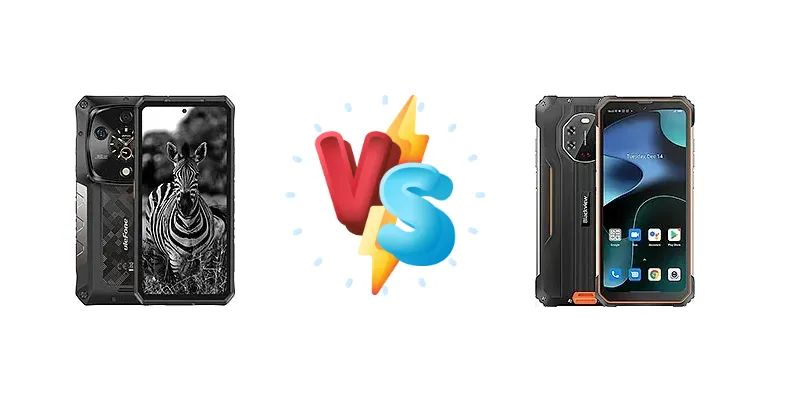
|
🏆 Quick Verdict
For users demanding top-tier performance and future-proofing, the Ulefone Armor 28 Ultra is the clear winner. Its Dimensity 9300+ chipset offers a massive leap in processing power and efficiency. However, the Blackview BV8800 remains a compelling choice for those prioritizing affordability and acceptable performance for everyday tasks.
| PHONES | ||
|---|---|---|
| Phone Names | Ulefone Armor 28 Ultra | Blackview BV8800 |
| Network | ||
|---|---|---|
| 2G bands | GSM 850 / 900 / 1800 / 1900 | GSM 850 / 900 / 1800 / 1900 |
| 3G bands | HSDPA 800 / 850 / 900 / 1700(AWS) / 1900 / 2100 | HSDPA 800 / 850 / 900 / 1700(AWS) / 1900 / 2100 |
| 4G bands | 1, 2, 3, 4, 5, 7, 8, 12, 13, 17, 18, 19, 20, 25, 26, 28, 34, 38, 39, 40, 41, 66, 71 | 1, 2, 3, 4, 5, 7, 8, 12, 13, 17, 18, 19, 20, 25, 26, 28, 30, 34, 38, 39, 40, 41, 66 |
| 5G bands | 1, 2, 3, 5, 7, 8, 20, 25, 28, 38, 40, 41, 66, 71, 77, 78, 79 SA/NSA/Sub6 | - |
| Speed | HSPA, LTE, 5G | HSPA, LTE |
| Technology | GSM / CDMA / HSPA / CDMA2000 / LTE / 5G | GSM / CDMA / HSPA / CDMA2000 / LTE |
| - | CDMA2000 1x | |
| Launch | ||
|---|---|---|
| Announced | 2025, February | 2021, December 24 |
| Status | Available. Released 2025, March 17 | Available. Released 2022, January 10 |
| Body | ||
|---|---|---|
| Dimensions | 174.2 x 83.6 x 19.4 mm (6.86 x 3.29 x 0.76 in) | 176.2 x 83.5 x 17.7 mm (6.94 x 3.29 x 0.70 in) |
| SIM | Nano-SIM + Nano-SIM | Nano-SIM + Nano-SIM |
| Weight | 450 g (0.99 lb) | 367 g (12.95 oz) |
| - | IP68/IP69K dust/water resistant (up to 1.5m for 30 min) Drop-to-concrete resistance from up to 1.5m MIL-STD-810H compliant | |
| Display | ||
|---|---|---|
| Protection | Corning Gorilla Glass Victus, Mohs level 4 | - |
| Resolution | 1080 x 2400 pixels, 20:9 ratio (~395 ppi density) | 1080 x 2408 pixels, 20:9 ratio (~401 ppi density) |
| Size | 6.67 inches, 107.4 cm2 (~73.8% screen-to-body ratio) | 6.58 inches, 104.3 cm2 (~70.9% screen-to-body ratio) |
| Type | AMOLED, 1B colors, 120Hz, 600 nits (HBM), 2200 nits (peak) | IPS LCD, 90Hz, 480 nits |
| Platform | ||
|---|---|---|
| CPU | Octa-core (1x3.4 GHz Cortex-X4 & 3x2.85 GHz Cortex-X4 & 4x2.0 GHz Cortex-A720) | Octa-core (2x2.05 GHz Cortex-A76 & 6x2.0 GHz Cortex-A55) |
| Chipset | Mediatek Dimensity 9300+ (4 nm) | Mediatek MT6781 Helio G96 (12 nm) |
| GPU | Immortalis-G720 MC12 | Mali-G57 MC2 |
| OS | Android 14, upgradable to Android 15 | Android 11, Doke-OS 3.0 |
| Memory | ||
|---|---|---|
| Card slot | microSDXC (dedicated slot) | No |
| Internal | 1TB 16GB RAM | 128GB 8GB RAM |
| - | UFS 2.1 | |
| Main Camera | ||
|---|---|---|
| Features | Quad-LED flash, HDR, panorama | Dual-LED flash, HDR, panorama |
| Quad | - | 50 MP, f/1.8, (wide), PDAF 8 MP, f/2.2, 117˚ (ultrawide) 20 MP, f/1.8, (IR camera), 2 IR emitters Auxiliary lens |
| Single | - | 16 MP, f/2.0, (wide) |
| Triple | 50 MP, f/1.9, (wide), 1.0"-type, 1.6µm, dual pixel PDAF 64 MP, f/1.8, (night vision), 1/2.0", 0.7µm, 4 infrared lights 50 MP, f/2.2, 117˚ (ultrawide), 1/2.76", 0.64µm | - |
| Video | 8K@30fps, 4K@30/60fps, 1080p@30/60fps, gyro-EIS | 1440p@30fps |
| Selfie camera | ||
|---|---|---|
| Single | 50 MP, f/2.5, (wide), 1/2.76", 0.64µm | 16 MP, f/2.0, (wide) |
| Video | 1080p@30fps | 1080p@30fps |
| Sound | ||
|---|---|---|
| 3.5mm jack | - | No |
| 35mm jack | Yes | No |
| Loudspeaker | Yes | Yes |
| Comms | ||
|---|---|---|
| Bluetooth | 5.4, A2DP, LE | 5.2, A2DP, LE |
| Infrared port | Yes | - |
| NFC | Yes | Yes |
| Positioning | GPS, GALILEO, GLONASS, QZSS, BDS, NavIC | GPS, GLONASS, GALILEO, BDS |
| Radio | Wireless FM radio, RDS, recording | FM radio |
| USB | USB Type-C 3.2 Gen2, Display Port 1.4, OTG, accessory connector pins | USB Type-C 2.0, OTG |
| WLAN | Wi-Fi 802.11 a/b/g/n/ac/6/7, tri-band | Wi-Fi 802.11 a/b/g/n/ac |
| Features | ||
|---|---|---|
| Sensors | Fingerprint (side-mounted), accelerometer, gyro, proximity, compass, barometer | Fingerprint (side-mounted), accelerometer, gyro, proximity, compass, barometer |
| Battery | ||
|---|---|---|
| Charging | 120W wired, PPS, 40% in 10 min 50W wireless, 35% in 30 min 10W reverse wired | 33W wired, 31% in 30 min, 100% in 90 min Reverse wired |
| Type | Li-Ion 10600 mAh | 8380 mAh |
| Misc | ||
|---|---|---|
| Colors | Black | Black, Orange, Green |
| Price | $ 749.99 / C$ 1,399.99 / € 799.99 | About 350 EUR |
| Tests | ||
|---|---|---|
| Battery life | - | Endurance rating 199h |
| Camera | - | Photo / Video |
| Display | - | Contrast ratio: 1348:1 (nominal) |
| Loudspeaker | - | -29.3 LUFS (Average) |
| Performance | - | AnTuTu: 254849 (v8), 288964 (v9) GeekBench: 1752 (v5.1) GFXBench: 10fps (ES 3.1 onscreen) |
| EU LABEL | ||
|---|---|---|
| Battery | 112:30h endurance, 1000 cycles | - |
| Energy | Class A | - |
| Free fall | Class A (270 falls) | - |
| Repairability | Class B | - |
Ulefone Armor 28 Ultra
- Exceptional performance with Dimensity 9300+
- Ultra-fast 120W wired and 50W wireless charging
- Potentially superior display quality
- Likely higher price point
- Detailed camera specs currently unknown
Blackview BV8800
- More affordable price
- Decent battery endurance for basic use
- Rugged build quality
- Outdated Helio G96 chipset
- Slow charging speeds
- Lower display brightness and contrast
Display Comparison
The Blackview BV8800 features a display with a 1348:1 contrast ratio and a measured peak brightness of 501 nits. While adequate for outdoor visibility, it lacks the advanced features expected in this price range. The Ulefone Armor 28 Ultra’s display specifications are currently unavailable, but given its flagship positioning, we anticipate a higher peak brightness and potentially a higher refresh rate for smoother scrolling. The BV8800’s contrast ratio, while decent, suggests a standard LCD panel, whereas the Armor 28 Ultra could potentially incorporate newer panel technology.
Camera Comparison
Both devices offer photo and video capabilities, but detailed camera specifications are limited for the Ulefone Armor 28 Ultra. The Blackview BV8800’s camera system is likely to be a standard configuration for its price point. Without specific sensor details for the Ulefone, it’s difficult to make a direct comparison. However, given its flagship status, we expect a larger main sensor and more advanced image processing algorithms, potentially including features like 8K video recording. The presence of a 2MP macro camera on the BV8800 is largely a marketing gimmick, offering limited practical benefit.
Performance
The performance gap between these two devices is substantial. The Ulefone Armor 28 Ultra’s Mediatek Dimensity 9300+ (4nm) chipset, with its octa-core configuration (1x3.4 GHz Cortex-X4, 3x2.85 GHz Cortex-X4, and 4x2.0 GHz Cortex-A720), represents a significant generational leap over the Blackview BV8800’s Mediatek MT6781 Helio G96 (12nm). The Dimensity 9300+’s 4nm process node delivers superior power efficiency and thermal management, minimizing throttling during sustained workloads. The G96’s octa-core setup (2x2.05 GHz Cortex-A76 & 6x2.0 GHz Cortex-A55) is geared towards mid-range performance, suitable for everyday tasks but struggling with demanding games or applications. The Armor 28 Ultra will offer a dramatically smoother and more responsive user experience.
Battery Life
The Ulefone Armor 28 Ultra boasts an impressive battery endurance rating of 112:30h, coupled with support for 120W wired charging (40% in 10 minutes) and 50W wireless charging (35% in 30 minutes). This significantly surpasses the Blackview BV8800’s 199h endurance and 33W wired charging (31% in 30 minutes, 100% in 90 minutes). While the BV8800’s endurance rating is respectable, the Armor 28 Ultra’s faster charging speeds and potentially larger battery capacity provide a more convenient and efficient user experience. The 1000 charge cycles promised by Ulefone also suggest a longer battery lifespan.
Buying Guide
Buy the Ulefone Armor 28 Ultra if you need uncompromising performance for demanding applications like gaming, video editing, or professional use, and value the fastest possible charging speeds. Buy the Blackview BV8800 if you prefer a more affordable rugged phone for basic communication, navigation, and light media consumption, and aren't concerned with having the latest and greatest processor.