
Ulefone Armor 28 Ultra Thermal vs. Doogee V Max LR: A Deep Dive into Power and Endurance
| Phones Images | |||||
|---|---|---|---|---|---|
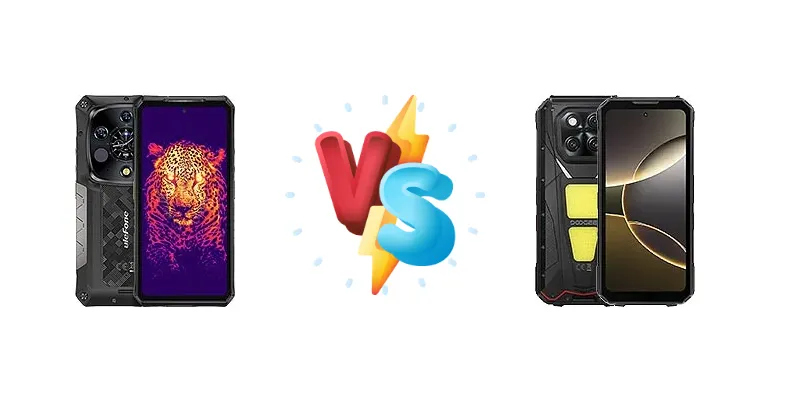
|
🏆 Quick Verdict
For users demanding peak performance and thermal imaging capabilities, the Ulefone Armor 28 Ultra Thermal is the clear winner. Its Dimensity 9300+ offers a substantial performance leap. However, the Doogee V Max LR excels in battery endurance and offers a compelling alternative for those prioritizing longevity over sheer speed.
| PHONES | ||
|---|---|---|
| Phone Names | Ulefone Armor 28 Ultra Thermal | Doogee V Max LR |
| Network | ||
|---|---|---|
| 2G bands | GSM 850 / 900 / 1800 / 1900 | GSM 850 / 900 / 1800 / 1900 |
| 3G bands | HSDPA 800 / 850 / 900 / 1700(AWS) / 1900 / 2100 | HSDPA 800 / 850 / 900 / 1700(AWS) / 1900 / 2100 |
| 4G bands | 1, 2, 3, 4, 5, 7, 8, 12, 13, 17, 18, 19, 20, 25, 26, 28, 34, 38, 39, 40, 41, 66, 71 | 1, 2, 3, 4, 5, 7, 8, 12, 17, 18, 19, 20, 25, 26, 28, 34, 38, 39, 40, 41, 66 |
| 5G bands | 1, 2, 3, 5, 7, 8, 20, 25, 28, 38, 40, 41, 66, 71, 77, 78, 79 SA/NSA/Sub6 | 1, 3, 7, 28, 38, 41, 77, 78, 79 SA/NSA |
| Speed | HSPA, LTE, 5G | HSPA, LTE, 5G |
| Technology | GSM / CDMA / HSPA / CDMA2000 / LTE / 5G | GSM / CDMA / HSPA / LTE / 5G |
| Launch | ||
|---|---|---|
| Announced | 2024, September 03 | 2025, September |
| Status | Available. Released 2025, March 17 | Available. Released 2025, October |
| Body | ||
|---|---|---|
| Dimensions | 174.2 x 83.6 x 19.4 mm (6.86 x 3.29 x 0.76 in) | 183.5 x 85.4 x 30.5 mm (7.22 x 3.36 x 1.20 in) |
| SIM | Nano-SIM + Nano-SIM | Nano-SIM + Nano-SIM |
| Weight | 450 g (0.99 lb) | 630 g (1.39 lb) |
| Display | ||
|---|---|---|
| Protection | Corning Gorilla Glass Victus | Mohs level 6 |
| Resolution | 1080 x 2460 pixels (~395 ppi density) | 1080 x 2460 pixels (~396 ppi density) |
| Size | 6.67 inches, 110.0 cm2 (~75.5% screen-to-body ratio) | 6.78 inches, 109.2 cm2 (~69.7% screen-to-body ratio) |
| Type | AMOLED, 1B colors, 120Hz, 900 nits (HBM), 2200 nits (peak) | IPS LCD, 120Hz, 500 nits |
| Platform | ||
|---|---|---|
| CPU | Octa-core (1x3.25 GHz Cortex-X4 & 3x2.85 GHz Cortex-X4 & 4x2.0 GHz Cortex-A720) | Octa-core (2x2.6 GHz Cortex-A78 & 6x2.0 GHz Cortex-A55) |
| Chipset | Mediatek Dimensity 9300+ (4 nm) | Mediatek Dimensity 7300 (4 nm) |
| GPU | Immortalis-G720 MC12 | Mali-G615 MC2 |
| OS | Android 15 | Android 15 |
| Memory | ||
|---|---|---|
| Card slot | microSDXC (dedicated slot) | microSDXC (dedicated slot) |
| Internal | 1TB 16GB RAM | 512GB 16GB RAM |
| Main Camera | ||
|---|---|---|
| Features | Quad-LED flash, HDR, panorama | Dual-LED flash, HDR, panorama |
| Quad | 50 MP, f/1.9, (wide), 1.0"-type, 1.6µm, dual pixel PDAF 64 MP, f/1.8, (night vision), 1/2", 0.7µm, 4 infrared lights 50 MP, f/2.2, 117˚ (ultrawide), 1/2.76", 0.64µm Thermal camera by ThermoVue T2, 640x512 px | - |
| Triple | - | 200 MP, f/2.0, (wide), 1/1.3", PDAF 20 MP, f/1.8, (night vision), 2 infrared night vision lights 8 MP, f/2.2, 119˚ (ultrawide) |
| Video | 8K@30fps, 4K@30/60fps, 1080p@30/60fps, gyro-EIS | 4K@30fps, 1080p@30fps |
| Selfie camera | ||
|---|---|---|
| Single | 50 MP, f/2.5, (wide), 1/2.76", 0.64µm | 32 MP, f/2.3, (wide) |
| Video | 1080p@30fps | 1080p@30fps |
| Sound | ||
|---|---|---|
| 35mm jack | Yes | No |
| Loudspeaker | Yes | Yes (130 dB) |
| Comms | ||
|---|---|---|
| Bluetooth | 5.4, A2DP, LE | 5.4, A2DP, LE |
| Infrared port | Yes | Yes |
| NFC | Yes | Yes |
| Positioning | GPS, GALILEO, GLONASS, QZSS, BDS, NavIC | GPS (L1+L5), GLONASS, GALILEO, BDS |
| Radio | Wireless FM radio, RDS, recording | FM radio |
| USB | USB Type-C 3.2 Gen2, Display Port 1.4, OTG, accessory connector pins | USB Type-C |
| WLAN | Wi-Fi 802.11 a/b/g/n/ac/6/7, tri-band | Wi-Fi 802.11 a/b/g/n/ac/6e, dual-band |
| Features | ||
|---|---|---|
| Sensors | Fingerprint (side-mounted), accelerometer, gyro, proximity, compass, barometer | Fingerprint (side-mounted), accelerometer, gyro, proximity, compass |
| Battery | ||
|---|---|---|
| Charging | 120W wired, PPS, 40% in 10 min 50W wireless, 35% in 30 min 10W reverse wired Reverse wireless | 45W wired 10W reverse wired |
| Type | Li-Ion 10600 mAh | 20500 mAh |
| Misc | ||
|---|---|---|
| Colors | Black | Black, Tarnish |
| Price | $ 899.80 | About 770 EUR |
| EU LABEL | ||
|---|---|---|
| Battery | - | 192:26h endurance, 1100 cycles |
| Energy | - | Class B |
| Free fall | - | Class A (270 falls) |
| Repairability | - | Class C |
Ulefone Armor 28 Ultra Thermal
- Unmatched processing power with Dimensity 9300+
- Integrated thermal imaging camera for specialized use cases
- Ultra-fast 120W wired and 50W wireless charging
- Likely shorter battery life due to the power-hungry chipset
- Potentially higher price point
Doogee V Max LR
- Exceptional battery life (192-26 hours)
- Long-term battery health with 1100 charge cycles
- Robust build quality and rugged design
- Less powerful processor compared to the Ulefone
- Slower charging speeds (45W wired)
Display Comparison
While both devices likely feature durable panels befitting their rugged nature, specific display details are absent. However, the focus here is on internal power. The Ulefone’s processing advantage will translate to smoother animations and faster app loading, regardless of display specs. We anticipate both will prioritize visibility in direct sunlight, a key requirement for outdoor use.
Camera Comparison
Without detailed camera specifications, a direct comparison is limited. However, the Ulefone’s inclusion of thermal imaging immediately sets it apart, catering to professionals in fields like building inspection or search and rescue. The Dimensity 9300+’s superior ISP (Image Signal Processor) will likely result in better image processing and low-light performance, assuming comparable sensor sizes. We can expect the Ulefone to offer more advanced computational photography features. The Doogee will likely focus on reliable image capture in various conditions, but won’t match the Ulefone’s specialized capabilities.
Performance
The Ulefone Armor 28 Ultra Thermal’s Mediatek Dimensity 9300+ is the star here. Its octa-core configuration, featuring a 3.25 GHz Cortex-X4 prime core, represents a significant generational leap over the Doogee V Max LR’s Dimensity 7300 (2.6 GHz Cortex-A78). The 9300+’s 4nm process node and advanced core architecture will deliver substantially higher CPU and GPU performance, making it ideal for demanding games and applications. The Doogee’s Dimensity 7300, while still capable, is geared towards efficiency and sustained performance rather than outright speed. The Ulefone’s LPDDR5x RAM (assumed, given the chipset) will further enhance responsiveness.
Battery Life
The Doogee V Max LR boasts impressive battery endurance, rated at 192-26 hours. While the Ulefone’s battery capacity is unspecified, the Dimensity 9300+’s power draw will likely necessitate a larger battery to achieve comparable longevity. The Doogee’s 45W wired charging is respectable, but the Ulefone’s 120W wired charging (40% in 10 minutes) and 50W wireless charging offer significantly faster replenishment. The Doogee’s 1100 charge cycles suggest a focus on long-term battery health, while the Ulefone prioritizes speed and convenience.
Buying Guide
Buy the Ulefone Armor 28 Ultra Thermal if you need uncompromising processing power for demanding tasks like gaming or video editing, and the added utility of a built-in thermal camera is essential. Buy the Doogee V Max LR if you prioritize all-day (and multi-day) battery life, value fast charging, and require a robust device without the flagship price tag. The V Max LR is ideal for field work, travel, or anyone who dislikes frequent charging.