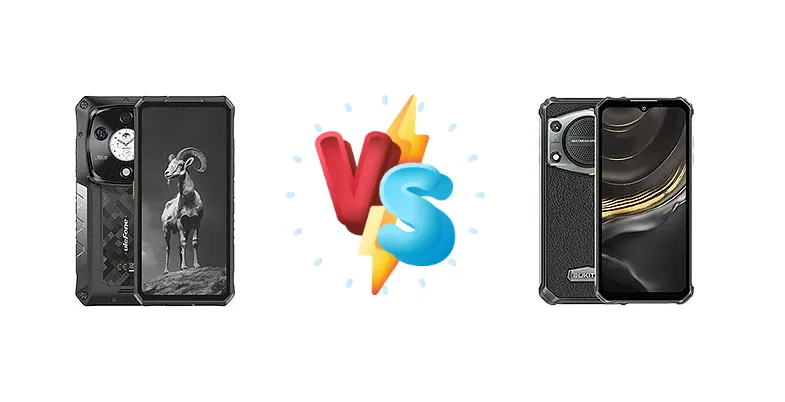
The rugged smartphone market caters to a specific need – durability. However, performance and features vary wildly. We pit the Ulefone Armor 28 Pro, a recent entrant boasting a flagship-level Dimensity 7300 chipset and blazing-fast charging, against the Oukitel WP22, a more affordable option relying on the older Helio P90. This comparison will dissect which phone delivers the best balance of toughness and technology.
🏆 Quick Verdict
For most users, the Ulefone Armor 28 Pro is the clear winner. Its Dimensity 7300 chipset provides a substantial performance leap over the Oukitel WP22’s Helio P90, coupled with significantly faster 120W wired and 50W wireless charging. While the WP22 offers a lower price point, the Armor 28 Pro’s capabilities justify the investment for power users and those prioritizing future-proofing.
| Network |
|---|
| 2G bands | GSM 850 / 900 / 1800 / 1900 | GSM 850 / 900 / 1800 / 1900 |
| 3G bands | HSDPA 800 / 850 / 900 / 1700(AWS) / 1900 / 2100 | HSDPA 850 / 900 / 1700(AWS) / 1900 / 2100 |
| 4G bands | 1, 2, 3, 4, 5, 7, 8, 12, 13, 17, 18, 19, 20, 25, 26, 28, 32, 34, 38, 39, 40, 41, 66, 71 | LTE |
| 5G bands | 1, 2, 3, 5, 7, 8, 20, 25, 28, 38, 40, 41, 66, 71, 77, 78, 79 SA/NSA/Sub6 | - |
| Speed | HSPA, LTE, 5G | HSPA, LTE |
| Technology | GSM / CDMA / HSPA / CDMA2000 / LTE / 5G | GSM / HSPA / LTE |
| Launch |
|---|
| Announced | 2025, May | 2023, March |
| Status | Available. Released 2025, May 12 | Available. Released 2023, March |
| Body |
|---|
| Dimensions | 174.2 x 83.6 x 19.4 mm (6.86 x 3.29 x 0.76 in) | - |
| SIM | Nano-SIM + Nano-SIM | Nano-SIM + Nano-SIM |
| Weight | 450 g (0.99 lb) | - |
| Display |
|---|
| Protection | Corning Gorilla Glass Victus, Mohs level 4 | - |
| Resolution | 1080 x 2400 pixels, 20:9 ratio (~395 ppi density) | 1080 x 2408 pixels, 20:9 ratio (~401 ppi density) |
| Size | 6.67 inches, 107.4 cm2 (~73.8% screen-to-body ratio) | 6.58 inches, 104.3 cm2 |
| Type | AMOLED, 1B colors, 120Hz, 2200 nits (peak) | IPS LCD, 480 nits |
| Platform |
|---|
| CPU | Octa-core (4x2.5 GHz Cortex-A78 & 4x2.0 GHz Cortex-A55) | Octa-core (2x2.2 GHz Cortex-A75 & 6x2.0 GHz Cortex-A55) |
| Chipset | Mediatek Dimensity 7300 (4 nm) | Mediatek MT6779 Helio P90 (12 nm) |
| GPU | Mali-G615 MC2 | PowerVR GM9446 |
| OS | Android 15 | Android 13 |
| Memory |
|---|
| Card slot | microSDXC (dedicated slot) | microSDXC (uses shared SIM slot) |
| Internal | 512GB 16GB RAM | 256GB 8GB RAM |
| Main Camera |
|---|
| Features | Quad-LED flash, HDR, panorama | Dual-LED flash |
| Triple | 50 MP, f/1.9, (wide), 1.0"-type, 1.6µm, dual pixel PDAF
64 MP, f/1.8, (night vision), 1/2.0", 0.7µm, 4 infrared lights
50 MP, f/2.2, 117˚ (ultrawide), 1/2.76", 0.64µm | 48 MP, f/1.8, (wide), PDAF
20 MP, (night vision), infrared night vision lights
2 MP (macro) |
| Video | 4K@30fps, 1080p@30/60fps | 4K@30fps, 1080p@30fps |
| Selfie camera |
|---|
| Single | 50 MP, f/2.5, (wide), 1/2.76", 0.64µm | 16 MP |
| Video | 1080p@30fps | Yes |
| Sound |
|---|
| 35mm jack | Yes | Unspecified |
| Loudspeaker | Yes | Yes (125 dB, 4W peak, 36mm speaker) |
| Comms |
|---|
| Bluetooth | 5.4, A2DP, LE | 5.0, A2DP, LE |
| Infrared port | Yes | - |
| NFC | Yes | Yes |
| Positioning | GPS, GALILEO, GLONASS, QZSS, BDS, NavIC | GPS, GLONASS, GALILEO, BDS |
| Radio | Wireless FM radio | Wireless FM radio |
| USB | USB Type-C 2.0, OTG, accessory connector pins | USB Type-C 2.0, OTG |
| WLAN | Wi-Fi 802.11 a/b/g/n/ac/6/7, tri-band | Yes |
| Features |
|---|
| Sensors | Fingerprint (side-mounted), accelerometer, gyro, proximity, compass, barometer | Fingerprint (side-mounted), accelerometer, proximity |
| Battery |
|---|
| Charging | 120W wired, PPS, 40% in 10 min
50W wireless, 35% in 30 min
10W reverse wired
5W reverse wireless | Reverse wired |
| Type | Li-Ion 10600 mAh | Li-Po 10000 mAh |
| Misc |
|---|
| Colors | Black | Black |
| Price | $ 399.99 / € 492.56 | About 240 EUR |
| EU LABEL |
|---|
| Battery | 111:30h endurance, 1000 cycles | - |
| Energy | Class A | - |
| Free fall | Class A (270 falls) | - |
| Repairability | Class B | - |
Ulefone Armor 28 Pro
- Significantly faster processor (Dimensity 7300)
- Blazing-fast 120W wired and 50W wireless charging
- Superior power efficiency and thermal management
- Likely higher price point
- Rugged design may add bulk
Oukitel WP22
- More affordable price
- Durable rugged design
- Reverse wired charging
- Outdated Helio P90 chipset
- Slow charging speeds
- Limited performance for demanding tasks
Display Comparison
Display specifications are absent from the provided data, but given the target market, both devices likely feature LCD panels optimized for outdoor visibility. The Armor 28 Pro’s chipset suggests potential for a higher refresh rate display, offering smoother scrolling and animations. The WP22, with its older chipset, is likely limited to a standard 60Hz panel. Bezels are expected to be substantial on both, prioritizing screen protection over a modern, edge-to-edge design.
Camera Comparison
Camera details are limited. However, the chipset difference implies a significant advantage for the Ulefone Armor 28 Pro. The Dimensity 7300 includes a more powerful image signal processor (ISP) capable of handling higher-resolution sensors and more complex image processing algorithms. While both phones may feature multiple cameras, the Armor 28 Pro is likely to produce superior image quality, especially in low-light conditions. The WP22’s Helio P90 will struggle with dynamic range and noise reduction compared to its competitor.
Performance
The performance gap is the most significant differentiator. The Ulefone Armor 28 Pro’s Mediatek Dimensity 7300 (4nm) is a modern, octa-core processor featuring four high-performance Cortex-A78 cores clocked at 2.5 GHz and four efficiency cores at 2.0 GHz. This contrasts sharply with the Oukitel WP22’s Helio P90 (12nm), which utilizes a configuration of two Cortex-A75 cores at 2.2 GHz and six Cortex-A55 cores at 2.0 GHz. The 4nm process node of the Dimensity 7300 translates to superior power efficiency and thermal management, minimizing throttling during sustained workloads. The Armor 28 Pro will deliver a noticeably smoother and more responsive user experience, particularly in demanding applications.
Battery Life
The Ulefone Armor 28 Pro boasts impressive charging capabilities: 120W wired (40% in 10 minutes), 50W wireless (35% in 30 minutes), 10W reverse wired, and 5W reverse wireless. The Oukitel WP22 only offers reverse wired charging, lacking any fast charging options. While battery capacity isn’t specified, the Armor 28 Pro’s 111:30h endurance suggests a large battery coupled with efficient power management. The WP22 will likely require more frequent charging due to its less efficient chipset and lack of fast charging support.
Buying Guide
Buy the Ulefone Armor 28 Pro if you need a rugged phone capable of handling demanding tasks like gaming, video editing, or running multiple apps simultaneously, and if fast charging is a priority. Buy the Oukitel WP22 if you prioritize affordability above all else and only require basic smartphone functionality in a durable package. The WP22 is suitable for users who primarily make calls, send texts, and occasionally use navigation apps.
Frequently Asked Questions
❓ Will the Ulefone Armor 28 Pro’s Dimensity 7300 overheat during prolonged gaming sessions?
The Dimensity 7300’s 4nm process node is designed for improved thermal efficiency. While some heat generation is inevitable during intensive gaming, the Armor 28 Pro’s rugged design likely incorporates heat dissipation features to mitigate throttling and maintain stable performance for extended periods.
❓ Is the reverse wired charging on the Oukitel WP22 useful for charging accessories like earbuds?
Yes, the reverse wired charging feature allows you to use the WP22 as a power bank to charge smaller devices like earbuds or smartwatches. However, the charging speed will be limited to 10W, so it’s best suited for topping up accessories rather than fully charging them quickly.
❓ How does the 1000 charge cycle claim for the Ulefone Armor 28 Pro impact long-term battery health?
The 1000 charge cycle claim suggests the battery is designed to retain a significant portion of its original capacity even after being fully charged and discharged 1000 times. This indicates a higher quality battery and a longer lifespan compared to phones with lower cycle counts.