
Ulefone Armor 28 Pro vs. Doogee V30 Pro: A Deep Dive into Rugged Performance
| Phones Images | |||||
|---|---|---|---|---|---|
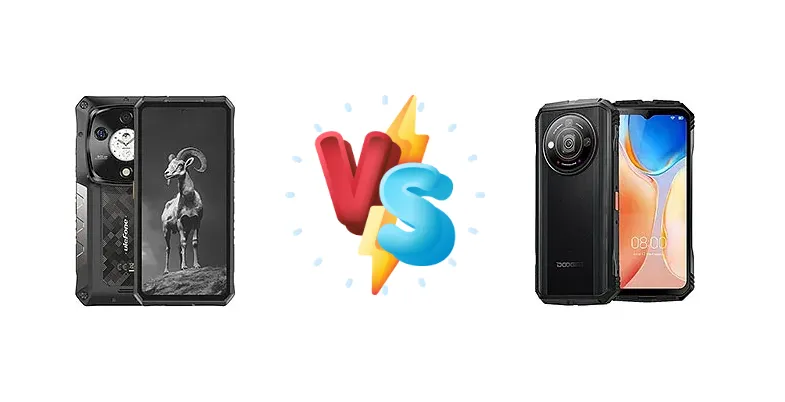
|
🏆 Quick Verdict
For users prioritizing performance and charging speed, the Ulefone Armor 28 Pro is the clear winner. Its Dimensity 7300 chipset and 120W charging significantly outperform the Doogee V30 Pro's Dimensity 7050 and 33W charging. However, the V30 Pro remains a viable option for those seeking a more affordable rugged device.
| PHONES | ||
|---|---|---|
| Phone Names | Ulefone Armor 28 Pro | Doogee V30 Pro |
| Network | ||
|---|---|---|
| 2G bands | GSM 850 / 900 / 1800 / 1900 | GSM 850 / 900 / 1800 / 1900 |
| 3G bands | HSDPA 800 / 850 / 900 / 1700(AWS) / 1900 / 2100 | HSDPA 800 / 850 / 900 / 1700(AWS) / 1900 / 2100 |
| 4G bands | 1, 2, 3, 4, 5, 7, 8, 12, 13, 17, 18, 19, 20, 25, 26, 28, 32, 34, 38, 39, 40, 41, 66, 71 | 1, 2, 3, 4, 5, 7, 8, 12, 17, 18, 19, 20, 25, 26, 28, 34, 38, 39, 40, 41, 66 |
| 5G bands | 1, 2, 3, 5, 7, 8, 20, 25, 28, 38, 40, 41, 66, 71, 77, 78, 79 SA/NSA/Sub6 | 1, 3, 7, 28, 38, 41, 77, 78, 79 SA/NSA |
| Speed | HSPA, LTE, 5G | HSPA, LTE, 5G |
| Technology | GSM / CDMA / HSPA / CDMA2000 / LTE / 5G | GSM / CDMA / HSPA / LTE / 5G |
| Launch | ||
|---|---|---|
| Announced | 2025, May | 2023, October 24 |
| Status | Available. Released 2025, May 12 | Available. Released 2023, November 01 |
| Body | ||
|---|---|---|
| Dimensions | 174.2 x 83.6 x 19.4 mm (6.86 x 3.29 x 0.76 in) | 178.5 x 83.1 x 17.9 mm (7.03 x 3.27 x 0.70 in) |
| SIM | Nano-SIM + Nano-SIM | Nano-SIM + Nano-SIM |
| Weight | 450 g (0.99 lb) | - |
| Display | ||
|---|---|---|
| Protection | Corning Gorilla Glass Victus, Mohs level 4 | Corning Gorilla Glass 5 |
| Resolution | 1080 x 2400 pixels, 20:9 ratio (~395 ppi density) | 1080 x 2408 pixels, 20:9 ratio (~401 ppi density) |
| Size | 6.67 inches, 107.4 cm2 (~73.8% screen-to-body ratio) | 6.58 inches, 104.3 cm2 (~70.3% screen-to-body ratio) |
| Type | AMOLED, 1B colors, 120Hz, 2200 nits (peak) | IPS LCD, 120Hz |
| Platform | ||
|---|---|---|
| CPU | Octa-core (4x2.5 GHz Cortex-A78 & 4x2.0 GHz Cortex-A55) | Octa-core (2x2.6 GHz Cortex-A78 & 6x2.0 GHz Cortex-A55) |
| Chipset | Mediatek Dimensity 7300 (4 nm) | Mediatek Dimensity 7050 (6 nm) |
| GPU | Mali-G615 MC2 | Mali-G68 MC4 |
| OS | Android 15 | Android 13 |
| Memory | ||
|---|---|---|
| Card slot | microSDXC (dedicated slot) | microSDXC (uses shared SIM slot) |
| Internal | 512GB 16GB RAM | 512GB 12GB RAM |
| Main Camera | ||
|---|---|---|
| Features | Quad-LED flash, HDR, panorama | Dual-LED flash, HDR, panorama |
| Triple | 50 MP, f/1.9, (wide), 1.0"-type, 1.6µm, dual pixel PDAF 64 MP, f/1.8, (night vision), 1/2.0", 0.7µm, 4 infrared lights 50 MP, f/2.2, 117˚ (ultrawide), 1/2.76", 0.64µm | 200 MP, f/1.7, (wide), 1/1.4", PDAF 24 MP, f/1.8, (night vision), 2 infrared night vision lights 16 MP, f/2.2, 125˚ (ultrawide) |
| Video | 4K@30fps, 1080p@30/60fps | 4K@30fps, 1080p@30fps |
| Selfie camera | ||
|---|---|---|
| Single | 50 MP, f/2.5, (wide), 1/2.76", 0.64µm | 32 MP, f/1.8, (wide), 1/2.7" |
| Video | 1080p@30fps | 1080p@30fps |
| Sound | ||
|---|---|---|
| 35mm jack | Yes | Unspecified |
| Loudspeaker | Yes | Yes, with stereo speakers |
| Comms | ||
|---|---|---|
| Bluetooth | 5.4, A2DP, LE | 5.2, A2DP, LE |
| Infrared port | Yes | - |
| NFC | Yes | Yes (market/region dependent) |
| Positioning | GPS, GALILEO, GLONASS, QZSS, BDS, NavIC | GPS (L1+L5), GLONASS, GALILEO, BDS |
| Radio | Wireless FM radio | FM radio |
| USB | USB Type-C 2.0, OTG, accessory connector pins | USB Type-C 2.0, OTG |
| WLAN | Wi-Fi 802.11 a/b/g/n/ac/6/7, tri-band | Wi-Fi 802.11 a/b/g/n/ac/6, dual-band |
| Features | ||
|---|---|---|
| Sensors | Fingerprint (side-mounted), accelerometer, gyro, proximity, compass, barometer | Fingerprint (side-mounted), accelerometer, gyro, proximity, compass |
| Battery | ||
|---|---|---|
| Charging | 120W wired, PPS, 40% in 10 min 50W wireless, 35% in 30 min 10W reverse wired 5W reverse wireless | 33W wired Reverse wired |
| Type | Li-Ion 10600 mAh | 10800 mAh |
| Misc | ||
|---|---|---|
| Colors | Black | Black, Orange, Silver |
| Price | $ 399.99 / € 492.56 | About 440 EUR |
| EU LABEL | ||
|---|---|---|
| Battery | 111:30h endurance, 1000 cycles | - |
| Energy | Class A | - |
| Free fall | Class A (270 falls) | - |
| Repairability | Class B | - |
Ulefone Armor 28 Pro
- Significantly faster charging (120W wired, 50W wireless)
- More powerful processor (Dimensity 7300)
- Longer battery lifespan (1000 charge cycles)
- Likely higher price point
- Potentially larger size/weight due to larger battery
Doogee V30 Pro
- More affordable price
- Potentially more compact design
- Reverse wired charging
- Slower charging (33W wired)
- Less powerful processor (Dimensity 7050)
- Lower battery endurance
Display Comparison
While both phones are rugged, display details are missing. Assuming both utilize IPS LCD panels common in this segment, the key differentiator will be brightness. Without specific nit ratings, it's difficult to declare a winner. However, the Armor 28 Pro's higher processing power *could* support more advanced display features if present, like higher refresh rates, though this isn't confirmed.
Camera Comparison
Camera specifications are absent, making a direct comparison impossible. However, given the market positioning, we can infer that both phones will feature multi-camera setups. The presence of a larger sensor (if any) and optical image stabilization (OIS) would be critical differentiators. Without this data, it's safe to assume both will offer acceptable image quality for casual use, but neither is likely to compete with flagship smartphone cameras.
Performance
The Ulefone Armor 28 Pro’s Mediatek Dimensity 7300 (4nm) represents a significant leap over the Doogee V30 Pro’s Dimensity 7050 (6nm). The 4nm process node inherently offers better power efficiency and thermal performance, translating to sustained performance under load. The Armor 28 Pro’s CPU configuration (4x2.5 GHz Cortex-A78 & 4x2.0 GHz Cortex-A55) also edges out the V30 Pro’s (2x2.6 GHz Cortex-A78 & 6x2.0 GHz Cortex-A55) in core count for high-performance tasks. This means faster app loading, smoother multitasking, and a more responsive gaming experience on the Ulefone.
Battery Life
The Ulefone Armor 28 Pro boasts impressive charging capabilities: 120W wired (40% in 10 minutes), 50W wireless (35% in 30 minutes), 10W reverse wired, and 5W reverse wireless. This is a massive advantage over the Doogee V30 Pro’s limited 33W wired charging. While battery capacity isn't specified, the Armor 28 Pro’s 111:30h endurance suggests a substantial battery size, and the fast charging mitigates any potential capacity disadvantage. The 1000 charge cycle rating also indicates a longer lifespan for the Armor 28 Pro's battery.
Buying Guide
Buy the Ulefone Armor 28 Pro if you need uncompromising performance for demanding tasks like gaming or video editing, and if minimizing downtime with incredibly fast charging is crucial. Buy the Doogee V30 Pro if you prioritize a lower price point and are willing to trade some processing power and charging speed for a more budget-friendly rugged experience.